
Fishing tips & tactics
How to catch Sauger
Sander canadensis
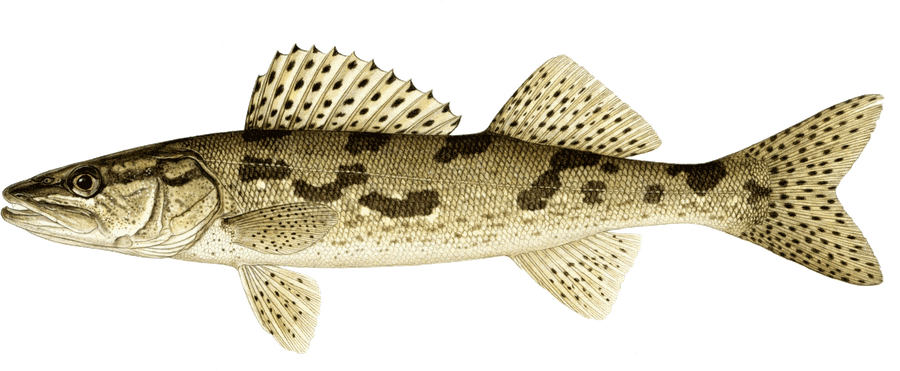
Bump Board's tactics library for Sauger — where to fish, what to tie on and how to fish it, season by season. In the app, these tips adapt live to the weather, the front and the light.
Sauger — Prespawn
Where to fish
- Before the spawn, sauger stage toward flowing-water spawning ground while the ration is still in its measured low half of the year — the field ration programme put the low from March through July, so prespawn fish are present and catchable but are not feeding at the autumn rate. Expect staging fish to hold deep and move little through the cold part of the day.
- The staging address is the deep, low-velocity pool: across the big-water studies, adults select high turbidity, low slope and deep, slow pools, and spawning aggregations form downstream of warm, turbid inflows. Work the deep slow water below those inflows first.
- On big turbid water, stage on the deep basin water nearest the inflow mouths — sauger were recorded from about 3 to 35 m deep in one northern system, routinely working darker, deeper water than walleye use. Start deep and check shallower only at the light changes.
What to tie on
- Match the demersal menu the stomach work measured: bottom-oriented prey fish — emerald shiner was over 75% of the food in one studied feeding bay, with yellow perch and young sauger also taken roughly in proportion to what was available, because sauger are not highly selective feeders. No lure or technique is named for sauger in the research behind this entry, and none is invented here — bottom-presented, prey-fish-sized and unhurried is the supported shape of it.
How to fish it
- Fish the dark half of the day hardest: two-thirds of the tracked sauger in one movement study moved into the feeding areas between sunset and midnight, and most of the rest arrived before 03:00. Be set up on the staging pools before sunset rather than travelling after it.
- Credit the cold-water physiology honestly: meals were still being digested at 5 °C — about 90% of a meal in 54 hours — and feeding continued every one to three days through the cold months in the southern reservoir record, even though growth in length stops at about 12 °C and below. Cold prespawn fish do feed; they just feed on a slow clock, so give a located pool real time.
If it's still tough
- If staging fish will not move for a bait, shrink the travel, not the spot: this is a demersal feeder whose prey sits on the bottom, so a presentation that leaves the bottom leaves the menu. Stay on the deepest slow water you have found and wait for the sunset movement instead of searching.
Sauger — Spawn
Where to fish
- The spawn itself is a shallow, flowing-water event at night: a broadcast over gravel, cobble and rubble — also sand, boulders and bedrock — in about 0.6 to 3.6 m of water, with males arriving first. Range-wide the published temperature family runs about 2.0 to 15.6 °C, and in Manitoba the run is mid-to-late May, weeks after the walleye run ends in the same system.
- Look for the aggregation below warm, turbid inflows: in study after study the spawning fish concentrated downstream of tributaries carrying warm, turbid water, on clean gravel in flowing water — on the home system, tributary mouths and gravel reaches are where the May fish gather.
- Where a turbid inflow enters big water, the delta and its secondary channels drew the spawning fish in the Missouri record — warmer water and high physical turbidity over gravel, chosen over the open main channel. Fish the inflow's gravel fan and its side channels first.
What to tie on
- There is no spawn tackle story in the sauger research, and this entry will not dress one up: no lure is named, and the honest offering is the year-round one — prey-fish-sized, on the bottom, in the gravel shallows the aggregation is using. What changes at spawn is the address and the hour, not the menu.
How to fish it
- Fish it after dark: spawning is nocturnal, and the movement record peaks between sunset and midnight. And read the catch rate honestly — spawning aggregations concentrate fish, and high catch rates on an aggregation are a density effect the research flags explicitly, not proof of a feeding peak. Sauger broadcast their eggs and give no parental care, so there is no nest-guarding strike pattern to fish for either.
- Expect the window to be population-variable, not a single weekend: some fish migrate hundreds of kilometres to spawn, while roughly a quarter to a third in one tracked reservoir population stayed resident and spawned locally. If one reach is empty, the next gravel reach may simply hold a different contingent.
If it's still tough
- If the gravel is crowded with fish that will not take, you are watching the density effect from the wrong side — spawning fish are spawning, not feeding. Drop to the deep slow water just off the spawning ground and fish the fish that are staging and recovering there, at dusk and into the night.
Sauger — Summer
Where to fish
- Summer is this species' own thermal country: the measured preferendum sits near 19.6 °C inside a physiological optimum plateau of 18 to 24 °C, with a May-to-August field preference of about 15 to 21 °C. Fish the deep, dark water inside that band — as summer flows and turbidity fall, the fish shift deeper, and the deep water is the summer address.
- The summer river address is the deep, low-velocity pool in the main channel: high turbidity, low slope, slow water over depth. When the water clears and drops, expect the fish to be in the deepest pools rather than spread through the shallows.
- On the big turbid basin, summer fish use the deep open water — the Ottawa record ran to 35 m, well below where walleye were typically found. Do not assume a shallow summer pattern on a fish whose eye is built for darker water than its cousin's.
What to tie on
- The summer menu is the demersal one: prey fish taken off the bottom — emerald shiner in the northern bay record, shad in the southern reservoirs, perch and young sauger elsewhere — with benthic invertebrates, including crayfish and insects, a real secondary food when prey fish are scarce. No lure is named in the sauger literature, and none is invented here: size to the bottom prey fish, keep it down, and let the fish's own low-light feeding do the rest.
How to fish it
- Use the diel shape the model is built on — dusk 1.0, night 0.85, dawn 0.80, day 0.65 — because it is measured, not borrowed: the sauger's tapetum is well developed and spread across the whole retina, demersal prey were eaten throughout the full 24 hours, and the daytime score is a real shift, not a lull, in the turbid water this fish lives in. In clear, bright conditions the balance tips to night; in murk, the day stays open.
- Watch the top of the temperature band as carefully as the bottom: the measured juvenile upper lethal family runs 26.6 to 30.4 °C, and the model's ceiling uses 26.6 °C, the family's low end — sauger's own number, not a walleye hand-me-down. As water pushes past the mid-20s, expect the fish deeper and slower, and past the plateau the honest move is to the coolest deep water available.
If it's still tough
- If a bright summer day is dead, do not conclude the fish have left — in clearer water this species feeds at night, and the same deep pools reopen after dark. Either wait for the light to go or find the most turbid water in the system, where the daytime feeding window stays open longest.
Sauger — Fall
Where to fish
- Fall is sauger's measured peak, and the entry is built around it: the Ohio River ration programme — 550 stomachs over fourteen months — found daily ration high from August through January with its maximum in October, and the low from March through July, the reverse of the walleye shape. Fish the deep pools and deep basin edges with the confidence that this, not summer, is the feeding season.
- Cooling river fish settle into the large, deep, low-velocity pools and move short distances between neighbouring pools — the fall-to-early-spring telemetry pattern. Once you find one occupied pool, its neighbours are worth the same careful work.
- On the big basin, fall fish stay on the deep water they used in summer and slide toward the inflow mouths as the year turns — the winter geography of the home system concentrates sauger toward the river mouth while the open basin's winter catch is overwhelmingly walleye.
What to tie on
- Upsize only to the menu: the autumn ration peak is a prey-fish ration — the same demersal shiner, shad and perch diet, eaten at the year's highest daily rate of up to roughly 3.5% of body weight on the top days in the Lake of the Woods record. No fall-specific lure is named in the research; prey-fish-sized, on the bottom, in the deep pools is the supported pattern at the season when the fish are most willing to use it.
How to fish it
- Fish the whole dark window, not just the edges of it: dusk is the peak, night holds at 0.85, and in the low-light months the Ohio record showed feeding running essentially continuously. October's combination — peak ration, falling light, cooling water moving into the plateau — is the best set-up this species offers all year.
- Let cooling work for you down to a point: ration stays high while the water falls through the teens, and gonadal growth through the coming winter is built on this autumn feeding. As the water drops toward 5 °C the digestion clock stretches — about 54 hours for a meal — so slow the presentation as the season deepens without abandoning the deep pools.
If it's still tough
- If fall fish are marked but refusing, the variable to change is light, not tackle: come back at dusk or after dark on the same pool. And if the water has already fallen out of the teens, treat the day as an early-winter day — fewer, slower feeds on the deepest slow water — rather than fishing it like October.
Sauger — Winter
Where to fish
- Open-water winter sauger hold the fall pattern at its slowest: sedentary in large, deep, low-velocity pools, moving short distances between nearby pools, on the telemetry record. The physiology underneath is measured and unusual — this fish keeps feeding and digesting at temperatures where many species stop, with meals processed every one to three days across the 5 to 15 °C band in the reservoir record.
- The winter river fishery on the home system is this species' own: in the winter 2024 creel between Lockport and the mouth, sauger were 33,985 of 49,425 fish caught — 69% of the catch. Winter river sauger are not a rumour; they are the main event, concentrated in the deep pools.
- The basin splits the species in winter, and the entry says so rather than averaging it: sauger were 43% of the studied winter commercial catch in 1950–51, yet only about 2.6% of the south-basin winter angling catch in 2018–19, when walleye made up 95%. On open basin water expect sauger to be scarce in winter; toward the inflow mouths, expect them concentrated.
What to tie on
- Small end of the prey-fish menu, presented on the bottom of the deep pools and given time: at 5 °C a meal takes roughly 54 hours to digest, so a winter fish that fed yesterday is not hunting today. No winter-specific tackle is named in the sauger research — the winter difference is patience and address, not gear.
How to fish it
- Fish slow windows on the deepest slow water, and handle deep-caught winter fish with the measured caution from the Pool 4 winter fishery: release mortality ran about 2.4% for fish from shallower than 9 m against 21 to 38% from 9.1 m and deeper. A deep winter sauger you intend to release is a fish to bring up and return quickly, or to leave alone.
- Time the day on the carried-over shape with its flag showing: the under-ice and winter diel pattern has never been measured for sauger, so dusk-first timing here is the open-water sunset-to-midnight movement applied to winter as a labelled transfer, not a winter finding.
If it's still tough
- A dead winter pool is usually a fed pool or an empty one, and the test is time: with digestion running to days, one good feeding window can silence a pool for the next two. Move to the next deep pool rather than changing baits in the one that just fed.
Sauger on the ice — Through the ice season
Where to fish
- The ice set for sauger is PROVISIONAL, and the entry carries that flag openly: winter feeding physiology, winter deep-pool habitat and a dominant ice fishery are all measured for this species, but its behaviour under ice — the diel shape, activity against snow, light and oxygen — has never been studied, and its Manitoba winter ration is unknown. Fish the large, deep, low-velocity pools and the deep basin water near the inflow mouths, where the winter fish are measured to hold.
- The home-system ice geography is explicit: the winter 2024 creel from Lockport to the mouth recorded sauger at 69% of all fish caught. On the river in winter, sauger are the fishery.
- On the open basin the same winter tells the opposite story — about 2.6% sauger in the 2018–19 south-basin winter angling catch against 95% walleye. Basin ice is walleye water that holds some sauger; the mouth water is where sauger concentrate.
What to tie on
- The winter end of the demersal menu — prey-fish-sized, on the bottom of the deep pools. No ice-specific presentation has ever been measured for sauger, and none is claimed here; the winter evidence supports the address and the patience, and the tackle follows the open-water diet honestly.
How to fish it
- Give each pool time on the measured winter clock: this species digests a meal in about 54 hours at 5 °C and fed every one to three days through a measured winter, so a pool's fish feed in windows days apart, not hours. The dusk-first timing is the open-water diel shape carried under ice as a labelled transfer — the under-ice shape itself is unmeasured, and the provisional flag above is exactly about that gap.
- Handle deep fish as the winter mortality data directs: in the Pool 4 winter fishery, release mortality was about 2.4% from shallower than 9 m and 21 to 38% from 9.1 m and deeper. Through the ice, a deep sauger bound for release should come up once, quickly, or the deep pools should be fished for the table only.
If it's still tough
- If the ice pools are silent for days, that is consistent with the measured winter clock rather than proof of absence — but check the geography before the tackle: if you are on open basin water, the measured winter concentration is toward the mouth and the pools, and moving water, not baits, is the fix the data supports.
Manitoba Master Angler
A Sauger of 46 cm (18 in) or better qualifies for Manitoba's Master Angler Program.
Where Sauger live
276 waters in the Bump Board dataset hold Sauger. A selection:
Manitoba
- Betula Lake
- Family Lake
- Kiskittogisu Lake
- Lake Manitoba
- Lake of the Woods
- Lake Winnipeg
- Lake Winnipegosis
- Pelican Lake
- Playgreen Lake
- Sipiwesk Lake
- Split Lake
Ontario
- Abitibi River
- Abram Lake
- Adamhay Lake
- Ahmic Lake
- Allumette Lake
- Arc Lake
- Ball Lake
- Barnston Lake
- Barrel Lake
- Berens River
- Big Fox Lake
- Big Grassy River
- Big Sand Lake
- Big Turtle River
- Black River
- Black Sturgeon Lakes
- Blanche River
- Bonnechere River
- Botsford Lake
- Broadcast Lake
- Bruce L. South Basin
- Bruce Lake
- Bury Lake
- Butler Lake
Plus 169 more Ontario waters — browse Ontario lakes.
Alabama
Colorado
Iowa
Illinois
Kansas
Kentucky
Michigan
Minnesota
- Crane Lake
- Iron Lake
- Kabetogama Lake
- Lac la Croix
- Lake Agnes
- Lake of the Woods
- Lake Pepin
- Little Vermilion Lake
- Loon Lake
- Namakan Lake
- Rainy Lake
- Rat Root Lake
- Sand Point Lake
- Spring Lake
Montana
- Bighorn Lake
- Fort Peck Lake
- Fresno Reservoir
- Jakes Reservoir
- Morony Reservoir
- Ryan Lake
- Spotted Eagle Lake
- Tongue River Reservoir
North Dakota
Nebraska
Ohio
Pennsylvania
South Dakota
Tennessee
- Calderwood Lake
- Cheatham Lake
- Cherokee Lake
- Chickamauga Lake
- Chilhowee Lake
- Cordell Hull Reservoir
- Douglas Lake
- Fort Loudoun Lake
- Kentucky Lake
- Melton Hill Lake
- Nickajack Lake
- Norris Lake
- Old Hickory Lake
- Tellico Lake