
Fishing tips & tactics
How to catch Lake Whitefish
Coregonus clupeaformis
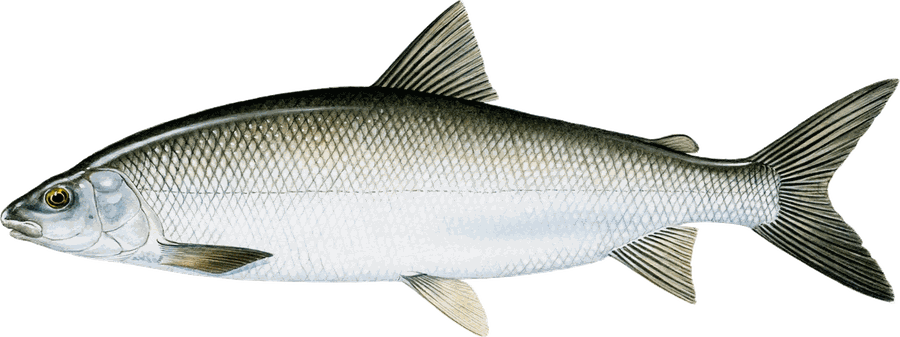
Bump Board's tactics library for Lake Whitefish — where to fish, what to tie on and how to fish it, season by season. In the app, these tips adapt live to the weather, the front and the light.
Lake Whitefish — Summer
Where to fish
- Summer is the cold-water distribution season, and the convergence across five programmes is the strongest thing this species has: in the Experimental Lakes Area study (856,606 detections), stratified-period occupied water sat in an interquartile range of just 5.3–7.9 °C with a year-round mean of 5.8 °C and under 15% of detections warmer than 10 °C even when reaching cold water meant tolerating low oxygen (Rodrigues et al. 2022); Huron fish were rarely over 12 °C at any time of year, with July–September occupied means of 8.7–10.2 °C (Bergstedt et al. 2016); and the Algonquin occupancy model put summer probability over 75% at 7.7–13.6 °C and 10–29 m, with the fish holding at the thermocline–substrate wash zone where the cold layer meets bottom (Challice et al. 2019). Fish that wash zone — cold water ON bottom — and you are fishing the measured summer address in three independent systems.
- State the width honestly alongside the core: Michigan summer occupancy ran 4–21.5 °C with a mean of 10.8 °C, and 58% of summer observations fell outside the textbook 10–14 °C optimal band (Reed et al. 2023). The core is cold and narrow; the tails are real. Fish the core first, but a warm-side blank does not prove the lake is empty — it may hold the wide part of this population's distribution. And do not let anyone anchor this fish warm on the laboratory number: the measured juvenile growth optimum is 18.5 °C (Edsall 1999), a different life stage sitting about 5 °C above where adults actually live, and it is ledgered in the study as do-not-use for adult fishing.
What to tie on
- The benthic menu again — chironomids, Chaoborus, gastropods, sphaeriids — fished on the wash-zone bottom where the summer fish hold. Summer adds one distribution fact to the presentation: the Erie telemetry watched whitefish occupy a cool, well-oxygenated part of the deep layer in stratification (Kraus et al. 2023), so summer presentations belong in the cold water that still carries oxygen where the lake offers both — while the oxygen entry in the tough section below explains why that is a preference to fish by, never a threshold to quote.
How to fish it
- Fish the cold bottom persistently rather than by the clock, for the reason the spring entry gives: no stomach-based study of when adult whitefish feed exists at all, and the movement programmes that do exist disagree about the daily phase (see the light overlays). What summer telemetry does support is position discipline: stay on the thermocline–substrate intersection as it shifts, because the occupied band is only a few degrees wide at its core and the fish track it — late-July Huron fish sat at 25.1 m and 10.2 °C, in the layer, not at a fixed depth (Bergstedt et al. 2016). Find the layer on the sounder each trip; last month's depth is not this month's address.
- That no-feeding-hour finding is worth its own line because it disciplines every summer hour, on any water: no stomach-based study of when adult whitefish feed exists at all, and the movement programmes that do exist disagree about the daily phase (see the light overlays) — so summer whitefish are fished by position, not by the clock. Keep the benthic presentation on the bottom in the coldest water available, cover it thoroughly, and let coverage do what timing cannot be shown to do.
If it's still tough
- If the cold layer is not producing, check the oxygen story before you move lakes — and check it in this species' own terms, not a trout's: when the ELA lake forced a choice, whitefish chose cold over oxygen outright, with 51% of detections below 4 mg/L against only 4% warmer than 10 °C, and 51–87% of detections in water under 2 mg/L under severe constraint (Rodrigues et al. 2022). The rule that whitefish need 4 mg/L or better comes from another species' study — the source paper itself flags it — and this species' own fish routinely live below it. Erie fish leaned the other way, toward well-oxygenated water — the direction is population-dependent, kept unmerged in the study — so the practical rule is only this: do not abandon cold water merely because a borrowed oxygen threshold says the fish cannot be there. In an ELA-type lake, they demonstrably can.
Lake Whitefish — Fall
Where to fish
- Fall is the run-up to the spawn, and the staging distribution is the isothermal one returning: as stratification breaks down the Ontario fish came back to the shore zone at 10–25 m, bottom-oriented (Hlina et al. 2026), and Michigan fall occupancy ran 4–21 °C as the lake cooled through the band the fish prefer (Reed et al. 2023). Activity holds at full open-water level until the spawn window itself (Gorsky et al. 2012) — fall is a feeding season on the shore-zone bottom, fished like spring in reverse, with the spawning shallows about to matter.
- Know the spawning address before you need it: spawning runs mid-October to early/mid-December at under 10 °C, typically as the water drops below 6 °C, in under 9 m over hard substrate on the agency profile, and in the Georgian Bay positioning study generally in under 5 m over rock and cobble (Ryther et al. 2024). The staging fish are on the bottom off that hard, shallow ground — fish the deep edge of the spawning shoals while the water is still above the trigger.
What to tie on
- The benthic invertebrate menu, unchanged — chironomids, Chaoborus, gastropods, sphaeriids, on bottom. Nothing fall-specific is measured in this species' diet, and this entry does not borrow a fall pattern from any other fish to fill the space.
How to fish it
- Fish the cooling as the schedule: the spawn is temperature-triggered (agency profiles put the trigger below 8 °C, the Maine work watched onset as the water fell through about 5–6 °C), so each cold step moves staging fish closer to the shallows. Work the shoal edges progressively shallower as the water falls through 10 °C toward 6 °C, and expect the feeding pattern to give way to the aggregation pattern described in the next entry once the window opens.
If it's still tough
- If fall fish are scattered, remember this population's measured width: occupancy envelopes in the studies run 6–32 m at the 50% level in summer (Challice et al. 2019) and 10–25 m through the isothermal season — staging whitefish use a broad shore band, not a single reef. Cover the band's bottom systematically before concluding the lake is between patterns.
Lake Whitefish — Winter
Where to fish
- Open winter water is the floor of this fish's year: winter activity ran at roughly half the spring, summer and fall level (Gorsky et al. 2012) and the season values sit near 0.55 against the summer peak — reduced, not absent. The winter distribution on the measured lakes is the isothermal shore zone (10–25 m, bottom-oriented, October–May in the Ontario study), and the through-ice pattern is covered in the ice entry below; in open cold water, fish that same shore-zone bottom and expect a half-rate fishery.
What to tie on
- The winter diet note in the record is a diet note and is used as one: the Champlain winter diet ran to gastropods and sphaeriid clams — the benthic menu at its hardest-shelled end. Small bottom presentations on the shore-zone bottom remain the whole supported tackle statement; no winter lure is named in the research.
How to fish it
- Fish slowly and cover bottom: at half the open-water activity level, a winter whitefish is a fish to be found by position, not provoked by pace. The winter telemetry adds that the daily vertical pattern was at its weakest of the whole year in winter (Gorsky et al. 2012) — winter is the season where hour-of-day matters least for this fish on any evidence, so spend the effort on the bottom band instead of the clock.
If it's still tough
- A quiet winter shore zone is the species at its measured rate, not necessarily a wrong spot: half activity across a whole season means half the encounters, and the telemetry winters show individual fish settling into divergent winter strategies — some deep, some shallow (Rodrigues et al. 2022) — so a blank at one depth band is worth one move to the other band before it is worth leaving.
Lake Whitefish — Spring
Where to fish
- Start with what kind of entry this is, because it governs everything below: lake whitefish tactics rest on distribution — seven telemetry programmes, hydroacoustics and a forty-year winter creel — and there is no measured feeding response for this species at any factor, so these entries tell you where the fish demonstrably are and when they demonstrably move, and claim nothing finer. In spring the distribution is the isothermal one: in eastern Lake Ontario, fish used the shore water at 10–25 m, predominantly bottom-oriented, through the whole October–May isothermal season (Hlina et al. 2026), and the Michigan archival tags put spring occupancy anywhere in 0–20 °C water as the lake mixes. Spring whitefish are bottom fish spread through the cold shore zone — fish the bottom in that band, not a temperature hunt.
- Activity is climbing out of the winter floor: winter activity ran at roughly half the spring, summer and fall level in the Clear Lake telemetry (Gorsky et al. 2012), so spring is a genuine recovery season — the fish are moving and feeding again at open-water rates after the ice, on the bottom structure of the shore zone.
What to tie on
- Fish the measured diet, because it is the firmest tackle fact this species has: a benthic invertebrate menu — chironomids, Chaoborus, gastropods and sphaeriid clams — taken off and just above the bottom. The finest-scale study watched whitefish make foraging forays for exactly those chironomids and Chaoborus (Rodrigues et al. 2022). No lure or bait is named for lake whitefish anywhere in the research behind this entry, and none is invented here; small bottom presentations sized to that invertebrate menu are the whole supported statement.
How to fish it
- Fish the bottom thoroughly and let the distribution do the work: this is a benthopelagic fish whose finest study found activity tracking habitat, not the clock — vertical movement ran 502.5 m a day under high habitat constraint against 81.2 m a day under moderate constraint (Rodrigues et al. 2022) — so a spring whitefish's day is organised by where its cold, food-bearing bottom is, not by a feeding hour. Cover the shore-zone bottom in the occupied band before you worry about timing.
If it's still tough
- If the shore zone is quiet, the honest check is depth and bottom contact, not a new tactic: spring occupancy ran 10–25 m and bottom-oriented in the isothermal study lake, and a presentation that is not spending its time on or within a step of the bottom is not fishing the water these fish were measured in.
Lake Whitefish — Fallspawn
Where to fish
- The spawn is this species' best-documented event: a 48-day season in the Georgian Bay positioning study, with bell-shaped site occupancy, a plateau of about a week at its peak, males arriving first, and spawning generally in under 5 m over rock and cobble (Ryther et al. 2024); Clear Lake onset was watched on 5 November at 5 °C, with eggs still being collected under the ice on 11 December, and the full observed spawning range runs 0.5–10 °C. The honest framing matches the brown trout rule in this library: spawning feeding suppression has never been measured in whitefish — the season model's November dip is its softest number, flagged as such in the study — so this is an aggregation entry, not a feeding entry. The fish are findable, concentrated and shallow; whether the ones on the rock are feeding is a question the research does not answer, and the feeders are best sought on the bottom at the shoals' edges.
What to tie on
- Nothing spawn-specific is named in the whitefish literature — no egg presentation, no spawning lure — and none is invented here. On the shoal edges, the supported offering remains the benthic menu the diet studies measure. Presentations over the spawning rock itself are not a tactic this library can source for this species.
How to fish it
- Fish the aggregation's own rhythm, which is measured even though its feeding is not: site use builds over the 48 days to a week-long peak plateau rather than spiking for a night or two, so the season rewards returning to a known shoal across the window instead of chasing a single predicted peak day. Within the day, the spawning study is also the one place a daily movement pattern IS measured for this species: both sexes held shallower at night and deeper by day on the spawning grounds (Ryther et al. 2024) — a spawn-window result, stated as one, and not evidence about feeding hours in any other season.
If it's still tough
- If the shoals hold fish that will not respond, that is consistent with everything the study can and cannot say: an aggregation whose feeding has never been measured. Move off the rock to the first bottom at the shoal's edge and fish the benthic menu there — the staging and post-spawn fish around an aggregation are the defensible target, and the window is long enough (mid-October into December) that the edges fish for weeks.
Lake Whitefish on the ice — Early ice
Where to fish
- PROVISIONAL — the whole ice set for this species is provisional, and this entry says so the way the study does: it rests on two full-winter telemetry datasets and a long winter creel, with no under-ice feeding or daily-feeding study anywhere behind it. First ice follows hard on the spawn — a minor through-ice fishery on Lake Winnipeg began soon after freeze-up, immediately post-spawn (Kennedy 1938) — and the shape support from the forty-year Simcoe winter fishery puts early-ice fish on humps and shoals at about 6 m. Treat those Simcoe depths as one shallow, productive lake's description, never as a species parameter: the telemetry lakes put winter fish deeper (about 15 m in Clear Lake). Fish the shallow structure near the spawning shoals first, at your own lake's early-ice depths.
What to tie on
- The benthic menu through the ice — chironomids, Chaoborus, gastropods, sphaeriids — presented on the bottom. The one positional fact in the angler record is consistent with the bottom-oriented telemetry: the Gull Lake, Alberta account has the fish holding 1–3 ft off bottom, with most action before noon (Grade C consensus, labelled as such). No ice lure or jig is named in the whitefish research, and none is invented here.
How to fish it
- Fish the early-ice shoals at the morning end of the day, held loosely: the morning lean in this species' ice pattern comes from creel and angler consensus (the Simcoe dawn-to-noon emphasis, the Gull Lake before-noon account), not from any measurement, and the telemetry says the winter daily pattern is the weakest of the year. Morning is a lean, not a rule — a first-ice fishery rewards being on the proven shoal more than being there at a proven hour, because no proven hour exists.
If it's still tough
- If the shallow shoals are blank, go to the telemetry depth before you go home: Clear Lake fish held about 15 m (a 12–17 m band) at 2–3 °C for the December–April winter. Early-ice depth disagreement between the creel lake and the telemetry lake is real and unresolved in the study; fishing both bands is the honest response to it.
Lake Whitefish on the ice — Mid ice
Where to fish
- Mid-winter is the telemetry season: Clear Lake fish held about 15 m at 2–3 °C under ice from December to April, at roughly half the open-water activity level (Gorsky et al. 2012), while the ELA winter showed the population splitting — two of five fish wintering deep (an 8.6–11.1 m band) while three held shallow (3.3–4.6 m) — divergent individual strategies in the same lake in the same winter (Rodrigues et al. 2022). The Simcoe shape support deepens fish toward about 30 m by late ice. There is no single mid-winter depth for this species on its own evidence; there are bands, and the fish are on bottom in one of them.
- Oxygen belongs in a mid-winter where, stated in this species' measured terms: deep-water low oxygen persisted all winter in the ELA lake, and two of its five fish wintered for stretches in water averaging under 4 mg/L — some individuals in that study wintered routinely below 2 mg/L (Rodrigues et al. 2022). Do not cross deep winter structure off your map on a borrowed oxygen threshold; whitefish were measured living the winter in water another fish's rule would call empty.
What to tie on
- The benthic menu on bottom, unchanged — the ELA work watched these fish making foraging forays for chironomids and Chaoborus even into the low-oxygen deep water, which is the closest thing to a measured under-ice feeding fact this species has: the food is benthic invertebrates, the fish go to the bottom to get it, and the presentation belongs there with it.
How to fish it
- Settle on a band and fish it thoroughly: at half activity with the year's weakest daily pattern, mid-winter whitefish are a position fishery. The morning lean from the creel consensus (dawn to noon on Simcoe) is the only timing guidance that exists and it is Grade C — worth fishing, not worth planning a day around to the exclusion of the depth work, which is where the telemetry says the variance actually lives.
If it's still tough
- If one depth band is dead, switch bands rather than presentations: the measured winter pattern is two coexisting strategies, deep and shallow, so a silent deep set genuinely does not clear the shallow shoals in the same lake on the same day — and the reverse is equally true. Cover both bands across a mid-winter session before calling the lake off.
Lake Whitefish on the ice — Late ice
Where to fish
- Late ice carries the Simcoe shape to its deep end — fish deepening toward about 30 m later in the season, with that fishery's peak running late January to mid-February (Grade C shape support from the creel lake, stated as such) — against the telemetry lakes holding their winter bands (about 15 m in Clear Lake; the split deep/shallow strategies in the ELA). The defensible late-ice where is the deep end of YOUR lake's winter band, on bottom: the pattern the sources agree on is deepening and bottom orientation, while every absolute depth in the record belongs to one named lake and travels no further than this sentence.
What to tie on
- The benthic menu, on bottom, at the deep band. No late-ice-specific presentation exists in the whitefish research — no meltwater or inflow response has ever been studied in this species, so this entry offers no late-ice inflow tactic rather than borrowing one from another fish, whose meltwater responses are their own measurements and not this fish's.
How to fish it
- Fish the deep band patiently through the morning lean and do not shorten the session on clock logic: winter's daily pattern is the year's weakest in the telemetry, activity is at half rate, and late-ice success in the creel record is a season-long accumulation on known deep structure. This is the season phase where the forty-year Simcoe series says the fishery itself peaks — the winter catch there vastly exceeds the summer catch, and whitefish are primarily an ice-fishery target in that system — so late ice is not this species' leftover season; on the creel evidence it is close to its main one.
If it's still tough
- If the deep band is silent, work back up the winter bands in order — deep telemetry band, then the shallow winter strategy band — before changing lakes: the split-strategy winter (Rodrigues et al. 2022) means a late-ice population can be sitting a full band away from where the shape support points, in the same lake, for reasons no study explains. Band coverage is the whole late-ice adjustment this species' evidence supports.
Manitoba Master Angler
A Lake Whitefish of 56 cm (22 in) or better qualifies for Manitoba's Master Angler Program.
Where Lake Whitefish live
2,515 waters in the Bump Board dataset hold Lake Whitefish. A selection:
Manitoba
- Archies Lake
- Bird Lake
- Bolton Lake
- Cedar Lake
- Clear Lake (Riding Mountain)
- Cormorant Lake
- Cross Lake
- Dauphin Lake
- Deep Lake
- Falcon Lake
- Fishing Lake
- Gull Lake
- Gull Lake
- Gunisao Lake
- Happy Lake
- High Lake
- Hunt Lake
- Inland Lake
- Kiskittogisu Lake
- Kississing Lake
- Lake Athapapuskow
- Lake Manitoba
- Lake of the Woods
- Lake St. Martin
Plus 22 more Manitoba waters — browse Manitoba lakes.
Ontario
- 16H-96, L.
- 5PB10-102, L.
- 5PB10-124, L.
- 5PB10-125, L.
- 5PB10-93, L.
- 5PB17-82, L.
- Abamasagi Lake
- Abamategwia Lake
- Abazotikichuan Lake
- Abbess Lake
- Abitibi River
- Abram Lake
- Abram Lake
- Adamhay Lake
- Addison Lake
- Adele Lake
- Admiral L. 075533
- Agimak Lake
- Agnes Lake
- Agnew Lake
- Agonzon Lake
- Ahmic Lake
- Al's L.
- Albany River
Plus 2,235 more Ontario waters — browse Ontario lakes.
Nova Scotia
- CARIBOU
- CHEZZETCOOK
- CONROD
- EDEN
- ELEVEN MILE
- G
- GIBRALTAR
- HARDY
- KEMPT BACK
- LITTLE MUSHAMUSH
- LITTLE PONHOOK
- LIVERPOOL HEAD
- MILLET
- MINARD
- MINK
- NARROW
- PARR
- PITTS
- PRINGLE
- SHAW BIG
Alaska
- Aliktongnak Lake
- Aniak Lake
- Arhymot Lake
- Arolik Lake
- Aukulak Lagoon
- Awayak Lake
- Battle Lake
- Chilkat Lake
- Desperation Lake
- Gibraltar Lake
- Gold Lake
- Goodnews Lake
- Iliamna Lake
- Imik Lagoon
- Imikruk Lagoon
- Imuruk Basin
- Inland Lake
- Ipiavik Lagoon
- Kako Lake
- Kayigyalik Lake
- Kenai Lake
- Kgun Lake
- Kisaralik Lake
- Kivalina Lagoon
Plus 34 more Alaska waters — browse Alaska lakes.
Idaho
Maine
- Beau Lake
- Big Hurd Pond
- Chesuncook Pond
- Churchill Lake
- Cliff Lake
- Crescent Pond
- Cunliffe Lake
- Dole Pond
- Echo Lake
- First Debsconeag Lake
- Fourth Saint John Pond
- Glazier Lake
- Harrow Lake
- Indian Pond
- Johnson Pond
- Millinocket Lake
- Pocumcus Lake
- Rowe Lake
- Saint Francis Lake
- Third Musquacook Lake
Michigan
- Beatons Lake
- Burt Lake
- Chicagon Lake
- Crystal Lake
- Elk Lake
- Higgins Lake
- Hubbard Lake
- Intermediate Lake
- Lake Medora
- Lake Michigamme
- Portage Lake
- Torch Lake
Minnesota
- Adams Lake
- Alpine Lake
- Basswood Lake
- Benedict Lake
- Bertha Lake
- Big Trout Lake
- Blackduck Lake
- Burntside Lake
- Cass Lake
- Clamshell Lake
- Crane Lake
- Deer Lake
- Devil Track Lake
- Elbow Lake
- Ester Lake
- Eugene Lake
- Good Lake
- Greenwood Lake
- Gull Lake
- Hanson Lake
- Hatch Lake
- Iron Lake
- Isabella Lake
- Island Lake
Plus 46 more Minnesota waters — browse Minnesota lakes.
Montana
- Canyon Ferry Lake
- Church Slough
- Clark Canyon Reservoir
- Fennon Slough
- Flathead Lake
- Fresno Reservoir
- Placid Lake
- Seeley Lake
- West Rosebud Lake
- Whitefish Lake