
Fishing tips & tactics
How to catch Cisco (Tullibee)
Coregonus artedi
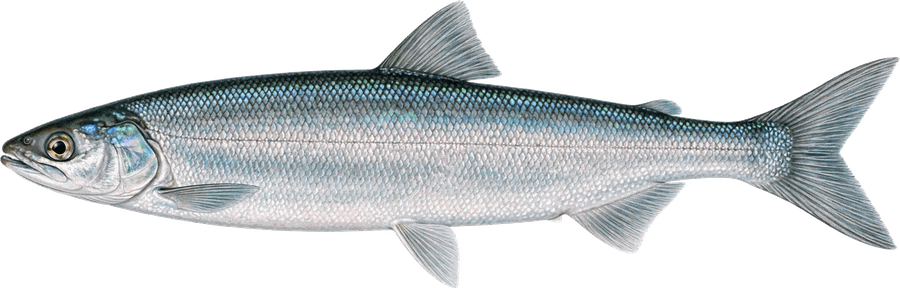
Bump Board's tactics library for Cisco (Tullibee) — where to fish, what to tie on and how to fish it, season by season. In the app, these tips adapt live to the weather, the front and the light.
Cisco (Tullibee) — Summer
Where to fish
- Summer cisco hold a narrow cold band in stratified water, and three programmes converge on it: in Lake Simcoe's Kempenfelt Bay, night tracking found fish in a 5–8 m band at 10.8–13.6 °C, sitting just below a 15–17 °C thermocline and tracking its internal-wave movement; Wisconsin summer netting put them mainly in metalimnetic water at 8–12 °C. Fish that cold band where it intersects the open water the schools travel — its depth is set by the stratification on the day, not by last month's mark.
- The second address rule is oxygen, and for this species it is not a preference, it is a survival boundary (see How): when the cold deep water loses its oxygen, cisco leave it outright — in the Amisk Lake oxygenation experiment, fish entirely avoided their preferred cool deep layer while it was low in oxygen, and returned to deep use when oxygenation restored it (Aku et al. 1997). Summer searching therefore targets cold water that still carries oxygen, in that order, every trip.
What to tie on
- Small zooplankton-sized presentations, fished at the school's exact depth in the cold band: a visual planktivore feeding on copepods and large cladocerans is a depth-and-size pattern, and a presentation running above or below the tracked band is not fishing the school no matter how well it matches the menu. No summer lure is named in the cisco research, and none is invented here.
How to fish it
- Carry the lethal boundary as the pair it actually is, never as a single temperature: field kills fitted a boundary running from 23.8 °C at 8 mg/L of dissolved oxygen down through 22.9 °C at 3 mg/L to 20.0 °C at 1 mg/L (Jacobson et al. 2008), and a 48-year simulation validated a constant survival pair of 22.1 °C at 3 mg/L against observed kills and survivals (Fang et al. 2016). Warmer water is survivable only with more oxygen; cooler water tolerates less. The practical summer rule follows the protective benchmark — full habitat at 6 mg/L or better (Lyons et al. 2017), a survival knee at 3 mg/L — and any one-number lethal temperature quoted for adult cisco is wrong in a way the primary literature fixed in 2008.
- Let the school's depth tell you which daily pattern your lake is running: some populations rise toward the surface at dusk to feed, some hold deep all day, and some do the reverse, and the study programmes that measured all three could sort them only by each system's prey, predators, temperature and oxygen. There is no species-level dusk rule for cisco, and this entry will not sell you one — find the migration, if your lake has one, by watching where the band sits at the light changes across a few trips.
If it's still tough
- If the cold band is empty in midsummer, suspect the squeeze before the tackle: warm surface water above and low-oxygen deep water below can compress this fish into a band only a few metres thick, higher and warmer than its preference — across 32 lakes, as the squeeze tightened, cisco were caught higher, in a narrower band, at higher minimum temperatures and lower minimum oxygen (Grow et al. 2022). Search the narrow oxygenated layer that remains, and if the deep water has gone truly low in oxygen, expect the fish to have abandoned it entirely rather than to be feeding slowly inside it.
Cisco (Tullibee) — Fall
Where to fish
- Fall is the squeeze releasing and the spawn approaching, in that order: season values step down from 0.90 in September to 0.80 in October as the feeding season gives way to aggregation, and cooling restores the deep cold water that summer oxygen loss took away. Fish the schools in the re-opening cold band early in the fall, and expect addresses to shift toward the spawning areas as October advances — Lake Superior aggregations form in October ahead of the late-fall spawn.
- Know the spawning address before the window opens: spawning runs over rocky nearshore ground, with eggs deposited at night, males arriving on the grounds before females and leaving first. The staging schools hold in cold open water off that hard, shallow ground — fish the deep edge of the nearshore spawning areas while the water is still above the spawning trigger.
What to tie on
- The zooplankton menu, unchanged — nothing fall-specific is measured in this species' diet, and the entry does not borrow a fall pattern from any other fish. On the staging edges, small presentations at the school's depth remain the whole supported tackle statement.
How to fish it
- Fish the cooling as the schedule: spawning is temperature-triggered into the low single digits (broodstock are taken once the water drops below 6.0 °C in the culture record, and the Alberta account puts spawning at about 5 °C falling to 2 °C), so each cold step moves staging schools closer to the nearshore ground. Work progressively toward the spawning areas as the surface temperature falls through the plateau toward 6 °C, and expect the feeding pattern to give way to the aggregation pattern in the next entry once the window opens.
- Use the light changes as sounding checks in fall, when daily movement is at its most extensive in the tracking record — the Lake Superior programme found spring migrations less extensive than summer and fall ones — so a fall school's depth at dawn and at dusk can genuinely differ. In a lake running the classic pattern that is a feeding ascent to intercept; in any lake it is the cheapest way to learn where the school spends the dark hours.
If it's still tough
- If fall schools seem scattered, remember what a school is in this species: a moving, depth-shifting aggregation whose address is set by temperature and oxygen on the week, not by fixed structure. Search the cold band systematically across depths before concluding the lake is between patterns — a missed school is usually a missed depth, not an absent population.
Cisco (Tullibee) — Winter
Where to fish
- Open winter water is an active season at a moderate floor for this fish — season values hold at 0.55 through January and February — and that activity is measured, not assumed: through-ice stomach work (covered fully in the ice entry) found cisco feeding selectively in March, and the year-round tracking study found winter fish present and deep all season. In open cold water, fish the deep cold band the schools occupy and expect a steady, unspectacular rate.
- Winter position is the year's simplest: in the one year-round study, cisco did not migrate vertically at all in winter, staying deep day and night in what the authors describe as low-risk, low-reward conditions at all depths. A winter school's address barely moves on the day — find it once, at depth, and it is found for the session.
What to tie on
- The winter menu is the narrowest of the year and it is measured: overwintering copepods, size-selected — in the March stomachs, zooplankton were the entire diet and the fish preferred larger zooplankton while selecting against small copepods and immature stages. Small presentations that read as the larger end of that winter plankton are the supported shape; the broader spring menu is not a winter claim.
How to fish it
- Fish deep and patiently, without a clock pattern, because the measured winter pattern is the absence of one: no vertical migration means no dawn or dusk movement to intercept, and winter success is school location repeated accurately. Give a located deep school real time — a fish feeding selectively on overwintering plankton in near-freezing water is browsing, not chasing, and presentations need to arrive at the school rather than call it over.
- Let the late-winter weeks carry a little more confidence than the first ones, at canon strength and labelled as such: the March stomach record is itself a late-winter feeding proof, and the Minnesota ice tradition holds that some of the best tullibee fishing of the year occurs in February and March. Early winter and late winter share the same measured floor in the model; the fishery record simply says the late end of it has been producing for a long time.
If it's still tough
- A quiet winter session is usually a missed school, not a refused bait: a non-migrating, deep, schooling fish offers few accidental encounters, so a blank at one depth is worth a systematic move through the deep band before it is worth a presentation change. And hold the limit honestly — no study measures a winter feeding rate against conditions for this species, so the floor values here are a distribution-based estimate, and your lake's winter pace is genuinely new information.
Cisco (Tullibee) — Spring
Where to fish
- Start with what kind of entry this is: cisco's rating is a DERIVED set, confidence capped at Low, and every curve in it is built from distribution — occupied temperatures, a fitted survival boundary, and vertical-migration tracking — because no measured adult feeding-rate response exists for this species at any factor. What these entries can honestly tell you is where the schools demonstrably are and how they demonstrably move; they claim nothing finer. In spring the annual cycle climbs out of the winter floor: season values rise from 0.60 in March through 0.70 in April to 0.85 in May.
- Spring is the shallow feeding phase in the standard accounts — the species' most active shallow period, graded as expert consensus and used only as season shape: fish come shallow and the diet broadens beyond the winter zooplankton base to crustaceans, mayflies and occasionally small fish. Treat the shallows as a spring address held at consensus strength, and expect the schools to slide back toward cold, deep holding water as stratification sets up.
What to tie on
- Fish the visual planktivore's menu: cisco feed by sight on zooplankton in open water, with large eyes built for picking individual prey — small presentations sized to large zooplankton are the diet-supported shape. No lure, size or presentation is named in any controlled cisco study, and the well-known controlled feeding-versus-light experiment in this corner of the library belongs to kokanee, a different genus; it is not borrowed here, and no cisco tackle claim is built on it.
How to fish it
- Fish position over timing, because the daily movement pattern is a lake-level outcome for this species: across the tracking programmes, normal vertical migration, no migration, and reverse migration are all documented, sorted by temperature, oxygen, prey and predation risk in each system. Spring migrations in the Lake Superior work were less extensive than summer and fall ones. Locate the school on the day, in the water the temperature and oxygen sections describe, and let its depth — not a clock rule — set your presentation depth.
- Work the climb into the adult plateau: the occupied band centres on 8–13 °C, built on the adult final preferendum of 10 °C and two modern field programmes, so warming spring water is at its best for this fish while it still holds in the low teens. The laboratory numbers that look better — a juvenile preferendum of 16.5 °C and a juvenile growth optimum near 14.5 °C — are age-0 fish, sit roughly 5 °C warmer than where adults actually live, and are quarantined in the study as do-not-use for adult fishing.
If it's still tough
- If the spring shallows are empty, the school has likely already taken its deep address — a pelagic, schooling fish is found by searching open water over depth, not by refining a shallow presentation. Drop to the cold band below the shallows and search for the school itself before changing a single bait.
Cisco (Tullibee) — Fallspawn
Where to fish
- The spawn is a late, cold, nocturnal aggregation: across the range it runs late October through December, peaking in November–December below about 6 °C, with eggs deposited at night. The honest framing matches the rule this library uses for every fall spawner: feeding suppression across the spawn has never been measured in cisco, the season model's November value of 0.60 is flagged in the study as its softest number, and this is therefore an aggregation entry, not a feeding entry — the fish are concentrated and findable, and whether the ones on the ground are feeding is a question the research does not answer.
- The spawning ground itself is shallow and hard: Lake Ontario spawning was targeted over shallow hard substrate at 2–5 m in December, and the range-wide account puts egg deposition over rocky nearshore substrate at night. Fish the first deep water at the edge of that shallow rock for the staging and travelling fish — the defensible target around an aggregation — rather than over the spawning ground itself.
What to tie on
- Nothing spawn-specific is named in the cisco literature — no egg presentation, no spawning lure — and none is invented here. At the edges of the grounds, the supported offering remains the zooplankton menu at the school's depth, presented to fish that are moving and staging rather than spawning.
How to fish it
- Fish the window's length rather than a predicted peak night: the season runs for weeks from late October into December, males arrive first, and deposition happens at night — a schedule that rewards returning to a known spawning area across the window. Do not convert that night deposition into a night feeding claim: spawning at night is measured, feeding at night during the spawn is not, and the entry keeps the two separate on purpose.
- As December runs on, fish the transition rather than the ground: the season values ease from the November aggregation value to the winter floor (0.60 to 0.55) as the late spawn ends and schools settle into the deep winter pattern described in the winter entry. The last weeks of the window are a move from shallow rock toward deep holding water, and the staging depth at the edge of the ground deepens with it — follow that slide instead of holding a November depth into the new year.
If it's still tough
- Dense schools sitting on known shoals that will not respond are the spawn working as described — aggregation is a distribution fact, not a feeding fact, and a packed school is not a promise of a bite. Slide off the rock to the staging depth at its edge; if the edges are also quiet, the window is long enough that the post-spawn schools will be feeding again on the winter pattern within weeks.
Cisco (Tullibee) on the ice — Through the ice season
Where to fish
- PROVISIONAL — flagged the way the study flags it: winter feeding for cisco is directly measured and winter movement is directly measured, which is more than most provisional sets have, but no under-ice feeding rate or catch-against-conditions study exists, so the ice rating stays provisional at the set's Low cap. The feeding measurement is a good one: 38 cisco collected through the ice at the Apostle Islands on 9 March 1994 held zooplankton as their entire diet and were feeding selectively — preferring larger zooplankton, especially the copepod Diaptomus sicilis, and selecting against small copepods and immature stages (Link et al. 1995). Selective foraging in March is deliberate feeding, not gut residue.
- Manitoba's own ice fishery confirms the target at home: tullibee are a recognised provincial ice target, with Big Whiteshell Lake called out as a top Master Angler tullibee destination and repeated winter records from Lake Winnipeg. The Saskatchewan and Manitoba guide account, graded as expert canon, puts winter schools over basin edges at 30–50 ft, roaming as a school — use that depth band as one productive lake class's description and as a starting search area, not as a species parameter.
- Winter depth barely negotiates: the year-round tracking found no vertical migration in winter, with fish deep day and night, so the through-ice address is the deep basin band the school already occupies — there is no shallow winter move to wait for in this species on its only year-round evidence.
What to tie on
- Small presentations sized to overwintering zooplankton, fished at the school's depth and kept close: the March stomach record says the winter diet is large copepods, selectively taken. The Minnesota ice tradition's spoon-and-dropper presentation is carried as what it is — Grade C guide canon, not a measured tactic — and the Manitoba canon likewise describes a visual fish that will rise many feet toward a flashed lure and then take with an exceptionally light bite. Canon can shape a session here; it is labelled canon every time it appears, and nothing stronger exists for cisco ice tackle.
How to fish it
- Fish a near-flat clock, because that flatness is measured rather than assumed: with no winter vertical migration, the ice diel values sit close together (day 0.90, dawn 0.85, dusk 0.85, night 0.75), and day is deliberately not penalised — the Manitoba and Saskatchewan ice canon independently reports best action often at midday in bright sun, with a slower dawn and dusk bite. A midday session on a located school is a first-choice pattern for this fish under ice, not a compromise.
- Carry the oxygen sensitivity into late ice at its proper weight: no cisco winterkill dataset exists, so the ice oxygen term is this species' measured warm-season oxygen sensitivity — full habitat at 6 mg/L or better, a survival knee at 3 mg/L, always as a temperature pair rather than a lone temperature — applied to the general late-ice oxygen decline, and labelled as that construction. In a shallow, depleting basin late in the season, better-oxygenated deep water is the supported move, on the boundary evidence rather than on any winter measurement.
If it's still tough
- If a deep basin set is silent, move with the school logic before changing baits: winter cisco roam as a school over basin structure in the canon record, and a non-migrating fish still relocates between days. Re-find the school at a neighbouring basin edge at the same depth band — depth first, then distance — and treat a full blank across bands as the provisional set's honest limit: winter feeding is proven for this species, its rate on your lake on your day is not something anyone has measured yet.
Where Cisco (Tullibee) live
2,781 waters in the Bump Board dataset hold Cisco (Tullibee). A selection:
Manitoba
- Bird Lake
- Black Lake
- Cross Lake
- Crowduck Lake
- Falcon Lake
- Lake Athapapuskow
- Lake Manitoba
- Lake Winnipeg
- Lake Winnipegosis
- Reed Lake
- Rocky Lake
- Wallace Lake
- Wekusko Lake
- Whitefish Lake
Ontario
- 17C-19, L.
- 21G-105, L.
- 21G-15, L.
- Aaron Lake
- Abamategwia Lake
- Abazotikichuan Lake
- Abbess Lake
- Abimatinu Lake
- Abitibi River
- Abram Lake
- Abram Lake
- Acheson Lake
- Achigan Lake
- Adele Lake
- Aerobus Lake
- Agnes Lake
- Agnew Lake
- Agreen Lake
- Ahmic Lake
- Aileen Lake
- Ajax Lake
- Al's L.
- Albany River
- Alberta Lake
Plus 2,266 more Ontario waters — browse Ontario lakes.
Indiana
Michigan
- Appleton Lake
- Au Train Lake
- Avalon Lake
- Barlow Lake
- Beaver Lake
- Ben-way Lake
- Big Blue Lake
- Big Cedar Lake
- Big Twin Lake
- Birch Lake
- Black Lake
- Blind Lake
- Bristol Lake
- Bruin Lake
- Bunker Lake
- Burt Lake
- Byron Lake
- Carr Lake
- Cass Lake
- Cedar Hedge Lake
- Cedar Lake
- Central Lake
- Clark Lake
- Cliff Lake
Plus 97 more Michigan waters — browse Michigan lakes.
Minnesota
- Aitkin Lake
- Alice Lake
- Alton Lake
- Andrusia Lake
- Antler Lake
- Baby Lake
- Bad Medicine Lake
- Ball Bluff Lake
- Ball Club Lake
- Balsam Lake
- Barbour Lake
- Barwise Lake
- Bass Lake
- Bass Lake
- Bass Lake
- Basswood Lake
- Batson Lake
- Bay Lake
- Bear Island Lake
- Bello Lake
- Beltrami Lake
- Benedict Lake
- Bertha Lake
- Big Lake
Plus 323 more Minnesota waters — browse Minnesota lakes.