Fishing tips & tactics
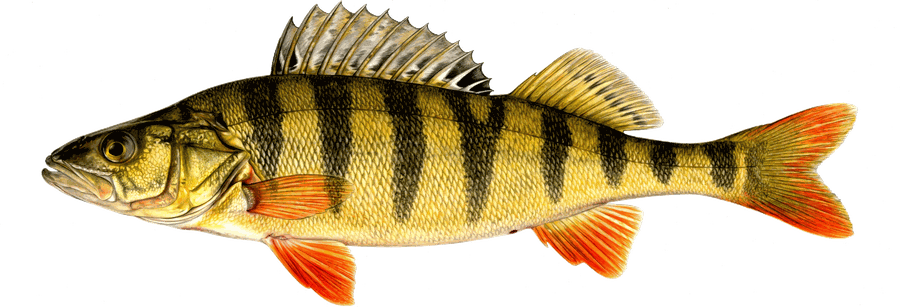
How to catch Yellow Perch
Perca flavescens
Bump Board's tactics library for Yellow Perch — where to fish, what to tie on and how to fish it, season by season. In the app, these tips adapt live to the weather, the front and the light.
Yellow Perch — Spawn
Where to fish
- Perch spawn in the shallows in early spring, over weeds a few feet deep, and they're the first panfish to move in. South-facing coves and dark bottoms warm first — in one measured case the back of a south cove ran 4 °F warmer in 3 ft of water than the main lake. Docks, stumps and laydowns that soak up sun hold early fish.
What to tie on
- Shiner minnows are the top ice-out bait — surprisingly, the size of the shiner matters less than you'd think. Small teardrop ice-style jigs in the 3–4.5 mm tungsten class, in glow, black, chartreuse or orange, match the early season's small food.
How to fish it
- Early schools are often sorted by sex — if you're only catching small males under one dock, move a few docks over before you change baits; the jumbos may be clustered separately. And don't try to sort for size with bigger baits at ice-out: upsizing doesn't sort bigger perch in this window, whatever it does later.
If it's still tough
- The spawn is brief — a week to ten days — and then they vanish back out. If the shallows suddenly empty, the show is over: follow them to the first deeper water off the spawning coves.
Yellow Perch — Postspawn
Where to fish
- After the spawn, perch head back to shallow warming water first, then slide toward the deeper weedlines as things warm. Follow the weed growth — emerging grass in the shallows is holding the food, and the perch.
- After the spawn, perch head back to shallow warming water first. Follow the weed growth — emerging grass in the shallows is holding the food, and the perch.
What to tie on
- Live bait and small jigs are the two standard methods, all season: minnows or a 1/32- to 1/8-oz jig. When you want the bigger fish specifically, minnows select for size — small fatheads as the general bait, a medium shiner when you're hunting jumbos.
How to fish it
- Keep moving until you find the right school — perch schools are sorted by size and age, so the school of small fish is telling you where the big ones aren't. A few docks or a hundred metres of weedline can be the whole difference.
- Keep moving until you find the right school — perch schools are sorted by size and age, so the school of small fish is telling you where the big ones aren't. A few docks can be the whole difference.
If it's still tough
- If they're looking but not biting, deadstick a minnow — perch that refuse flashy lures will often take a still bait hanging near bottom.
Yellow Perch — Summer
Where to fish
- Summer perch live deeper: the deeper weedlines and offshore structure. For the jumbos, the key teaching is the base of the structure, not the top — they feed at the bottom-type transitions at a structure's foot, on ground surrounded by soft bottom, from mid-morning to early evening. Isolated rockpiles, reefs and hard-bottom humps are the spots.
- At about 8–9 in a perch's diet shifts to minnows, and the jumbos follow them — the smallest shiners matter most to the biggest fish.
What to tie on
- Whole minnow near the structure; waxworms or maggots farther out on the flats — that's the pro split. On the structure itself, small spoons in the 1/16- to 1/4-oz range and small jigging baits are the active offerings, and rattling baits call jumbos in from a distance. Golden Shiner, Shiner, Perch and Rainbow are the near-universal colour patterns.
- For finding them: drift with a crawler or pull a spinner harness to locate a school — then anchor and work them properly.
How to fish it
- Once you've located them, anchor and fish a slip bobber with the bait 6–12 in off the bottom — the classic perch float lies on its side and stands up when a fish takes. Duwe's rig: a small ½- to ¾-in float, a 6½–7 ft medium-light rod, 4–6 lb line.
- On deep Great Lakes water the perch spreader — minnows on a vertical two-hook rig — is the classic, though no book we found gives its dimensions; fish it straight down over the school.
If it's still tough
- Catching small perch is information, not bad luck: the schools are size-sorted, so keep moving — jumbos range farther afield than the small fish. And if flashy baits get looks but no bites, deadstick a minnow beside the active rod.
Yellow Perch — Fall
Where to fish
- From late summer through freeze-up, jumbos gather on the transitions from hard bottom to soft — 10 ft down in shallow inland lakes, 40 ft and more on the Great Lakes. Ahead of winter they stage on sand or rock with scattered weeds in 8–12 ft, close to soft mucky bottom — and clouds of baitfish are a must; no bait, no staging perch.
What to tie on
- Minnows for size, small jigs for numbers — the same split as summer. This is also when one pro's contrarian system produces his biggest perch of the year: deep-diving crankbaits off 12–16 ft weedlines, and late in the fall a heavy 3/4-oz football jig on the bottom in deep water. It's a big-lure exception to the small-bait rule, and it belongs to this season.
- Minnows for size, small jigs for numbers — the same split as summer. This is also when one pro's contrarian system produces his biggest perch of the year: late in the fall a heavy 3/4-oz football jig on the bottom in deep water. It's a big-lure exception to the small-bait rule, and it belongs to this season.
How to fish it
- Search with a drifted crawler or spinner harness, anchor on the school, and slip-bobber them 6–12 in off bottom. After turnover, follow them deeper again — late-fall perch go back out to where the bait is.
- Search with a drifted crawler or spinner harness, anchor on the school, and slip-bobber them 6–12 in off bottom. Follow them deeper again — late-fall perch go back out to where the bait is.
If it's still tough
- If the staging areas are empty, there's no bait there — leave. Staging perch are bait-driven; find the shiner clouds and you've found the fish.
Yellow Perch — Late fall
Where to fish
- Late-fall perch are out deep with the bait after turnover — main-basin structure bases and the deep side of the fall transitions. His biggest perch of the year came to one pro in 35 ft of water at this time, off the deep pattern.
What to tie on
- Small jigs and minnows, fished deep and slow — plus that deep football-jig option: a 3/4-oz jig worked right on the bottom in deep water is a legitimate late-fall jumbo bait, not a mistake.
How to fish it
- Fish vertically over the school once sonar finds them, keep the bait within a foot of bottom, and move with the baitfish — cold-water perch don't stray far from the food.
If it's still tough
- Small and still beats big and busy now. A deadsticked minnow at the base of deep structure is the late-fall percentage play.
Yellow Perch on the ice — Early ice
Where to fish
- Early ice: shallow backwaters, just 1½–8 ft, and the weed edges. Perch are the first panfish in during the fall and the first you'll find shallow under new ice.
What to tie on
- Tiny tungsten teardrops — 3–4.5 mm, glow, black, chartreuse or orange — and small spoons. Tip with a whole minnow or a minnow head (the head alone is very productive), or maggots on the finesse rig.
How to fish it
- Hole-hop: 5–10 minutes a hole, holes 50–75 ft apart, drilled in a C-pattern search. And work the bait close to bottom — perch root insect larvae out of it, and pounding the bottom draws them in.
If it's still tough
- Minnows sort for size under the ice, too: waxworms catch smaller fish, so if you're sorting dinks, switch the tipping to a whole minnow or minnow head.
Yellow Perch on the ice — Mid ice
Where to fish
- Mid-winter, jumbos slide from the structure bases out onto the basin flats as insect eggs hatch into food. The midday hours are theirs: big winter perch feed roughly 9 to 3 at the base of structure — they need light coming through the ice, and they don't feed with the walleyes at dawn and dusk.
- Mid-winter, jumbos slide from the structure bases out onto the flats as insect eggs hatch into food. The midday hours are theirs: big winter perch feed roughly 9 to 3 at the base of structure — they need light coming through the ice, and they don't feed with the walleyes at dawn and dusk.
What to tie on
- The three-rod system covers a school: a 3-in rattling darter-style bait as the aggressive rod, a 1/16- to 1/8-oz rattling spoon in the middle, and a slick jig pounding bottom as the third. Whole minnows near structure, waxworms and maggots out on the flats.
How to fish it
- Fish the middle of the day like it's prime time — for winter jumbos, it is. Pound the bottom to pull rooting fish in, then let the bait sit in the cloud.
If it's still tough
- The tough-bite rig is as small as it gets: a bead-chain dropper to a #6 or #8 tungsten jig with one or two maggots, jigged on the bottom with the line held tight to a tiny float, on 3–4 lb line. Beside it, a back-hooked minnow on a deadstick (#4 or #6 octopus hook) — about a 12-in leash when fish are neutral, 18–20 in when they're neutral but moving.
Yellow Perch on the ice — Late ice
Where to fish
- Late ice: mud flats and the sand-gravel edges of mud flats, where the insect and larvae hatches kick off — and the staging water on the way to the spawning shallows. Bait 1–2 ft off bottom over the mud is the standard late-ice depth.
What to tie on
- Small tungsten jigs with maggots over the mud, minnow and minnow-head rigs where you want size. Keep one rod aggressive (rattling spoon) and one rod still.
How to fish it
- Follow the hatch edges — where gravel meets mud is the late-ice perch line. Hole-hop the transition until you land on a school, then set up on it properly.
If it's still tough
- If the flats are dead, the hatch hasn't started there — slide toward the spawning shallows; late-ice perch are travelling one direction now.
Manitoba Master Angler
A Yellow Perch of 33 cm (13 in) or better qualifies for Manitoba's Master Angler Program.
Where Yellow Perch live
13,064 waters in the Bump Board dataset hold Yellow Perch. A selection:
Manitoba
- Adam Lake
- Arrow Lake
- Beautiful Lake
- Beresford Lake
- Betula Lake
- Big Bobs Lake
- Big Whiteshell Lake
- Bird Lake
- Black Beaver Lake
- Black Lake
- Boissevain Reservoir
- Booster Lake
- Bower Lake
- Brereton Lake
- Caddy Lake
- Carroll Lake
- Clear Lake (Riding Mountain)
- Crowduck Lake
- Dauphin Lake
- Deloraine Reservoir
- Ditch Lake
- East Goose Lake
- East Shoal Lake
- Elgin Reservoir
Plus 78 more Manitoba waters — browse Manitoba lakes.
Ontario
- 16H-96, L.
- 17C-19, L.
- 20J-33, L.
- 21G-105, L.
- 21G-15, L.
- 21I-04, L.
- 5PB10-102, L.
- 5PB10-124, L.
- 5PB10-125, L.
- 5PB10-93, L.
- 5PB17-82, L.
- A.Y. Jackson Lake
- Aaron Lake
- Aaron Lake
- Abamategwia Lake
- Abazotikichuan Lake
- Abbess Lake
- Abbey Lake
- Abimatinu Lake
- Abitibi River
- Abram Lake
- Acheson Lake
- Acorn Lake
- Acre Lake
Plus 6,483 more Ontario waters — browse Ontario lakes.
Nova Scotia
- AGARD
- ALLEN
- ALMA
- ALVIN
- AMIRAULT
- ANDERSON
- ANDERWS
- ANDREW
- ANNIS
- ARTHURS
- AYLESFORD
- BACK
- BAILLE
- BAR
- BARNES
- BARNIE
- BARTLETTS
- BAYER
- BEACH
- BEAR
- BEAVER
- BEAVER DAM #2
- BEAVERCREEK
- BEAVERDAM
Plus 407 more Nova Scotia waters — browse Nova Scotia lakes.
Alabama
Colorado
- Aurora Reservoir
- Barr Lake
- Bear Creek Lake
- Beckwith Reservoir
- Blackrock Lake
- Boyd Lake
- Carter Lake Reservoir
- Chatfield Lake
- Cheesman Lake
- Crawford Reservoir
- Crown Hill Lake
- Douglass Lake
- Eaglewatch Lake
- Echo Canyon Reservoir
- Elevenmile Canyon Reservoir
- Harper Lake
- Highline Lake
- Hine Lake
- Horsetooth Reservoir
- Jackson Gulch Reservoir
- Jackson Lake
- Joe Moore Reservoir
- Johnson Reservoir
- Kendrick Reservoir
Plus 35 more Colorado waters — browse Colorado lakes.
Connecticut
- Alexander Lake
- Amos Lake
- Amston Lake
- Anderson Pond
- Andover Lake
- Angus Park Pond
- Ashland Pond
- Aspetuck Reservoir
- Aspinook Pond
- Avery Pond
- Babcock Pond
- Bailey Pond
- Ball Pond
- Baltic Reservoir
- Bantam Lake
- Barkhamsted Reservoir
- Bashan Lake
- Batterson Park Pond
- Beach Pond
- Beachdale Pond
- Beseck Lake
- Bigelow Pond
- Billings Lake
- Birge Pond
Plus 189 more Connecticut waters — browse Connecticut lakes.
Delaware
- Becks Pond
- Blairs Pond
- Chipman Pond
- Coursey Pond
- Derby Pond
- Griffith Lake
- Horseys Pond
- Ingram Pond
- Lums Pond
- McColley Pond
- McGinnis Pond
- Millsboro Pond
- Moores Lake
- Portsville Millpond
- Records Pond
- Trap Pond
- Wagamons Pond
- Waples Pond
Florida
Georgia
Iowa
- Ada Hayden Heritage Park Lake
- Alice Wyth Lake
- Arrowhead Lake
- Big Creek Lake
- Big Lake
- Black Hawk Lake
- Brushy Creek Lake
- Bussey Lake
- Butler Lake
- Center Lake
- Clear Lake
- Dakins Lake
- Diamond Lake
- East Okoboji Lake
- Elk Lake
- Five Island Lake
- Gimmel Lake
- High Lake
- Ingham Lake
- Iowa Lake
- Lake Cornelia
- Lake Hendricks
- Lake Icaria
- Lake Meyer
Plus 20 more Iowa waters — browse Iowa lakes.
Idaho
- Alexander Reservoir
- American Falls Reservoir
- Anderson Lake
- Arrowrock Reservoir
- Ashton Reservoir
- Avondale Lake
- Black Canyon Reservoir
- Black Lake
- Blackfoot Reservoir
- Blue Lake
- Blue Lake
- C J Strike Reservoir
- Carey Lake
- Cave Lake
- Chase Lake
- Cocolalla Lake
- Coeur d'Alene Lake
- Condie Reservoir
- Corral Creek Reservoir
- Crane Falls Lake
- Dawson Lake
- Devil Creek Reservoir
- Dierkes Lake
- Dog Creek Reservoir
Plus 52 more Idaho waters — browse Idaho lakes.
Illinois
Indiana
- Adams Lake
- Appleman Lake
- Atwood Lake
- Ball Lake
- Banning Lake
- Barton Lake
- Bass Lake
- Baugher Lake
- Bear Lake
- Beaver Dam Lake
- Bell Lake
- Big Chapman Lake
- Big Lake
- Big Long Lake
- Bixler Lake
- Black Lake
- Blue Lake
- Bower Lake
- Brokesha Lake
- Buck Lake
- Cass Lake
- Cedar Lake
- Cedar Lake
- Cedar Lake
Plus 108 more Indiana waters — browse Indiana lakes.
Massachusetts
- Aldrich Lake
- Althea Lake
- Alum Pond
- Ames Long Pond
- Arcadia Lake
- Ashfield Pond
- Ashland Reservoir
- Ashmere Lake
- Ashumet Pond
- Asnacomet Pond
- Badluck Lake
- Baker Pond
- Baldpate Pond
- Bare Hill Pond
- Barret Pond
- Barrett Pond
- Bartlett Pond
- Bassett Pond
- Beaver Pond
- Beck Pond
- Bell Pond
- Benedict Pond
- Benton Pond
- Berry Pond
Plus 252 more Massachusetts waters — browse Massachusetts lakes.
Maryland
- Blairs Valley Lake
- Deep Creek Lake
- Johnson Pond
- Liberty Lake
- Loch Raven Reservoir
- Piney Run Lake
- Prettyboy Reservoir
- Tuckahoe Lake
- Unicorn Mill Pond
- Wye Mills Community Lake
Maine
- Allen Pond
- Anderson Pond
- B Lake
- Bartlett Pond
- Basin Pond
- Beau Lake
- Beaver Pond
- Beaver Tail Pond
- Beddington Lake
- Beech Pond
- Belden Pond
- Berry Pond
- Berry Pond
- Big Caribou Pond
- Big Duck Pond
- Big Hurd Pond
- Billings Pond
- Biscay Pond
- Black Pond
- Black Pond
- Bonny Eagle Pond
- Bowler Pond
- Boyd Pond
- Bradbury Lake
Plus 238 more Maine waters — browse Maine lakes.
Michigan
- Ackerman Lake
- Adams Lake
- Albino Lake
- Alderman Lake
- Aleck Lake
- Algoe Lake
- Algonquin Lake
- Allen Lake
- Alley Lake
- Alma Lake
- Ambrose Lake
- Anderson Lake
- Anderson Lake
- Andrus Lake
- Appleton Lake
- Archer Lake
- Armstrong Lake
- Arnold Lake
- Ashford Lake
- Au Sable Lake
- Au Train Lake
- Austin Lake
- Avalon Lake
- Avery Lake
Plus 1,271 more Michigan waters — browse Michigan lakes.
Minnesota
- Adams Lake
- Adney Lake
- Agassa Lake
- Agnes Lake
- Ahsub Lake
- Airport Lake
- Aitkin Lake
- Albert Lake
- Albert Lea Lake
- Alden Lake
- Alder Lake
- Alger Lake
- Alice Lake
- Allen Lake
- Alton Lake
- Amber Lake
- Amelia Lake
- Anderson Lake
- Andrew Lake
- Andrusia Lake
- Ann Lake
- Ann Lake
- Anna Lake
- Annie Battle Lake
Plus 1,958 more Minnesota waters — browse Minnesota lakes.
Mississippi
Montana
- Ackley Lake
- Alvord Lake
- Anita Reservoir
- Arapooish Pond
- Ashley Lake
- Banana Lake
- Beaver Lake
- Big McNeil Slough
- Bighorn Lake
- Bison Bone Reservoir
- Blanchard Lake
- Blue Lake
- Bootjack Lake
- Boxelder Lake
- Bull Lake
- Burnt Lake
- Bynum Reservoir
- Canyon Ferry Lake
- Carters Pond
- Church Slough
- Corona Lake
- Cow Creek Reservoir
- Crystal Lake
- Cutler Lake
Plus 103 more Montana waters — browse Montana lakes.
North Carolina
North Dakota
- Alkali Lake
- Alkaline Lake
- Antelope Lakes
- Armourdale Lake
- Arnegard Dam
- Arnies Lake
- Audubon Lake
- Beaver Lake
- Belcourt Lake
- Belfield Pond
- Bisek Lake
- Blacktail Lake
- Bowman-Haley Lake
- Braddock Dam
- Brush Lake
- Buffalo Lodge Lake
- Cain Lake
- Camp Lake
- Carpenter Lake
- Cavanaugh Lake
- Cedar Lake
- Cherry Lake
- Cherry Lake
- Clear Lake
Plus 117 more North Dakota waters — browse North Dakota lakes.
Nebraska
- Agate Dam Reservoir
- Big Alkali Lake
- Birdwood Lake
- Blue Lake
- Board Gate Dam Reservoir
- Box Butte Reservoir
- Burchard Lake
- Calamus Reservoir
- Chadron Reservoir
- Clear Lake
- Clear Lake
- Cottonwood Lake
- Cozad Lake
- Crane Lake
- Crescent Lake
- Cub Creek Reservoir
- Czechland Lake
- Davis Creek Reservoir
- Dewey Lake
- Duck Lake
- East Sutherland Lake
- Frye Lake
- Goldeneye Lake
- Goose Lake
Plus 26 more Nebraska waters — browse Nebraska lakes.
New Hampshire
- Akers Pond
- Angle Pond
- Ashuelot Pond
- Ayers Pond
- Back Lake
- Back Pond
- Bacon Pond
- Bagley Pond
- Bagley Pond
- Bailey Pond
- Balch Pond
- Barrett Pond
- Barrett Pond
- Barville Pond
- Baxter Lake
- Beaver Lake
- Beaver Pond
- Bellamy Reservoir
- Berry Bay
- Berry Pond
- Black Pond
- Bolster Pond
- Bow Lake
- Brindle Pond
Plus 159 more New Hampshire waters — browse New Hampshire lakes.
New Jersey
- Alcyon Lake
- Alloway Lake
- Barbour Pond
- Bargaintown Pond
- Bennetts Pond
- Big Pine Lake
- Bostwick Lake
- Brushwood Pond
- Budd Lake
- Canistear Reservoir
- Carnegie Lake
- Catfish Pond
- Cedar Lake
- Clarks Pond
- Clinton Reservoir
- Colliers Lake
- Conines Millpond
- Cooper River Lake
- Cranberry Lake
- Crater Lake
- Cumberland Pond
- Daretown Lake
- Davis Millpond
- Deal Lake
Plus 105 more New Jersey waters — browse New Jersey lakes.
Nevada
New York
- Ann Lee Pond
- Argyle Lake
- Arnold Lake
- Artist Lake
- Ballston Lake
- Basic Creek Reservoir
- Bear Lake
- Belmont Lake
- Big Moose Lake
- Big Pond
- Black Lake
- Black River Pond
- Blake Falls Reservoir
- Blue Mountain Lake
- Bog Brook Reservoir
- Brant Lake
- Buck Pond
- Burden Lake
- Butterfield Lake
- Canaan Lake
- Canada Lake
- Canadarago Lake
- Canadice Lake
- Canandaigua Lake
Plus 254 more New York waters — browse New York lakes.
Ohio
- Belmont Lake
- Buckeye Lake
- Burr Oak Reservoir
- City Reservoir
- Dow Lake
- Ferguson Reservoir
- Findlay Reservoir
- Findlay Upground Reservoir Number Two
- Forked Run Lake
- Fremont Reservoir
- Grand Lake
- Hammertown Lake
- Hocking Hills Reservoir
- Kiser Lake
- Knox Lake
- Lake Erie
- Lake Hope
- Lima Reservoir
- Lost Creek Reservoir
- Metzger Reservoir
- Monroe Lake
- Nettle Lake
- New London Upground Reservoir
- North Baltimore Reservoir
Plus 10 more Ohio waters — browse Ohio lakes.
Oregon
- Agate Reservoir
- Agency Lake
- Beale Lake
- Ben Irving Reservoir
- Brownlee Reservoir
- Bully Creek Reservoir
- Bybee Lake
- Carter Lake
- Cemetery Lake
- Chapman Ponds
- Clear Lake
- Clear Lake
- Cleawox Lake
- Coffenbury Lake
- Collard Lake
- Cottage Grove Lake
- Crabapple Lake
- Cullaby Lake
- Cunningham Lake
- Devil Lake
- Devils Lake
- Dorena Lake
- Drews Reservoir
- Elbow Lake
Plus 48 more Oregon waters — browse Oregon lakes.
Pennsylvania
- Acme Lake
- Allegheny Reservoir
- Bearwallow Pond
- Beaver Meadows Lake
- Beechwood Lake
- Beltzville Lake
- Black Moshannon Lake
- Blue Marsh Lake
- Briar Creek Reservoir
- Canoe Creek Lake
- Chapman Dam Reservoir
- City Reservoir
- Clear Lake
- Cloe Lake
- Colver Reservoir
- Colyer Lake
- Conemaugh River Lake
- Conneaut Lake
- Cooks Pond
- Cowans Gap Lake
- Cranberry Glade Lake
- Crooked Creek Lake
- Curwensville Lake
- Duck Harbor Pond
Plus 103 more Pennsylvania waters — browse Pennsylvania lakes.
Rhode Island
South Dakota
- Amsden Lake
- Antelope Lake
- Bear Butte Lake
- Beaver Lake
- Belle Fourche Reservoir
- Bismark Lake
- Blue Dog Lake
- Brakke Dam
- Brant Lake
- Brush Lake
- Bullhead Lake
- Bullhead Lake
- Byre Lake
- Chapelle Lake
- Clear Lake
- Clear Lake
- Clear Lake
- Clear Lake
- Clubhouse Slough
- Corsica Lake
- Cottonwood Lake
- Cottonwood Lake
- Cottonwood Lake
- Cottonwood Lake
Plus 111 more South Dakota waters — browse South Dakota lakes.
Tennessee
Utah
- Brough Reservoir
- Deer Creek Reservoir
- Echo Reservoir
- Fish Lake
- Forsyth Reservoir
- Hyrum Reservoir
- Johnson Valley Reservoir
- Jordanelle Reservoir
- Mantua Reservoir
- Mill Meadow Reservoir
- Newton Reservoir
- Pineview Reservoir
- Red Fleet Reservoir
- Rockport Lake
- Sevier Bridge Reservoir
- Starvation Reservoir
- Utah Lake
- Willard Bay Reservoir
Virginia
- Airfield Pond
- Beaverdam Swamp Reservoir
- Burke Lake
- Claytor Lake
- Conner Lake
- Diascund Creek Reservoir
- Harwoods Mill Reservoir
- Lake Culpeper
- Lake Drummond
- Lake Laura
- Lake Moomaw
- Lake Orange
- Little Creek Reservoir
- Martinsville Reservoir
- Shields Lake
- Swan Lake
- Swift Creek Lake
- Waller Mill Reservoir
- Western Branch Reservoir
Vermont
- Amherst Lake
- Arrowhead Mountain Lake
- Baker Pond
- Berlin Pond
- Black Pond
- Breese Pond
- Bristol Pond
- Brownington Pond
- Buck Lake
- Bullhead Pond
- Burr Pond
- Caspian Lake
- Cedar Lake
- Charleston Pond
- Chittenden Reservoir
- Clarks Pond
- Clyde Pond
- Coits Pond
- Colchester Pond
- Coles Pond
- Colton Pond
- Crystal Lake
- Curtis Pond
- Danby Pond
Plus 108 more Vermont waters — browse Vermont lakes.
Washington
- Alder Lake
- American Lake
- Angle Lake
- Banks Lake
- Bass Lake
- Bay Lake
- Bear Lake
- Beaver Lake
- Beaver Lake
- Beaver Lake
- Big Lake
- Billy Clapp Lake
- Black Lake
- Blackmans Lake
- Bonney Lake
- Bonnie Lake
- Boundary Lake
- Cain Lake
- Chambers Lake
- Chapman Lake
- Clark Pond
- Clear Lake
- Coffeepot Lake
- Coffin Lake
Plus 141 more Washington waters — browse Washington lakes.
Wyoming
- Beck Lake
- Bighorn Lake
- Black Hills Power and Light Reservoir
- Boysen Reservoir
- Buffalo Bill Reservoir
- Crystal Lake Reservoir
- Driskill Reservoir
- Festo Lake
- Gillette Fishing Lake
- Glendo Reservoir
- Goshen Hole Reservoir
- Granite Springs Reservoir
- Grayrocks Reservoir
- Guernsey Reservoir
- Harrington Reservoir
- Hawk Springs Reservoir
- Healy Reservoir
- Keyhole Reservoir
- Lake Absarraca
- Lake Cameahwait
- Lake De Smet
- Lake Hattie Reservoir
- Ocean Lake
- Packer Lake
Plus 6 more Wyoming waters — browse Wyoming lakes.