Fishing tips & tactics
How to catch White Crappie
Pomoxis annularis
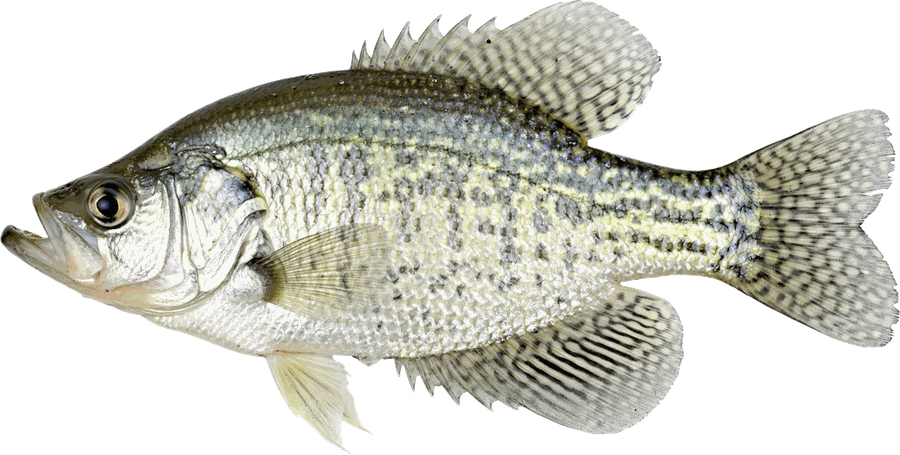
Bump Board's tactics library for White Crappie — where to fish, what to tie on and how to fish it, season by season. In the app, these tips adapt live to the weather, the front and the light.
White Crappie — Prespawn
Where to fish
- White crappie stage ahead of the spawn as the water climbs toward about 14 °C, when spawning starts. Look for staging schools off the spawning shallows — and remember this species' split personality: among lakes it occupies shallower systems, but within a lake it holds deeper and on gentler slopes than black crappie do.
What to tie on
- These are visual planktivores turning piscivore as they grow — small offerings that match plankton-and-minnow food, fished at the depth the schools are holding, are the approach the diet evidence supports. The studies name the food, not a lure; size to the forage you see.
How to fish it
- Fish the staging schools slowly and at their exact depth — a suspended school feeds at its level, not above or below it. Movement peaks in May in the telemetry, so prespawn fish are travelling: check the routes between deep water and the shallows, not just the ends.
If it's still tough
- If the shallows are empty, the stage hasn't happened yet — go back to the deeper, gentler water this species prefers within the lake and wait for the temperature to do its work.
White Crappie — Spawn
Where to fish
- Spawning starts at about 14 °C and peaks around 18–21 °C — two numbers, not one band, and any single-temperature spawn rule for this fish was rejected in the research. Fish the spawning shallows while the water is in the peak window.
What to tie on
- Small, slow and at nest depth. As in prespawn, the evidence supports matching the small forage — plankton first for the small fish, minnows for the adults — over any named lure.
How to fish it
- Work the shallows methodically while the window is open; it's short. Adults are night-led feeders even now, so the low-light hours on the spawning water are worth more than midday.
If it's still tough
- If the shallows suddenly empty, believe it: this species' post-spawn move deep is rapid and white-specific. Follow them out instead of waiting for them to return.
White Crappie — Postspawn
Where to fish
- The defining white crappie move: right after the spawn they go deep, fast — the opposite of their black crappie cousins in the same lakes, who linger shallow. Fish the deep move: suspended schools over deeper water off the spawning areas.
What to tie on
- Suspended-school presentations at the depth the fish are showing. The turbidity evidence is a real guide here: moderate clarity is best, high turbidity is tolerated with a slow decline — and this fish shows no preference for murk, whatever the folklore says.
How to fish it
- Find the schools on electronics and fish their level precisely. A white crappie school is a depth before it's a spot.
If it's still tough
- If you can't find them shallow, stop looking shallow — the post-spawn fish are deep and suspended, and the search is a sonar search, not a casting one.
White Crappie — Summer
Where to fish
- Summer white crappie are suspended schoolers over deeper, low-velocity water. The adult day runs backwards from most panfish: feeding peaks late at night into early morning, with movement picking up from about 23:00. Small juveniles reverse it — they feed on Daphnia by daylight — so a daytime school of small fish is a different pattern, not a contradiction.
What to tie on
- Adults turn more piscivore in summer — minnow-matching offerings at the school's depth. In turbid water the adults' one measured edge is exactly that piscivory; in clear water, plankton-sized offerings still rule the small fish.
How to fish it
- Plan the trip around the night-led clock: dusk through the first hours of dark, and again toward morning, are the adult windows. Oxygen sets a floor — feeding holds to about 5 mg/L, breaks around 3.3, and the floor is near 2.0 — so in the summer squeeze, fish the layer that still has oxygen, not the depth that worked in June.
If it's still tough
- Rising water is the one measured negative in the flow evidence — after a rise, expect scattered fish and lean on the stable deep schools. And if midday is dead, that's the species' clock, not your bait: come back at dark.
White Crappie — Fall
Where to fish
- Fall brings the shoreward return — schools slide back toward the shallows and the banks as the water cools, reversing the post-spawn move. Fish the routes in: the first structure and breaks between the deep summer water and the shore.
What to tie on
- Minnow-matching offerings at school depth, as in summer. The night-led adult clock still runs the day — low light and dark remain the feeding windows.
How to fish it
- Follow the schools shoreward a step at a time and fish the edges of the move: a school travelling between summer and winter water pauses on the breaks along the way.
If it's still tough
- If the shoreward spots are quiet, the schools are still out — check the deep suspended pattern once more before you conclude the fall move has happened.
White Crappie — Winter
Where to fish
- Winter white crappie are deep, slow and oxygen-bound: the same floors as summer apply (feeding break near 3.3 mg/L, floor near 2.0), in the deepest low-velocity water they use all year.
What to tie on
- Small and still, at the school's depth. Cold white crappie are not a chasing fish — the presentation the evidence supports is a bait hanging in front of them.
How to fish it
- Fish vertically over located schools and give a spot time. Winter movement is the year's lowest ebb in everything but the spawn-season telemetry — location first, presentation second.
If it's still tough
- If winter fish won't go, check oxygen before technique: in a low-oxygen basin the fish are wherever the remaining oxygen is, and that address outranks every structure rule.
White Crappie on the ice — Through the ice season
Where to fish
- The caveat comes first, because it's the finding: no under-ice study of white crappie exists — not one. What follows is a scaffold built from this species' measured oxygen and temperature bounds plus the programme's shared ice machinery, and it is not research-backed the way the walleye and perch ice patterns are.
What to tie on
- No white-crappie ice presentation is species-verified. Small, slow offerings at the depth of located fish are consistent with the open-water evidence — nothing stronger can honestly be claimed.
How to fish it
- Fish the scaffold's logic: deep, low-velocity water, oxygen first (the ~2 mg/L floor is measured for this species), and the night-led clock extrapolated under the ice — flagged as an extrapolation, because under-ice diel has never been measured in this fish.
If it's still tough
- Treat white crappie through the ice as an experiment and say so. The genuine ice crappie science in this library belongs to black crappie; where both species swim, the black crappie ice entry is the sourced one.
Where White Crappie live
631 waters in the Bump Board dataset hold White Crappie. A selection:
Ontario
- Baptiste Creek
- Bear Creek
- Big Creek
- Big Rideau Lake
- Canard River
- Catfish Creek
- Collins L.
- Cooley Pond
- Darling Lake
- Doubloon Lake
- Dry Creek
- East Otter Creek
- Elbow Lake
- Elsie Creek
- Grand River
- Grays Creek
- Grindstone Creek
- Hardy Creek
- Hickory Creek
- Humber River
- Kettle Creek
- Lac Deschênes
- Lac Dollard-des-Ormeaux
- Lake Erie
Plus 28 more Ontario waters — browse Ontario lakes.
Alabama
- Coffeeville Lake
- Gantt Lake
- H Neely Henry Lake
- Jordan Lake
- Lake Tuscaloosa
- Martin Lake
- Mitchell Lake
- Point A Lake
- R E 'Bob' Woodruff Reservoir
- William 'Bill' Dannelly Reservoir
- Yates Reservoir
Arkansas
Colorado
- Boyd Lake
- Cottonwood Lake
- Jackson Lake
- Johnstown Reservoir
- North Sterling Reservoir
- Pomona Lake
- Prewitt Reservoir
Delaware
Georgia
Iowa
- Alice Wyth Lake
- Backbone Lake
- Beeds Lake
- Big Creek Lake
- Big Woods Lake
- Bussey Lake
- Cedar Lake
- Cedar Lake
- Center Lake
- Clear Lake
- Coralville Lake
- Diamond Lake
- Don Williams Lake
- East Lake
- Five Island Lake
- Folsom Lake
- George Wyth Lake
- Grays Lake
- Green Valley Lake
- Greenfield Lake
- High Lake
- Ingham Lake
- Lake Binder
- Lake Ellis
Plus 27 more Iowa waters — browse Iowa lakes.
Idaho
- Ben Ross Reservoir
- C J Strike Reservoir
- Crane Creek Reservoir
- Lake Cascade
- Lake Hayden
- Lake Lowell
- Lake Walcott
- Mann Lake
- Paddock Valley Reservoir
- Salmon Falls Creek Reservoir
- Soldiers Meadow Reservoir
- Stone Reservoir
- Tolo Lake
Illinois
- Argyle Lake
- Canton Lake
- Carlyle Lake
- Cedar Lake
- Crab Orchard Lake
- Evergreen Lake
- Forbes Lake
- Governor Bond Lake
- Horseshoe Lake
- Kinkaid Lake
- Lake Clinton
- Lake Decatur
- Lake Glenn Shoals
- Lake Jacksonville
- Lake Lou Yaeger
- Lake Mattoon
- Lake Murphysboro
- Lake Pittsfield
- Lake Sara
- Lake Shelbyville
- Lake Springfield
- Lake Storey
- Lake Taylorville
- Lake Vermilion
Plus 9 more Illinois waters — browse Illinois lakes.
Indiana
- Ball Lake
- Bass Lake
- Baugher Lake
- Cedar Lake
- Cedar Lake
- Jones Lake
- Little Cedar Lake
- Little Long Lake
- McClures Lake
- Old Lake
- Riddles Lake
- Rupel Lake
- Sellers Lake
- Silver Lake
- Skinner Lake
- Steinbarger Lake
- Town Lake
- Williams Lake
Kentucky
- Barren River Lake
- Dewey Lake
- Green River Lake
- Lake Barkley
- Lake Cumberland
- Marion County Lake
- Paintsville Lake
Louisiana
Maryland
Michigan
- Bear Lake
- Belleville Lake
- Gun Lake
- Lake Sanford
- Ross Lake
- Secord Lake
- Smallwood Lake
- Van Etten Lake
- Versluis Lake
Minnesota
- Albert Lea Lake
- Amber Lake
- Ann Lake
- Ballantyne Lake
- Barrett Lake
- Bass Lake
- Big Kandiyohi Lake
- Big Swan Lake
- Big Twin Lake
- Black Dog Lake
- Bloody Lake
- Briggs Lake
- Bright Lake
- Budd Lake
- Buffalo Lake
- Carrie Lake
- Cedar Lake
- Cedar Lake
- Charley Lake
- Clear Lake
- Clear Lake
- Clear Lake
- Comfort Lake
- Courthouse Lake
Plus 90 more Minnesota waters — browse Minnesota lakes.
Missouri
- Atkinson Lake
- Binder Lake
- Blind Pony Lake
- Blue Springs Lake
- Clearwater Lake
- Crowder Lake
- Fellows Lake
- Forest Lake
- Hamilton Reservoir
- Harry S Truman Reservoir
- Hunnewell Lake
- Lake Jacomo
- Lake of the Ozarks
- Lake Paho
- Limpp Lake
- Long Branch Lake
- Mark Twain Lake
- Perry County Community Lake
- Pomme de Terre Lake
- Pony Express Lake
- Smithville Lake
- Sterling Price Community Lake
- Stockton Lake
- Table Rock Lake
Plus 3 more Missouri waters — browse Missouri lakes.
Mississippi
- Aberdeen Lake
- Aliceville Lake
- Arkabutla Lake
- Bailey Lake
- Bee Lake
- Choctaw Lake
- Columbus Lake
- Enid Lake
- Grenada Lake
- Horseshoe Lake
- Lake Bogue Homo
- Lake Lowndes
- Lake Tangipahoa
- Lake Washington
- Mayes Lake
- Moon Lake
- Okatibbee Lake
- Okhissa Lake
- Ross R Barnett Reservoir
- Sardis Lake
- Simpson Legion State Fishing Lake
Montana
- Anita Reservoir
- Arapooish Pond
- Bighorn Lake
- Boxelder Lake
- Broadview Pond
- Castle Rock Lake
- Fort Peck Lake
- Hollecker Lake
- Lake Elmo
- Lake Josephine
- Nelson Reservoir
- Rattlesnake Reservoir
- South Sandstone Reservoir
- Spotted Eagle Lake
- Tongue River Reservoir
North Dakota
Nevada
- Chimney Reservoir
- Echo Canyon Reservoir
- Little Washoe Lake
- Nesbitt Lake
- Rye Patch Reservoir
- Washoe Lake
- Willow Creek Reservoir
New York
Ohio
Oklahoma
- Atoka Reservoir
- Birch Lake
- Canton Lake
- Copan Lake
- Eufaula Lake
- Fort Gibson Lake
- Greenleaf Lake
- Hugo Lake
- Kaw Lake
- Keystone Lake
- Lake Arcadia
- Lake Ellsworth
- Lake Hudson
- Lake Thunderbird
- Oologah Lake
- Robert S Kerr Reservoir
- Skiatook Lake
- Tenkiller Ferry Lake
- Webbers Falls Reservoir
- Wister Lake
Oregon
- Anderson Lake
- Blue Lake
- Brownlee Reservoir
- Bully Creek Reservoir
- Bumphead Reservoir
- Bybee Lake
- Campbell Lake
- Cold Springs Reservoir
- Colorado Lake
- Cow Lakes
- Crump Lake
- Cullaby Lake
- Dexter Reservoir
- Drews Reservoir
- Fern Ridge Lake
- Flagstaff Lake
- Gerber Reservoir
- Goose Lake
- Hart Lake
- Hills Creek Lake
- Krumbo Reservoir
- Lookout Point Lake
- McClure Lake
- Mission Lake
Plus 19 more Oregon waters — browse Oregon lakes.
Pennsylvania
- Allegheny Reservoir
- Blue Marsh Lake
- Bridgeport Reservoir
- Canonsburg Lake
- Conneaut Lake
- Cowans Gap Lake
- Crooked Creek Lake
- Dutch Fork Lake
- Edinboro Lake
- Fords Lake
- Foster Joseph Sayers Lake
- Frances Slocum Lake
- Glade Dam Lake
- Glade Run Lake
- Green Lane Reservoir
- Green Lick Reservoir
- Hammond Lake
- Harbar Acres Lake
- Holtzhauer Lake
- Kahle Lake
- Keystone Lake
- Keystone Lake
- Lackawanna Lake
- Lake Arthur
Plus 33 more Pennsylvania waters — browse Pennsylvania lakes.
South Dakota
- Beaver Lake
- Belle Fourche Reservoir
- Clear Lake
- Hanson Lake
- Lake Cavour
- Lake Kampeska
- McCook Lake
- Shadehill Reservoir
- Wall Lake
Tennessee
Texas
- Bachman Lake
- Ballinger City Lake
- Brady Reservoir
- Buffalo Springs Lake
- Champion Creek Reservoir
- Eagle Mountain Lake
- Grapevine Lake
- Greenbelt Reservoir
- Hords Creek Lake
- Hubbard Creek Reservoir
- Joe Pool Lake
- Kirby Lake
- Lake Abilene
- Lake Alan Henry
- Lake Arlington
- Lake Arrowhead
- Lake Brownwood
- Lake Cisco
- Lake Coleman
- Lake Crook
- Lake Daniel
- Lake Dunlap
- Lake Fort Phantom Hill
- Lake Gonzales
Plus 35 more Texas waters — browse Texas lakes.
Virginia
- Amelia Lake
- Emporia Lake
- Lake Chesdin
- Leesville Reservoir
- Martinsville Reservoir
- North Fork of Pound Lake
- Occoquan Reservoir
- South Fork Rivanna River Reservoir