
Fishing tips & tactics
How to catch White Bass
Morone chrysops
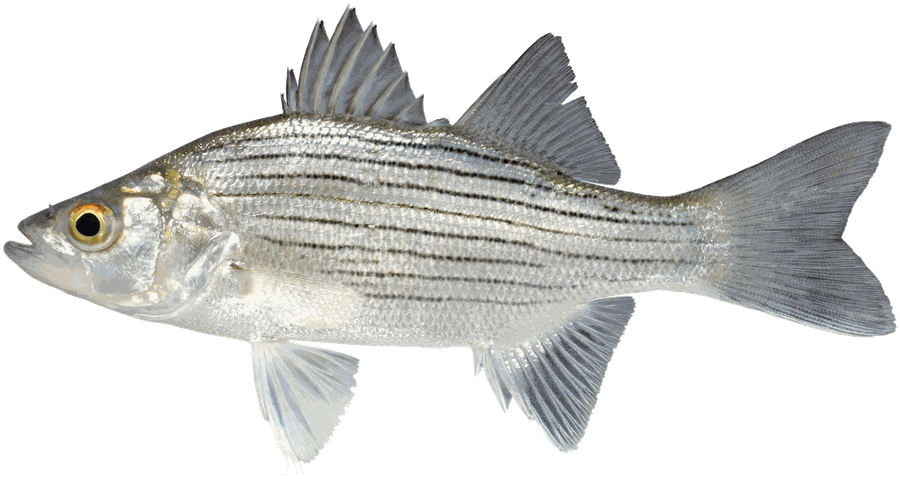
Bump Board's tactics library for White Bass — where to fish, what to tie on and how to fish it, season by season. In the app, these tips adapt live to the weather, the front and the light.
White Bass — Prespawn
Where to fish
- Prespawn is a staging season with its own measured clock: migration begins as the water rises above about 7 °C, with males moving up to a month before females, toward the running water and spawning shores where the run will happen once the water reaches 12–14 °C. Fish the staging water below and beside the spawning ground — the fish are travelling and gathering, not yet spawning.
- Stage on the lower reaches and the holding water below the gravel and rock spawning reaches. The run's catch rate in the Arkansas River work rose as temperatures reached 13 °C, so the staging pools closest to the spawning water load first as the thermometer climbs through the low teens.
- Spawning happens on windswept shores as well as in tributary water, so the staging pattern has a shore version too: fish the points and gravel shores the wind works, off the deeper holding water, as the temperature builds toward the trigger.
What to tie on
- Match the forage the schools are following — this species is more sensitive to prey location than to habitat features in the habitat-suitability synthesis, and schools track baitfish concentrations rather than structure. No lure is named in the white bass literature, and none is invented here: baitfish-profile offerings sized to the local shiners are the supported pattern.
- Feeding changes around the run rather than stopping for it: reservoir stomach work found contents differing significantly before, during and after spawning. Prespawn fish are feeding fish — present the baitfish profile actively, as a chased meal, not a bedside offering.
How to fish it
- Fish the temperature build, not the calendar: the cold limb is anchored by behaviour — staging from about 7 °C, catch rates rising at 13 °C — and below that band feeding is genuinely depressed; age-0 fish held at 5 °C fed, but at rates too low to maintain body weight. A cold prespawn session over staging fish is a slow session by measurement, not by bad luck.
- Time the day by the agency line the model is built on: most active at dawn and dusk, with a solid day value of 0.80 for a daylight-spawning, surface-chasing school fish. Be on the staging water at the light changes, and do not write off the bright hours the way you would for a night-feeding species.
- Cover water: staging schools are mobile and prey-led, so a quiet pool is a reason to move along the staging route, not to wait. The run's shape also varies by year — unimodal one spring, bimodal the next in the Arkansas record — so expect waves, not a single day.
If it's still tough
- If staging fish will not take, check the thermometer first: below about 7 °C you are under the staging band and on the depressed part of the cold limb. Fish the warmest staging water, slow the presentation down, and expect the trigger temperatures to do what no bait change can.
- If one staging area is empty, move toward the spawning water rather than away from it as the temperature climbs — the distribution loads progressively up the route, and the catch-rate rise at 13 °C was measured on fish moving into the tributary water, not sitting still.
White Bass — Summer
Where to fish
- Summer white bass are an open-water, schooling chase: the schools track baitfish concentrations rather than structure, and the location skill is finding the forage, not the cover. In Manitoba the inshore feeding season runs from the early-to-late June arrival through September, with lakewide surveys finding the greatest biomass in summer — fish the bait, wherever the bait is.
- Temperature sets the broad band: the model's plateau runs 20–27 °C, built openly as a construction between the two measured families — fish selected 18–30 °C through the year with summer selection at the warm end, while occupied summer habitat ran 19–28 °C and agency bands centre lower. Both families agree the fish is warm-water and active all summer; neither supports chasing the single hottest water in the system.
- On open water, work the bait schools themselves — the surface breaks where schools drive bait upward are the classic sign, classically at dawn and dusk and again in fall. A located bait school with no white bass under it is worth one pass, not an hour: the predators move with the food, not with the map.
What to tie on
- Fish the shad season: in Lake Erie stomachs, the diet shifted from shiners, perch and midge larvae in June to gizzard shad at 56–97% of the diet from July through October, and threadfin shad made 56% frequency of occurrence in the Clarks Hill adults. Manitoba's version of the same menu is emerald shiners and perch, the forage the Lake Winnipeg adults share with walleye and sauger. Baitfish profiles matched to the local forage fish are the supported summer pattern; no specific lure is named in the literature, and none is invented here.
- Size to the school, not the species average: this is a chase feeder taking prey in the open, so the offering should read as one of the forage fish the school is driving. When the bait is small shiners, a large profile is the wrong story however well it works on other species.
How to fish it
- Dawn and dusk are the stated peaks — the agency account's most-active line, carried at 1.0 at both light changes — with day at 0.80 and night the low value at 0.40. The honest limit rides with the shape: diel structure is measured for this species, but the original studies' peak hours were not retrieved in the research, so the peaks here are the agency line and the schooling canon, not a stomach-by-hour curve.
- Oxygen is a hard ladder for this fish, from one primary experiment: 1 mg/L was lethal at warm temperatures, 2 mg/L was extremely stressful, activity and colour fell off below 3 mg/L, and 5 mg/L is taken as the lower optimum. In a still, hot basin, fish the oxygenated water and passes the deep, depleted water by — below 3 mg/L the fish are not feeding, they are enduring.
- Stay mobile and let the school tell you when to leave: summer schools follow concentrations of bait, and a school that was feeding hard can be gone with its food within the hour. Mark the bait, not the spot — tomorrow's fish are where tomorrow's forage gathers.
If it's still tough
- If summer schools will not take at midday, you are fishing the documented trough between two peaks, not a mystery: shift the session to the light changes before you change the tackle box. The day stays genuinely fishable at 0.80 — but dawn and dusk are where this entry puts its money.
- If the heat has pushed the surface past about 30 °C, expect the measured decline — the curve steps down through the 30 °C chronic and 31 °C acute reference values toward an upper incipient lethal of 33.5 °C and a maximum tolerance of 35.3 °C. Fish early, late, and in the coolest oxygenated water; no single lethal point is quoted because the record holds three different quantities, not one.
- Murk is a mild factor here, not a verdict: across five studies turbidity showed no observable effect on spawning, larval survival or growth, and the only directional finding is avoidance of continuously turbid water. In stained water, fish on — but give a permanently muddy basin a pass in favour of water that clears at least sometimes.
White Bass — Fall
Where to fish
- Fall is the second schooling season: schools gather on the fall baitfish concentrations in the canon, and the diet record backs the timing — shad dominate the stomachs through October. In Manitoba the inshore season runs until September, so early fall fishes like a continuation of summer; the dispersal and the step down the cold limb come after.
- Fish the cooling limb deliberately: the temperature curve still pays 0.85 at 17 °C and 0.70 at 14 °C, so mid-fall water is feeding water, and the season score holds 0.85 through September before stepping down. The fall fish are where the bait concentrates as the water cools, not where they were in August.
- On running water, fall fish drop back toward the deeper holding water they will winter in as the temperature falls through the teens. Work the deep pools on the route down from the summer and spawning reaches — the same corridor as the spring run, travelled in reverse and at a feeding pace.
What to tie on
- Keep the baitfish profile while the forage lasts: the shad-dominated diet runs July through October in the stomach record, so fall is not the moment to downsize to a panfish story. Match the size of the fall bait the schools are driving.
- As the water cools into the low teens, slow the same profile down rather than replacing it: the fish are still chase feeders on the measured limb, but the chase shortens as the temperature falls. No fall-specific lure is named in the literature, and none is invented here.
How to fish it
- The fall surface season is part of the canon for a reason the diet record supports: schools driving bait to the surface are classically a dawn-and-dusk event in fall as in summer. Cover water at the light changes, watching for working schools, and fish found schools hard while the bait holds.
- Use the warmest part of the cooling trend: fall activity rides the temperature curve down, so a mild spell that holds the water in the mid-teens is a genuine feeding window, and the first hard drop toward single digits is the signal to switch to the deep holding pattern.
- Expect to re-find fish daily: fall schools are prey-led and mobile, and yesterday's concentration is a starting guess, not an address. Search the bait first — wind-worked shores and points are where the canon says bait gathers and schools follow, carried here as canon, not as a measured wind effect.
If it's still tough
- If fall fish have vanished from the summer water, follow the temperature and the bait downhill together: cooling water empties the shallows in order, and the deep holding pools on the corridor are the next address, not a smaller bait in the old one.
- If the water has fallen below about 10 °C, you are on the low cold limb — 0.40 at 10 °C, 0.25 at 7 °C — and sessions become a located-school game. Fish slowly over found fish in the deep water and save the searching for the next warming trend.
White Bass — Winter
Where to fish
- Winter is the floor of this species' year, and the record is blunt about it: the season score sits at 0.25, and in the one adult field record every fish collected in January and February had empty stomachs, at 7 °C — warmer water than any winter fishery here ever sees. The open-water winter address is the deep, stationary school: southern winter accounts describe schools holding deep, roaming little, with reduced metabolism for a few weeks.
- Presence is not feeding, and this entry keeps them separate: winter white bass exist in the deep water and can be located — young fish at 5 °C in the laboratory did feed, but too little to maintain body weight, losing condition as they fed. Fish winter schools as a low-rate pattern at best, over located fish, and expect long odds.
- The winter schools in the northern angler record hold deep — the biggest concentrations reported at 40–60 ft, smaller schools around 30 ft, sometimes several feet thick, and mixed with perch. That is angler-grade evidence for where fish are, carried with its grade: it locates fish; it does not promise they are feeding.
What to tie on
- Slow, small baitfish-profile presentations, delivered to located schools and given time: there is no measured winter feeding pattern to copy, so the honest winter tackle story is the summer forage pattern at its slowest, over fish you have found rather than fish you hope are there. No winter-specific lure is measured for this species.
- Do not downsize your expectations along with the bait: a winter school that will not take is behaving the way the stomach record says winter fish behave. The offering is rarely the winter problem.
How to fish it
- Sonar first, casts second: winter movement is minimal in the accounts, so a found school stays found — the reverse of the summer search. Spend the session's effort on locating deep stationary schools, then fish the warmest, most stable part of the short day over them.
- Keep the light changes as your best hours even here — the open-water diel shape is the only diel evidence this species has, and winter has none of its own. That is an estimate carried into an unmeasured season, and the entry labels it as such rather than dressing it as a winter finding.
- Treat every winter take as information, not a pattern: with mid-winter stomachs empty in the field record and juveniles losing weight while feeding, winter feeding — when it happens at all — is a brief, local event. Note the temperature and depth, because the literature cannot check your result against anything.
If it's still tough
- If deep winter schools will not take, that is the expected outcome on this species' own evidence, not a signal to change baits all afternoon. The sourced seasons for white bass are the spring run, the summer bait season and the fall — winter is the floor, and the entry says so plainly.
- If you need a winter target with a measured winter pattern, this is the honest place to say this species is not it on current evidence. Stay with located deep schools in the warmest part of the day, or wait for the spring staging at 7 °C — the next measured event in this fish's year.
White Bass — Springrun
Where to fish
- The run has a hard thermal trigger, the best-documented fact in this file: the water must reach 12–14 °C before spawning begins, and tributary catch rates rose as temperatures reached 13 °C. In Manitoba the run is a May to late-June event at 14–21 °C in the Red and Winnipeg systems. When the thermometer crosses the trigger, be on the spawning water, not the staging water.
- The spawning address in running water is gravel and rock, and the velocity record is specific — occurrence was highest in water moving at 0.6–0.7 m/s, intermediate at 0.2 m/s, and lowest at 0.4–0.5 and 0.9–1.0 m/s, in water 1–2 m deep. That is an occurrence pattern, not a measured bite rate, and this entry labels it as such — but as a place to start on a run, it is this species' own data.
- The shore-spawning half of the run is real: this species also spawns on windswept shores, broadcasting eggs with no nest and no guarding. On shore-spawning water, fish the wind-worked gravel shores while the temperature sits in the 12–20 °C spawning range.
What to tie on
- Time the offering to the run's feeding rhythm, carried in the file as agency tradition and labelled as such: fish feed heavily immediately before and after spawning and bite little while actively spawning. The feeding fish are the arrivals and the spent fish — work the staging edges and the water just off the spawning ground for them, with the baitfish profile the schools follow.
- There is no nest to fish and no guarding state to exploit — this is a broadcast spawner, and the nest-guarding playbook from the bass and panfish entries does not exist here. Present to moving, schooling fish: baitfish profiles worked through the run water at the depth the school is travelling.
How to fish it
- This is a daylight spawner, and the day is a real shift: the model's day value is 0.80, with dawn and dusk at the 1.0 peaks the agency account states. Fish the full day on the run, hardest at the light changes, instead of saving everything for dark.
- Expect the run in waves and stay ready between them: the Arkansas record was unimodal in one year and bimodal the next, and males arrive up to a month ahead of females. A quiet day inside the temperature band is a gap between waves more often than it is the end of the run.
- Keep moving with the fish: run schools distribute along the route and concentrate where the forage is, and the tributary record showed catch rates varying sharply between neighbouring tributaries in the same spring. If your reach is quiet at the right temperature, the next reach is a better bet than a new presentation.
If it's still tough
- If the fish on the spawning ground itself will not bite, you are probably casting at actively spawning fish — the one part of the run the tradition says bites little. Drop to the staging water below the ground or work its edges for arriving and spent fish, which are the feeding part of the run.
- If the temperature is right and the run water is empty, check the shore side before you leave: the run splits between tributary gravel and windswept shores, and a year that loads one may slight the other. The trigger is thermal, not geographic — follow the 12–14 °C crossing to whichever spawning ground the fish chose.
White Bass on the ice — Through the ice season
Where to fish
- No ice parameter set exists for this species, deliberately: no under-ice study of white bass exists in any form — no under-ice diel, no telemetry under ice, no catch-rate series against conditions — and issuing an ice template would invent one. If your water is ice-covered, the honest guidance is the winter open-water pattern, labelled as exactly that: deep, stationary schools in the holding water, fished as the low end of the open-water model, not as an ice measurement.
- The ice fishery itself is real and is carried at its true grade: angler-grade accounts place winter schools deep — the biggest at 40–60 ft at Devils Lake, smaller schools near 30 ft, roaming flats around 18 ft on Winnebago, and backwater schools in 10–15 ft on the Mississippi system. Those numbers locate where anglers find fish through ice; the research is explicit that presence is the whole of what they prove.
What to tie on
- No ice presentation is measured for white bass, and nothing is borrowed from another species to fill this space. The only tackle mention in the ice record is angler-grade — small spoons taken aggressively by schooled fish in the Winnebago account — carried here as canon with its label, not as a measured ice pattern.
- Fish the winter forage story at its slowest if you fish at all: small baitfish profiles over located deep schools. A school that ignores them is consistent with everything the winter record holds.
How to fish it
- Treat ice-season white bass as unstudied water: the winter scores for this species reuse the open-water model with a seasonal floor, and should be read as estimates. Fish the deep holding pattern if you fish them, relocate as the canon insists — the schools are described as highly mobile day to day, not where you found them yesterday — and know the library has no ice science to check your results against.
- Weigh the one hard winter datum before you drill: every adult in the January–February field collection had an empty stomach, and laboratory juveniles at 5 °C lost condition while feeding. The ice season, on present evidence, is a season this fish endures at low ebb — plan effort accordingly.
If it's still tough
- The sourced white bass seasons are the spring run, the summer bait season and the fall. The ice season is, on present evidence, a gap — this entry says so rather than papering over it, and the disposition reopens the moment any under-ice study or a proper winter creel dataset with effort and conditions exists for this species.
- If deep schools under ice will not take, that result matches the winter record better than a hot bite would. Note it, fish the warmest stable part of the day over located fish, and save serious effort for the staging water when the temperature climbs back toward 7 °C.
Manitoba Master Angler
A White Bass of 38 cm (15 in) or better qualifies for Manitoba's Master Angler Program.
Where White Bass live
398 waters in the Bump Board dataset hold White Bass. A selection:
Manitoba
Ontario
- Ausable River
- Baptiste Creek
- Big Otter Creek
- Bronte Creek
- Credit River
- Decker Creek
- Deer Bay
- Duffins Creek
- Echo Bay
- Echo Lake
- Etobicoke Creek
- Foster Creek
- Frenchman's Bay
- Graham Creek
- Grindstone Creek
- Hilliards Creek
- Humber River
- Lake Erie
- Lake Huron
- Lake Nipissing
- Lake Ontario
- Lynde Creek
- Main Channel (French River)
- Mimico Creek
Plus 13 more Ontario waters — browse Ontario lakes.
Alabama
- Bartletts Ferry Lake
- Logan Martin Lake
- Martin Lake
- R E 'Bob' Woodruff Reservoir
- Thurlow Reservoir
- Wheeler Lake
- Yates Reservoir
Arkansas
- Blue Mountain Lake
- Bull Shoals Lake
- Greers Ferry Lake
- Lake Dardanelle
- Lake Greeson
- Millwood Lake
- Nimrod Lake
Arizona
Colorado
Florida
Georgia
Iowa
- Big Creek Lake
- Big Lake
- Butler Lake
- Center Lake
- Clear Lake
- Coralville Lake
- East Okoboji Lake
- Gimmel Lake
- Lake MacBride
- Lake Red Rock
- Lost Island Lake
- Martelle Lake
- Minnewashta Lake
- Rathbun Lake
- Roberts Creek
- Saylorville Lake
- Silver Lake
- Spirit Lake
- Storm Lake
- West Okoboji Lake
Illinois
- Carlyle Lake
- Crab Orchard Lake
- Heidecke Lake
- Lake Clinton
- Lake Decatur
- Lake Sara
- Lake Shelbyville
- Lake Springfield
- Newton Lake
- Rend Lake
- Sangchris Lake
Indiana
- Big Chapman Lake
- Hoffman Lake
- Irish Lake
- James Lake
- Koontz Lake
- Little Barbee Lake
- Pike Lake
- Ridinger Lake
- Troy Cedar Lake
- Waubee Lake
- Wolf Lake
- Yellow Creek Lake
Kansas
- Big Hill Lake
- Cedar Bluff Reservoir
- Cheney Reservoir
- Clinton Lake
- Coffey County Lake
- Council Grove Lake
- El Dorado Lake
- Elk City Lake
- Fall River Lake
- Hillsdale Lake
- John Redmond Reservoir
- Kirwin Reservoir
- La Cygne Lake
- Lovewell Reservoir
- Marion Reservoir
- Melvern Lake
- Milford Lake
- Perry Lake
- Pomona Lake
- Toronto Lake
- Tuttle Creek Lake
- Waconda Lake
- Webster Reservoir
- Wilson Lake
Kentucky
- Barren River Lake
- Bullock Pen Lake
- Cave Run Lake
- Dewey Lake
- Fishtrap Lake
- Green River Lake
- Herrington Lake
- Lake Barkley
- Lake Cumberland
- Laurel River Lake
- Nolin Lake
- Taylorsville Lake
Louisiana
Michigan
- Belleville Lake
- Devils Lake
- Grand Sable Lake
- Lake Charlevoix
- Lake Macatawa
- Lake Sanford
- Lower Herring Lake
- Mullett Lake
- Muskegon Lake
- Ross Lake
- Van Etten Lake
Minnesota
- Artichoke Lake
- Beason Lake
- Big Stone Lake
- Black Dog Lake
- Bright Lake
- Cannon Lake
- Cedar Lake
- Charley Lake
- Circle Lake
- Cross Lake
- Deep Lake
- Fish Lake
- Fox Lake
- French Lake
- German Lake
- Gorman Lake
- Iowa Lake
- Lac Qui Parle
- Lake Byllesby
- Lake Emily
- Lake Pepin
- Lake Traverse
- Lake Winona
- Little Spirit Lake
Plus 17 more Minnesota waters — browse Minnesota lakes.
Missouri
- Blue Springs Lake
- Clearwater Lake
- Harry S Truman Reservoir
- Lake Jacomo
- Lake of the Ozarks
- Lake Taneycomo
- Longview Lake
- Mark Twain Lake
- Pomme de Terre Lake
- Smithville Lake
- Stockton Lake
- Table Rock Lake
Mississippi
- Aliceville Lake
- Arkabutla Lake
- Chotard Lake
- Columbus Lake
- Enid Lake
- Grenada Lake
- Lake Ferguson
- Lake Washington
- Sardis Lake
North Dakota
- Audubon Lake
- Bowman-Haley Lake
- Devils Lake
- Lake Ashtabula
- Lake Sakakawea
- Lake Trenton
- Lake Tschida
- Stump Lake
Nebraska
- Calamus Reservoir
- Davis Creek Reservoir
- Elwood Reservoir
- Enders Reservoir
- Glenn Cunningham Lake
- Harlan County Lake
- Harry Strunk Lake
- Hugh Butler Lake
- Jeffrey Reservoir
- Johnson Lake
- Lake Maloney
- Lake McConaughy
- Lake Minatare
- Lake North
- Merritt Reservoir
- Ogallala Lake
- Sherman Reservoir
- Sutherland Reservoir
- Swanson Lake
- Whitney Lake
- Willow Creek Lake
- Yankee Hill Lake
New Mexico
Nevada
Oklahoma
- Broken Bow Lake
- Canton Lake
- Copan Lake
- Eufaula Lake
- Fort Gibson Lake
- Foss Reservoir
- Grand Lake O' The Cherokees
- Greenleaf Lake
- Hugo Lake
- Keystone Lake
- Lake Altus
- Lake Arcadia
- Lake Ellsworth
- Lake Eucha
- Lake Hudson
- Lake Texoma
- Lake Thunderbird
- Oologah Lake
- Tenkiller Ferry Lake
Pennsylvania
South Dakota
- Belle Fourche Reservoir
- Blue Dog Lake
- Brant Lake
- Durkee Lake
- Fish Lake
- Goose Lake
- Lake Albert
- Lake Campbell
- Lake Farley
- Lake Francis Case
- Lake Henry
- Lake Kampeska
- Lake Madison
- Lake Norden
- Lake Poinsett
- Lake Sinai
- Lake Thompson
- Lake Whitewood
- McCook Lake
- Pelican Lake
- Pickerel Lake
- Richmond Lake
- Shadehill Reservoir
- Waubay Lake
Tennessee
- Boone Lake
- Calderwood Lake
- Center Hill Lake
- Cheatham Lake
- Cherokee Lake
- Chickamauga Lake
- Cordell Hull Reservoir
- Dale Hollow Lake
- Douglas Lake
- Fort Loudoun Lake
- Fort Patrick Henry Lake
- J Percy Priest Reservoir
- John Sevier Detention Reservoir
- Kentucky Lake
- Melton Hill Lake
- Nickajack Lake
- Normandy Lake
- Norris Lake
- Old Hickory Lake
- South Holston Lake
- Tellico Lake
- Tims Ford Lake
- Watauga Lake
- Watts Bar Lake
Plus 1 more Tennessee waters — browse Tennessee lakes.
Texas
- Aquilla Lake
- Ballinger City Lake
- Champion Creek Reservoir
- Choke Canyon Reservoir
- Coleto Creek Cooling Pond
- Comanche Creek Reservoir
- E V Spence Reservoir
- Eagle Mountain Lake
- Ellison Creek Reservoir
- Granger Lake
- Grapevine Lake
- Greenbelt Reservoir
- Hubbard Creek Reservoir
- Hubert M Moss Lake
- Inks Lake
- Joe Pool Lake
- Lake Amon G Carter
- Lake Arlington
- Lake Arrowhead
- Lake Athens
- Lake Bridgeport
- Lake Brownwood
- Lake Buchanan
- Lake Corpus Christi
Plus 36 more Texas waters — browse Texas lakes.