
Fishing tips & tactics
How to catch Redbreast Sunfish
Lepomis auritus
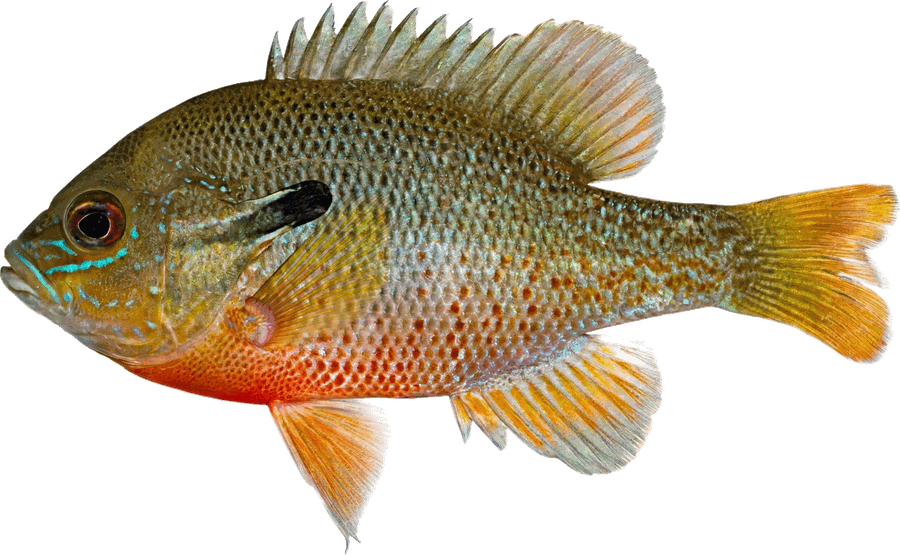
Bump Board's tactics library for Redbreast Sunfish — where to fish, what to tie on and how to fish it, season by season. In the app, these tips adapt live to the weather, the front and the light.
Redbreast Sunfish — Prespawn
Where to fish
- Redbreast build toward the spawn on a thermal trigger, not a calendar: nest density was almost fully explained by degree-days accumulated after the water first reached 20 °C. Ahead of that crossing, fish are at their most mobile of the year — movement peaks in May and June after the winter minimum — moving out of the deep winter aggregations toward the nesting and feeding water. Fish the warming, structured shallows and the routes into them.
- This is a stream fish first: manoeuvrable, visually oriented predators of low-velocity water and structured habitat, holding near snags and other hard structure where food production concentrates. Ahead of the spawn, work the slow, structured water beside the nesting banks — the fish are staging in their feeding habitat, close to where they will nest.
- In still water, look for the same prescription without the flow: clear, rocky, structured shallows over sand and gravel, in the warmer bays first. The species account tradition prefers clean, clear water and rocky areas, and the prespawn move follows the warming toward 20 °C, not the date.
What to tie on
- Fish the measured drift-and-benthos menu: the nymphal stages of aquatic insects — mayflies first (70.5% of the Juniata diet across all hours), then dipterans and caddis — plus terrestrial insects, small crustaceans and small fish. No lure is named in the redbreast literature, and none is invented here; small, natural offerings worked through the structured feeding water are the supported shape.
How to fish it
- Fish the daylight and weight the afternoon: in the summer diel work the feeding peak came at 1600 h with minimal feeding at night, and the 24-hour stream work found the greatest food diversity by day and the least after dark. Prespawn effort belongs in the bright hours, with the late afternoon as the peak window.
- Work one good reach thoroughly: in three years of tagging, redbreast were among the most sedentary fish in their streams — some held a single 50 m section for six months or more — even though a few individuals roamed several kilometres and returned. A located prespawn fish is a resident, not a passer-by; give its structure real time.
If it's still tough
- If the shallows are empty, the degree-days have not arrived — spawning is gated from the 20 °C crossing, so drop to the deeper structured water the fish are leaving and wait for the temperature rather than changing baits.
Redbreast Sunfish — Spawn
Where to fish
- Spawning runs on the degree-day clock from 20 °C, in a main band of 20–29 °C: successful nests averaged 24.3 °C, and June nests in North Carolina sat at 21.7–25.6 °C. Colonies form on sand and gravel — never silt or detritus in the North Carolina work — at depths of about 0.25–1.5 m, with more than half the Virginia nests at 30–60 cm, each nest roughly 25–125 cm across. Fish the nesting shallows and the feeding water at their edges.
- The nest address is precise, and it is stillness: 128 Virginia nests averaged only 0.9 cm/s of current, successful nests sat at about 5 cm/s in the water column and under 1 cm/s just above the nest, typically beside hard structure in the slow shadow downstream of an obstruction, and at lower discharge than failed nests. Find the near-still pockets beside structure in the nesting reach and you have found the colonies.
What to tie on
- Bottom and drift offerings sized to the nesting-season menu — mayfly and other insect nymphs, small crustaceans — worked around the beds and their edges. Nothing spawn-specific beyond the beds themselves is redbreast-measured, and no spawn lure is named in the literature.
How to fish it
- The guard-state rule is this species' own measurement here, not a family assumption: non-nesting fish had fuller stomachs than nesting males, nesting measurably reduced both the quantity and diversity of prey eaten, and bioenergetics predicted weight loss for nesting males through the season. A strike on the nest is defence, not feeding — fish the colony edges for the fish that are actually eating.
- Respect a rising flow as a hard stop, not a challenge: during hydropower releases of about 200 m³/s, spawning behaviour ceased and nests were abandoned, and in tailwater sampling the fish fed primarily before generation began and little or not at all during it. If the water is being pushed hard, the measured move is to wait for the low, stable flow the successful nests require.
If it's still tough
- If bed fish swat rather than eat, you are watching the guard state the stomach work measured — move to the colony edges and the first feeding structure off the beds. And if a spate has just run through the reach, give the colonies time to re-form on stable water before you judge them empty.
Redbreast Sunfish — Summer
Where to fish
- Summer redbreast are at their measured best in the construction this entry is built on: no preferred temperature has ever been measured for this species — its habitat authors said so plainly — but three lines agree on a growth plateau at 25–30 °C, with growth reduced below 15 °C and above 33 °C and consumption collapsing at 33 °C in the modelled river work. Fish the warm, structured feeding water inside that band, and treat water past the low 30s as the warm limb, not the peak.
- The summer address is low velocity plus structure: adults and juveniles are most abundant at velocities up to about 35 cm/s and decline where average flow runs faster, and the feeding stations are the snags and hard structure that produce so much of the food in these systems. Fish the slow, structured pools and bank water; the drift delivers the menu to a fish that holds its station.
- In still water the same fish wants the clear, rocky shallows: the synopsis tradition prefers clean, clear water, ranks this species less tolerant of poor-quality water than its common cousins, and the habitat curve calls growth good at 18–32 °C. Colour alone is not a disqualifier — Florida lake fish persisted at low clarity from tannin — but suspended murk is a different matter (see How).
What to tie on
- The drift menu at full summer strength: mayflies lead, with dipterans, caddis, dragonfly nymphs and terrestrial insects, plus crayfish and small fish — agency copy calls it probably the most varied diet of any sunfish, and the primary diet lists support the breadth. Match what the water is actually delivering at your structure; no lure is named in the redbreast literature, and none is invented here.
- In coloured or stained water, keep offerings natural and close: moderate turbidity of about 25–100 JTU should not impair foraging on the habitat record, but above roughly 100 JTU visual feeding degrades by the family mechanism — that bound is a habitat statement, not a measured dose–response, and no finer turbidity rule is claimed.
How to fish it
- Weight the day toward the afternoon: the July feeding peak was 1600 h, feeding was minimal at night that season, and fish fed at both dawn and dusk transitions with a higher share of bottom prey at dawn. A summer redbreast day is a daylight day with a late peak — plan the best structure for mid-to-late afternoon.
- Keep two honest limits in view. Oxygen: no redbreast oxygen measurement exists at all — its rating carries no oxygen curve, only the synopsis note that this species is not especially tolerant of low oxygen — so do not fish it as a low-oxygen specialist. Clarity: it is a visual feeder, so as suspended turbidity climbs past the moderate band, shorten the distance and slow down rather than reaching for a louder bait the literature never names.
If it's still tough
- If warm structured water is silent, check which limb you are on before the bait: below about 15 °C growth and feeding are already reduced on the construction, and past 33 °C the modelled consumption fell off a cliff. The fix for either is water inside the 25–30 °C plateau, not a new presentation.
Redbreast Sunfish — Fall
Where to fish
- Fall redbreast keep feeding as the water cools through the teens — the October record has them feeding across the full day — while the year's other flow story closes: year-class strength in Florida rivers keyed partly on fall flows, and the standing stock itself tracks the prior year's low-water levels. Fish the same structured, low-velocity feeding water as summer, sliding deeper as the temperature falls toward the winter aggregations.
- The fall stations are the summer stations, slower: snags, rock and bank structure in the pools, where the drift menu still delivers. Movement is falling away from its spring peak toward the winter minimum, so located fall fish are increasingly residents — work their structure completely before moving on.
What to tie on
- The summer menu, with the bottom share rising: at dawn in the transition study, bottom prey made up a higher share of the diet than at dusk, and the autumn diet stays insect-led. Small bottom-and-drift offerings around the structure cover the measured fall menu; no fall-specific lure is named in the literature.
How to fish it
- Carry the autumn clock honestly, because it is this species' strangest measured fact: in July feeding peaked at 1600 h and bottomed at night, but in October, in the same river with the same design, feeding peaked at 0400 h with low, steady feeding through the rest of the day. The model's night value (0.30) is a stated compromise between those two seasons. In fall, do not write off the dark hours the way the summer entry allows — and do not build the whole trip on a single October result either.
- Fish the cooling slide by the ladder underneath it: this fish still swam independently at 9 °C in the classic laboratory comparison. Through the fall teens and single digits it is slowing, not stopped — slow the presentation and lengthen the time on each structure as the temperature falls.
If it's still tough
- If fall fish go quiet week over week, it is the temperature-and-movement slide toward the winter aggregation, not an emptied reach — this is a site-attached fish whose winter posture is documented shutdown. Move toward the deeper, stiller holding water before you move reaches.
Redbreast Sunfish — Winter
Where to fish
- Winter redbreast do not feed their way through — they shut down, and that is measured, not inferred: in the classic comparison they swam independently at 9 °C, formed feeble aggregations at 7 °C, and formed a quiescent resting school at 5 °C. Movement is at its annual minimum in January and February. The winter entry describes a persistence posture, not a feeding pattern, and the entry grades it that way.
- At the northern fringe the field statement matches the laboratory: fish congregate in deeper water and remain inactive under ice until spring, and the lake tradition describes dense hibernating schools once temperatures fall below about 5 °C. In open southern water, the warmest, deepest, stillest structured pools are the only winter address the record supports — fished with low expectations set by the quiescence ladder.
What to tie on
- If you fish them at all in the cold, the drift menu at its smallest and slowest, delivered to a located aggregation — winter consumption has never been measured for this species, so no winter presentation is claimed as a finding. No lure is named in the redbreast literature, and none is invented here.
How to fish it
- Treat winter as the off-season the physiology says it is: the redbreast year is the warming spring, the degree-day spawn and the warm summer plateau. Cold-season effort is honestly better spent on species with a measured winter feed — this entry will not dress a quiescent fish up as a pattern.
- In the mildest open-water windows, fish the middle of the day over the deep aggregations and give them long, still presentations: the only winter behaviour on record is aggregation and inactivity, so any winter bite is a located-fish event, not a searching pattern.
If it's still tough
- A dead winter reach is the species working as measured — quiescent at 5 °C, inactive at its northern fringe, moving least in midwinter. Wait for the warming toward the 20 °C degree-day clock; that climb, not a bait change, is the entire redbreast spring pattern.
Redbreast Sunfish on the ice — Through the ice season
Where to fish
- Not applicable — and stated as a result, not an omission: redbreast is a riverine Atlantic-slope species whose winter behaviour is documented quiescence — laboratory fish formed a quiescent resting school at 5 °C, and at its northern fringe the species congregates in deeper water and remains inactive under the ice until spring. No winter-feeding measurement and no ice fishery exist for this species, so ICE mode for redbreast returns not applicable, and no ice weights were issued or borrowed.
- The under-ice picture the record actually gives is an inactive aggregation in deeper water, not a feeding fish to locate: that sentence, from the northern-fringe assessment, is the whole ice chapter in this species' science. There are no ice-season shallows, phases or pockets to send you to.
What to tie on
- No ice presentation exists for redbreast sunfish, and none is borrowed from another sunfish to fill this space.
How to fish it
- The cold-season redbreast guidance is the winter entry in this guide: quiescent aggregations, movement at its annual minimum, and a fish waiting for the warming that starts its degree-day spawn clock. There is no ice technique in the research to summarise.
- If winter redbreast are your goal, the sourced season is open water at the warm end of the cold months — deep, still, structured pools fished slowly at midday — labelled as open-water guidance, not as an ice pattern.
If it's still tough
- If you are standing on ice over redbreast water, the honest answer is that you are outside this fish's fishing season: its centre of range is largely ice-free, and where ice does occur the documented behaviour under it is inactivity. The library's ice-covered sunfish patterns belong to the species with measured winter feeding.
- Any measured under-ice feeding or ice-catch record would reopen this disposition — the research states that condition openly — but until one exists, silence under ice is the evidence, not a problem to solve with tackle.
Where Redbreast Sunfish live
173 waters in the Bump Board dataset hold Redbreast Sunfish. A selection:
Connecticut
- Alexander Lake
- Amos Lake
- Andover Lake
- Aspinook Pond
- Avery Pond
- Ball Pond
- Baltic Reservoir
- Bantam Lake
- Bashan Lake
- Batterson Park Pond
- Beach Pond
- Bunnells Pond
- Burr Pond
- Chapman Pond
- Colebrook River Lake
- Columbia Lake
- Cream Hill Lake
- Crystal Lake
- Easton Reservoir
- Gardner Lake
- Glasgo Pond
- Hatch Pond
- Hemlock Reservoir
- Highland Lake
Plus 50 more Connecticut waters — browse Connecticut lakes.
Georgia
Massachusetts
- Alum Pond
- Goose Pond
- Hamilton Reservoir
- Hardwick Pond
- Lake Attitash
- Lake Chaubunagungamaug
- Lake Lorraine
- Norwich Pond
- Onota Lake
- Otis Reservoir
- Quaboag Pond
- Sudbury Reservoir
- Walden Pond
- Wickaboag Pond
Maine
- Allen Pond
- Black Pond
- Buker Pond
- Center Pond
- Chandler Lake
- Cochnewagon Lake
- Collins Pond
- Crystal Lake
- Deane Pond
- Dundee Pond
- Fahi Pond
- First Davis Pond
- Flinn Pond
- Flying Pond
- Foss Pond
- Georges Pond
- Greenleaf Pond
- Hale Pond
- Hancock Pond
- Heart Pond
- Hodgdon Pond
- Indian Pond
- Indian Pond
- Jimmy Pond
Plus 33 more Maine waters — browse Maine lakes.
New York
- Burden Lake
- Canadarago Lake
- Dunham Reservoir
- Goodyear Lake
- Hessian Lake
- Lake Moraine
- Lake Taghkanic
- Otsego Lake
- Tully Lake