Fishing tips & tactics
How to catch Rainbow Trout
Oncorhynchus mykiss
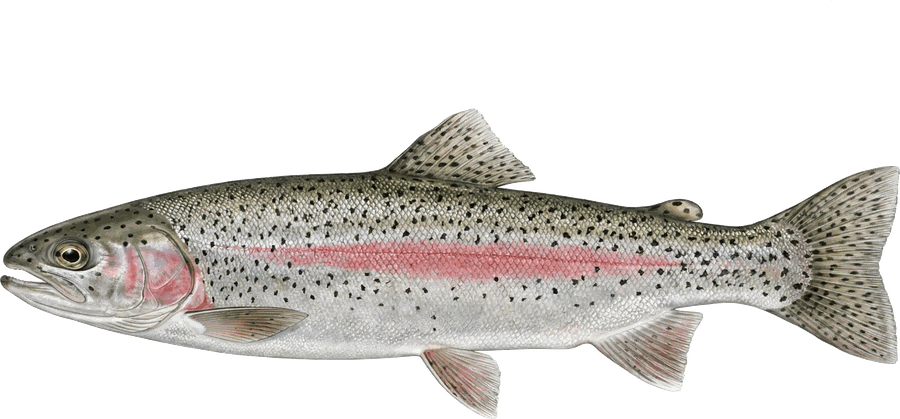
Bump Board's tactics library for Rainbow Trout — where to fish, what to tie on and how to fish it, season by season. In the app, these tips adapt live to the weather, the front and the light.
Rainbow Trout — Summer
Where to fish
- Summer rainbows track the comfort band — temperature plus oxygen, around 10–18 °C — and the thermocline is an oxygen barrier as much as a temperature layer; don't fish under it expecting life. The big summer chironomid emergences rise out of deep water: in the classic worked example, trout were feeding 3–5 ft off the bottom over 29 ft of water, on pupae coming up from as deep as 40 ft.
What to tie on
- Chironomid pupae at the sounder's depth, leeches for searching and for the summer doldrums, and the big subaquatic food patterns when they're hunting meat. Match lure and fly size to the food you can see — 'look over the side of the boat' is the whole selection method.
How to fish it
- Deep indicator work is the summer skill: leaders of 17–24 ft (a 25-ft leader in the master's own account), pupae hung at the depth the fish are showing, a slight breeze doing the moving. Or dangle a sinking line to 2 ft off bottom and wait for the rod to be nearly taken from you.
- Time the zones: rainbows travel between deep and shallow at dawn and dusk — the drop-offs at the light changes are the summer addresses for moving fish.
If it's still tough
- In the doldrums, leeches at first and last light, fished slow.
- And if the lake gives you nothing, a river will: tight-line nymphing through the pools and runs produces in the heat, and the biggest river fish can be provoked from their resting lies with a streamer worked with a jerk-strip — animate it by jerking the rod tip, not by pulling line.
Rainbow Trout — Fall
Where to fish
- Fall cools the shoals back into the comfort band and the fish return to the littoral zone and the drop-offs — the spring map, reversed. Lake fish concentrate where the food is as the insect year winds down: leeches, scuds and the last emergences along the shoals.
What to tie on
- Leeches move to the front in fall — the non-hatch searching choice and the low-light pattern in one. Chironomids still produce on the warm afternoons.
How to fish it
- Fish the shoal edges and drop-offs with the long-leader presentations, slow. Fall rainbows feed deliberately — the retrieves timed to the second matter more, not less, as the water cools.
If it's still tough
- When the lake is quiet, go to moving water: fall rivers fish well with nymphs and swung wet flies — the classic down-and-across swing with a hand-twist retrieve is a century old and still catches these fish.
Rainbow Trout — Spring
Where to fish
- Find the comfort water first: rainbows live where temperature and oxygen suit them — roughly the 10–18 °C band — and in a lake that's organised in three zones: the littoral shoals, the drop-offs, and the deep water. Spring puts them on the shoals and along the shoreline edges, where the food is.
- The stillwater master's first move costs nothing: look over the side of the boat. The food tells you where the fish are — rainbow trout feed mostly on aquatic insects, and the hatch is the map.
What to tie on
- Chironomids are the year-round stillwater staple — the pupa patterns (basic black-and-red is the type) fished as they ascend. Leeches are the searching pattern when there's no hatch, and the low-light pattern always. One disagreement we keep honest: a famous stillwater authority holds that trout feed only at shoreline edges and in the top foot of the surface, with deep fish merely resting — while the Kamloops school demonstrably catches feeding fish deep, on chironomid pupae ascending from as much as 40 ft. Both are in the books; if the edges are dead, the deep chironomid game is real and proven.
How to fish it
- The Kamloops trio of presentations: (1) Indicator fishing — the fly rides about 2 ft off bottom; deep work takes leaders of 17–24 ft, with the pupae suspended at the depth the sounder shows, and a slight breeze supplies the movement. (2) 'Naked' — floating line, long leader, no indicator, a very slow retrieve. (3) 'Dangling' — a sinking line lowered to about 2 ft off bottom; strikes are violent and the trout hook themselves.
- Retrieves in this canon are specified to the second — check your wristwatch. Slow means measured, not approximate.
- In rivers, read the water first: currents, rocks, pools, riffles, runs, bends. During a hatch, fish the emerger early; the exact-imitation school (Swisher & Richards) found their flat-floating patterns roughly twice as effective as hackled flies on selective fish — match the insect, not the catalogue. The 'pounds of meat' rule settles fly choice: fish take the food that gives the most food value for the least effort.
If it's still tough
- No hatch? The Balanced Leech is not just an indicator fly — cast and retrieved, it hops and pitches, and it's the proven no-hatch searcher.
- In rivers on the toughest days, remember where the biggest trout are: resting, in daylight, in the deep lies — they have to be provoked, not fed.
Rainbow Trout — Warm
Where to fish
- The water is above the comfort band — the fish have left for the cool, oxygenated layer, and the thermocline is a hard ceiling on their world: below it, oxygen fails. Fish the layer itself and the drop-offs that reach it, or don't fish rainbows at all today.
What to tie on
- Deep presentations only: chironomid pupae hung at the sounder's depth on very long leaders, or dangled lines at 2 ft off bottom in the comfort layer. Surface and shoal patterns are for cooler days.
How to fish it
- If you can't reach the comfort layer with your tackle, the honest answer is to fish the coldest part of the day — dawn — in the deepest part of the shoal zone, or switch water. Warm, oxygen-thin water stresses these fish; handle any you catch with extra care and release them quickly.
If it's still tough
- Springs and inflows are the warm-season refuges — where cold water enters, rainbows gather. Fish the inflow edges at first light.
Rainbow Trout on the ice — Through the ice season
Where to fish
- Under the ice, rainbows stay in their comfort water — the same temperature-and-oxygen thinking that runs their whole year. Shallower than the deep species, along the shoal and drop-off water they used in the fall.
What to tie on
- Being straight about the sources: rainbow-specific ice tactics were the thinnest ice coverage in tonight's library work. The one ice-fishing book in the canon covers trout — location, strategy, jigging and set lines, with sonar — but its rainbow-specific depths and baits weren't something we could verify, so we won't invent them.
How to fish it
- What carries over with confidence from the open-water canon: these are insect-eaters that feed by sight in the top of their world — small, natural presentations, fished slowly in the shoal zone, are the consistent-with-canon approach. For the rest, treat ice rainbows as the experiment they honestly are in the literature.
If it's still tough
- If the ice rainbows won't go, that's a genuinely under-documented fishery — the books leave it nearly blank. The proven cold-season rainbow fishing is the open water: late fall and early spring on the shoals.
Manitoba Master Angler
A Rainbow Trout of 51 cm (20 in) or better qualifies for Manitoba's Master Angler Program.
Where Rainbow Trout live
4,274 waters in the Bump Board dataset hold Rainbow Trout. A selection:
Manitoba
- Amphipod Lake
- Antons Lake
- Arrow Lake
- Bagguley Lake
- Barbe Lake
- Barren Lake
- Bear Lake
- Beautiful Lake
- Bell Pond
- Big Sand Lake
- Black Beaver Lake
- Blueberry Pond
- Boissevain Reservoir
- Bower Lake
- Cache Lake
- Camp Lake
- Cedar Pond
- Childs Lake
- Chocolate Lake
- Clearwater Lake
- Corstophine Lake
- Crater Lake
- Crowduck Lake
- Davidson Lake
Plus 100 more Manitoba waters — browse Manitoba lakes.
Ontario
- Achigan Creek
- Agonzon Lake
- Alaska's Lake
- Alder Creek
- Allan Park Trout Pond
- Allen Lake
- Allumette Lake
- Alps Creek
- Amable du Fond River
- Amanda Lake
- Anjigami Lake
- Anne L.
- Artemesia L. B
- Ausable River
- Austins Lake
- Axe Lake
- Baden P.s
- Badger Lake
- Bailey Lake
- Balancing Lake
- Banner Lake
- Barnard Lake
- Barry Lake
- Basin Lake
Plus 572 more Ontario waters — browse Ontario lakes.
Nova Scotia
Alaska
- Abercrombie Lake
- Airstrip Pond
- Alder Pond
- Anderson Lake
- Artillery Lake
- Aurora Lake
- Backdown Lake
- Ballaine Lake
- Barbara Lake
- Barley Lake
- Bathing Beauty Pond
- Beach Lake
- Bear Lake
- Bear Paw Lake
- Benka Lake
- Beverly Lake
- Big Beaver Lake
- Big D Pond
- Big Lake
- Big Noluck Lake
- Birch Lake
- Blueberry Lake
- Bluff Cabin Lake
- Bolio Lake
Plus 231 more Alaska waters — browse Alaska lakes.
Alabama
Arizona
- Ashurst Lake
- Bear Canyon Lake
- Big Lake
- Bunch Reservoir
- C.C. Cragin Reservoir
- Cataract Lake
- City Reservoir
- Dogtown Reservoir
- Hulsey Lake
- Knoll Lake
- Lynx Lake
- Riggs Lake
- Rose Canyon Lake
- Santa Fe Reservoir
- Upper Goldwater Lake
- Willow Springs Lake
- Woods Canyon Lake
California
- Adams Lake
- Agnew Lake
- Albert Lake
- Altha Lake
- Anne Lake
- Anne Lake
- Antelope Lake
- Arrowhead Lake
- Ashley Lake
- Avalanche Lake
- Bare Island Lake
- Barney Lake
- Battalion Lake
- Bear Lake
- Bear Lake
- Bear Twin Lakes
- Beauty Lake
- Beck Lakes
- Bench Lake
- Bench Lakes
- Beryl Lake
- Beyers Lakes
- Big Bear Lake
- Big Blue Lake
Plus 397 more California waters — browse California lakes.
Colorado
- Alexander Lake
- Andrews Lake
- Antero Reservoir
- Arrowhead Lake
- Atkinson Reservoir
- Aurora Reservoir
- Bailey Reservoir
- Balman Reservoir
- Barnes Meadow Reservoir
- Baron Lake
- Barr Lake
- Bear Creek Lake
- Bear Lake
- Beaver Creek Reservoir
- Beaver Lake
- Beaver Lake
- Beckwith Reservoir
- Bellaire Lake
- Berkeley Lake
- Big Creek Lakes
- Big Meadows Reservoir
- Blue Lakes
- Blue Mesa Reservoir
- Bonham Reservoir
Plus 198 more Colorado waters — browse Colorado lakes.
Connecticut
- Alexander Lake
- Amos Lake
- Andover Lake
- Aspetuck Reservoir
- Ball Pond
- Bantam Lake
- Bashan Lake
- Beach Pond
- Beachdale Pond
- Bigelow Pond
- Billings Lake
- Birge Pond
- Black Pond
- Black Pond
- Black Rock Pond
- Bunnells Pond
- Cedar Lake
- Colebrook River Lake
- Compensating Reservoir
- Cream Hill Lake
- Crystal Lake
- Day Pond
- Dodge Pond
- Foster Pond
Plus 48 more Connecticut waters — browse Connecticut lakes.
Georgia
Iowa
Idaho
- Alexander Reservoir
- Alturas Lake
- American Falls Reservoir
- Arrowrock Reservoir
- Ashton Reservoir
- Avondale Lake
- Baldy Lake
- Bayhorse Lake
- Ben Ross Reservoir
- Big Hazard Lake
- Big Trinity Lake
- Black Canyon Reservoir
- Black Lake
- Black Lake
- Blackfoot Reservoir
- Blackwell Lake
- Boulder Lake
- Boulder Meadows Reservoir
- Box Lake
- Brundage Reservoir
- Brush Lake
- Buckhorn Lake
- Bull Trout Lake
- C J Strike Reservoir
Plus 100 more Idaho waters — browse Idaho lakes.
Illinois
Indiana
Kentucky
- Beulah Lake
- Cannon Creek Lake
- Combs Lake
- Fagan Branch Lake
- Fishpond Lake
- Greenbo Lake
- Mill Creek Lake
- Paintsville Lake
- Wood Creek Lake
Massachusetts
Maryland
Maine
Michigan
- Ackerman Lake
- Algoe Lake
- Andrus Lake
- Arnold Lake
- Au Train Lake
- Baptist Lake
- Bass Lake
- Bear Den Lake
- Beatons Lake
- Beaver Lake
- Beaver Lake
- Big Blue Lake
- Big Cedar Lake
- Big Fish Lake
- Big Trout Lake
- Big Twin Lake
- Bills Lake
- Birch Lake
- Bird Lake
- Black Lake
- Blanchard Millpond
- Bob Lake
- Bridge Lake
- Bright Lake
Plus 169 more Michigan waters — browse Michigan lakes.
Minnesota
- Bad Medicine Lake
- Bean Lake
- Benjamin Lake
- Big Watab Lake
- Birch Lake
- Blacksmith Lake
- Blue Lake
- Blue Lake
- Bone Lake
- Briar Lake
- Chant Lake
- Clearwater Lake
- Corona Lake
- Crappie Lake
- Deep Lake
- Diamond Lake
- Divide Lake
- Echo Lake
- Esther Lake
- Extortion Lake
- Grindstone Lake
- Hanson Lake
- Hazel Lake
- High Lake
Plus 29 more Minnesota waters — browse Minnesota lakes.
Missouri
Mississippi
Montana
- Ackley Lake
- Ajax Lake
- Als Coulee Reservoir
- Anderson Reservoir
- Ayers Reservoir
- Bailey Lake
- Bair Reservoir
- Banana Lake
- Barrier Lake
- Bass Lake
- Bearpaw Lake
- Beaver Lake
- Big Bear Lake
- Big Brother Lake
- Big Lake
- Bighorn Lake
- Bill Lake
- Blackfoot Lake
- Blue Lake
- Blue Lake
- Blue Paradise Lake
- Bonanza Reservoir
- Bootjack Lake
- Bootjack Lake
Plus 222 more Montana waters — browse Montana lakes.
North Dakota
- Belfield Pond
- Camels Hump Lake
- Fish Creek Lake
- Hooker Lake
- Kettle Lake
- Moon Lake
- Mooreton Pond
- North Lemmon Lake
- Painted Woods Lake
- Strawberry Lake
Nebraska
- Ansley Reservoir
- Birdwood Lake
- Bowling Lake
- Chadron Reservoir
- Grove Lake
- Holmes Lake
- Ogallala Lake
- Rock Creek Lake
- Stanton Lake
New Hampshire
- Akers Pond
- Back Lake
- Barbadoes Pond
- Beaver Lake
- Berry Bay
- Bog Pond
- Boston Lot Lake
- Bow Lake
- Campton Pond
- Canaan Street Lake
- Canobie Lake
- Cedar Pond
- Center Pond
- Chocorua Lake
- Clark Pond
- Clough Pond
- Club Pond
- Coffin Pond
- Conway Lake
- Crescent Lake
- Crystal Lake
- Crystal Lake
- Davis Pond
- Deering Reservoir
Plus 85 more New Hampshire waters — browse New Hampshire lakes.
New Mexico
- Bill Evans Lake
- Bottomless Lakes
- Chaparral Lake
- Fenton Lake
- Green Meadow Lake
- Lake Van
- McGaffey Lake
- Monastery Lake
- Perch Lake
Nevada
- Adams-McGill Reservoir
- Angel Lake
- Bassett Lake
- Bilk Creek Reservoir
- Blue Lake
- Boies Reservoir
- Boulder Reservoir
- Cave Creek Reservoir
- Comins Lake
- Dacey Reservoir
- Dorsey Reservoir
- Dry Creek Reservoir
- Eagle Valley Reservoir
- Echo Canyon Reservoir
- Fort Churchill Cooling Ponds
- Granite Mountain Reservoir
- Groves Lake
- Hinkson Slough
- Hobart Creek Reservoir
- Illipah Creek Reservoir
- Knott Creek Reservoir
- Marlette Lake
- Onion Valley Reservoir
- Ruby Lake Unit Twenty-one
Plus 10 more Nevada waters — browse Nevada lakes.
New York
- Argyle Lake
- Arnold Lake
- Ashokan Reservoir
- Bass Lake
- Belmont Lake
- Big Pond
- Brant Lake
- Bullhead Pond
- Canaan Lake
- Canada Lake
- Canadice Lake
- Canandaigua Lake
- Cayuga Lake
- Chazy Lake
- Connery Pond
- Dead Lake
- Eaton Reservoir
- Edgecomb Pond
- Eighth Lake
- First Lake
- Gilbert Lake
- Gilman Lake
- Glass Lake
- Glen Lake
Plus 53 more New York waters — browse New York lakes.
Ohio
- Adams Lake
- Belmont Lake
- Caldwell Lake
- City Reservoir
- Clark Lake
- Clouse Lake
- Dow Lake
- Evergreen Lake
- Forked Run Lake
- Friendship Park Lake
- Grand Lake
- Greenfield Lake
- Hammertown Lake
- Hargus Lake
- Hinckley Lake
- Hocking Hills Reservoir
- Jackson Lake
- Jefferson Lake
- Knox Lake
- Lake Alma
- Lake Ann
- Lake Erie
- Lake Vesuvius
- Lima Reservoir
Plus 19 more Ohio waters — browse Ohio lakes.
Oregon
- Agate Reservoir
- Alder Lake
- Allotment Reservoir Number Three
- Ana Reservoir
- Aneroid Lake
- Antelope Flat Reservoir
- Anthony Lake
- Applegate Lake
- Azalea Lake
- Babyfoot Lake
- Badger Lake
- Balm Creek Reservoir
- Battle Lake
- Bay City Reservoir
- Becker Ponds
- Benson Lake
- Betty Lake
- Beulah Reservoir
- Big Cliff Reservoir
- Big Lake
- Big Rock Reservoir
- Blue Lake
- Blue Lake
- Blue Lake
Plus 377 more Oregon waters — browse Oregon lakes.
Pennsylvania
Rhode Island
- Alton Pond
- Barber Pond
- Browning Mill Pond
- Carbuncle Pond
- Carolina Trout Pond
- Meadow Brook Pond
- Olney Pond
- Shippee Sawmill Pond
- Silver Spring Lake
- Simmons Pond
- Spring Grove Pond
- Stafford Pond
- Tarkiln Pond
- Tucker Pond
- Watchaug Pond
- Willett Pond
South Carolina
South Dakota
- Bismark Lake
- Canyon Lake
- Center Lake
- Cottonwood Springs Lake
- Cox Lake
- Dalton Lake
- Deerfield Lake
- Iron Creek Lake
- Lakota Lake
- Legion Lake
- Major Lake
- Mitchell Lake
- Pactola Reservoir
- Reausaw Lake
- Roubaix Lake
- Sheridan Lake
- Sylvan Lake
Tennessee
Utah
- Adams Reservoir
- Baker Reservoir
- Big East Reservoir
- Birch Creek Reservoirs
- Boulger Reservoir
- Box Lake
- Brough Reservoir
- Browne Lake
- Burriston Ponds
- Causey Reservoir
- Cleveland Reservoir
- Crouse Reservoir
- Currant Creek Reservoir
- Deep Lake
- Deer Creek Reservoir
- Dons Lake
- East Canyon Reservoir
- East Park Reservoir
- Echo Reservoir
- Electric Lake
- Emerald Lake
- Fairview Lakes
- Ferron Reservoir
- Fish Lake
Plus 76 more Utah waters — browse Utah lakes.
Virginia
Vermont
- Amherst Lake
- Bald Hill Pond
- Black Pond
- Caspian Lake
- Crystal Lake
- Echo Lake
- Echo Lake
- Ewell Pond
- Forest Lake
- Harvey Lake
- Holland Pond
- Island Pond
- Joes Pond
- Kent Pond
- Knapp Brook Pond Number One
- Lake Bomoseen
- Lake Champlain
- Lake Dunmore
- Lake Fairlee
- Lake Memphremagog
- Lake Paran
- Lake Parker
- Lake Raponda
- Lake Rescue
Plus 15 more Vermont waters — browse Vermont lakes.
Washington
- Aeneas Lake
- Aldrich Lake
- Alta Lake
- Amber Lake
- American Lake
- Ancient Lake
- Anderson Lake
- Angle Lake
- Badger Lake
- Baker Lake
- Banks Lake
- Barclay Lake
- Battle Ground Lake
- Bay Lake
- Bayley Lake
- Bear Lake
- Beaver Lake
- Beaver Lake
- Beaver Lake
- Benson Lake
- Beth Lake
- Big Meadow Lake
- Big Twin Lake
- Billy Clapp Lake
Plus 362 more Washington waters — browse Washington lakes.
Wyoming
- Adelaide Lake
- Alcova Reservoir
- Alice Lake
- Allen Lake
- Alsop Lake
- Barbara Lake
- Barber Lake
- Bear Lake
- Beaver Lakes
- Beck Lake
- Bertha Lake
- Beulah Belle Lake
- Big Milky Lake
- Big Sandy Reservoir
- Bighorn Lake
- Black Hills Power and Light Reservoir
- Bosler Reservoir
- Boulder Lake
- Boysen Reservoir
- Brooks Lake
- Brown Bear Lake
- Brown Number 1 Reservoir
- Buffalo Bill Reservoir
- Burlington Lake
Plus 171 more Wyoming waters — browse Wyoming lakes.
Alberta
- Acadia Valley
- Acadia Valley Reservoir
- Airdrie
- Alexander
- Alford Lake
- Ardmore
- Ardmore Community Pond
- Ashland Reservoir
- Athabasca
- Atlantic Richfield
- Atlantic Richfield Reservoir
- Barrhead
- Bashaw Pond
- Bathing Lake
- Bear Pond
- Beauvais Lake
- Beaver Lake
- Beaver Mines Lake
- Bellis Beach Lake
- Birch Lake
- Black Nugget Mine
- Black Nugget Mine Pit
- Blairmore
- Blood Indian Creek
Plus 372 more Alberta waters — browse Alberta lakes.
Saskatchewan
- Battle Creek Cypress Hills Interprov. Park
- Belanger Creek 12 km SE of Cypress Hill Prov. Park
- Bell Pond 1 km S of Luseland
- Bill's Lake 30 km E of Reserve
- Camp 10 Lake Km 2, Hwy #916
- Constance Lake 13 km SW of Mont Nebo
- David Laird Pond 1 km E of North Battleford
- Deer Lake 12 km NE of Leoville
- Denzil Pond Denzil
- Dog Lake Hwy #916, km 16 Rock Lake Rd
- Dr. Mainprize Pond 16 km S of Halbrite
- Eagle Creek Pond Eagle Creek Regional Park
- Etomami River 20 km SW of Hudson Bay (town)
- Exner Lake 8 km S of Loon Lake (town)
- Fern Lake S of Keeley Lake, N of Meadow Lake
- Five Mile Dam 8 km S of Gull Lake (town)
- Hudson Bay A-Borrow Pit 2 km E of Hudson Bay (town)
- Kerrobert Reservoir 1 km SW of Kerrobert
- Kipling Reservoir 9 km SW of Kipling
- Lisieux Pond 1 km S of Lisieux
- Lloydminster Pond 11 km SE of Lloydminister
- Loch Leven Cypress Hills Interprov. Park
- Luseland Pond 1.5 km SE of Luseland
- Maidstone Pond Maidstone
Plus 25 more Saskatchewan waters — browse Saskatchewan lakes.