Fishing tips & tactics
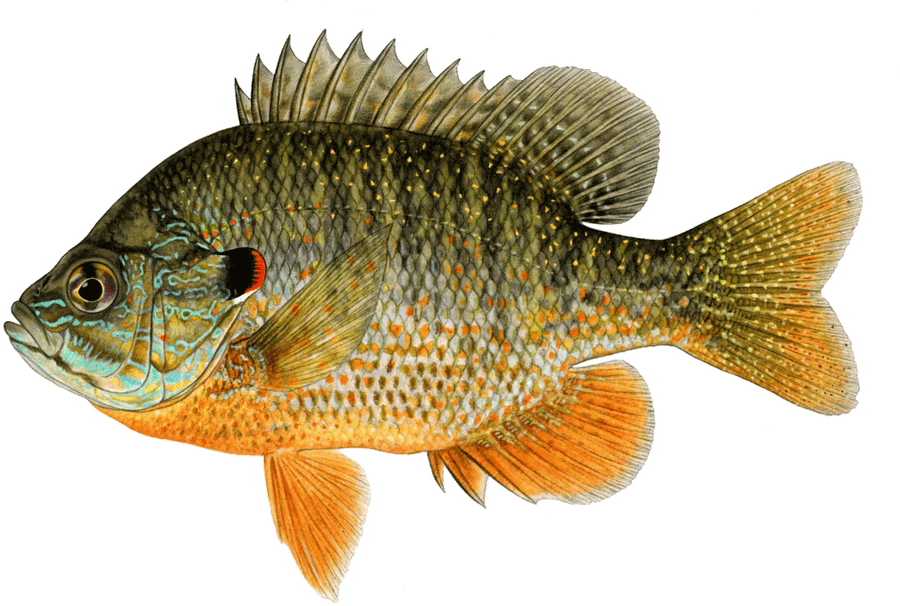
How to catch Pumpkinseed
Lepomis gibbosus
Bump Board's tactics library for Pumpkinseed — where to fish, what to tie on and how to fish it, season by season. In the app, these tips adapt live to the weather, the front and the light.
Pumpkinseed — Prespawn
Where to fish
- As the water climbs through the low teens toward the ~15 °C nest-building onset, pumpkinseed move into the shallow, vegetated littoral they will nest in — colonies form on sand and gravel in water from about 15 cm deep to a few feet. Fish the vegetated shallows near that nesting ground; this species stages in its feeding habitat, close to where it will spawn.
- In streams the habitat record is specific: adults hold near the bank in the clearer, slower water, with plant cover and woody structure over sand — and avoid riffles, deep water and high velocity. Fish the quiet, covered bank water, not the runs.
What to tie on
- Small offerings matched to the measured diet at this size and season: the young and smaller fish feed in the vegetation on insect larvae and other vegetation-dwelling invertebrates, and chironomids run through the diet all year. No lure is named in the pumpkinseed literature, and none is invented here — small, natural, and presented in the vegetation at close range is the whole supported tackle story for a visual, encounter-driven littoral feeder.
How to fish it
- Time the day by this species' own clock, not bluegill's: pumpkinseed feeding peaks at dawn and dusk on a solid daylight base — the stomach studies agree on the twin peaks. Be set up on the shallows at the light changes, and fish the warming middle of the day as a real second shift, not a wait for evening.
- Below about 8 °C, expect the measured floor: spontaneous activity collapses toward a minimum at 7.9 °C and feeding drops markedly below it. Cold prespawn fish are a patience pattern — slow, close presentations in the warmest shallow water you can find.
If it's still tough
- If the shallows are empty, the temperature has not arrived — nest-building is temperature-gated from ~13–15 °C, so drop to the first edge off the nesting flats and wait for the water rather than changing baits.
Pumpkinseed — Spawn
Where to fish
- The spawn is a colony season: nests in colonies of about 3–15, on sand and gravel in water from about 15 cm to a few feet deep, each nest roughly twice the fish's length (about 10–38 cm across), often in or beside bluegill colonies. Onset is around 15 °C with the main band at 17–25 °C, and the colonies pulse in repeated bouts of about 10–11 days from May into August — there is almost always a fresh wave of nesting fish somewhere in the window.
What to tie on
- Offerings sized to the littoral menu — insect larvae and the small benthic invertebrates of the nesting shallows — worked in and around the beds. The adult specialisation on snails (below) is a feeding-ground pattern; on the colonies themselves, size to the small invertebrate food the shallows hold. No spawn-specific lure is named in the literature.
How to fish it
- Fish the light changes hardest: guarding males feed measurably less than females, and what feeding they do is concentrated at dawn and dusk near the nest — the twin peaks are the spawn clock as much as the summer one. And the guard-state rule, stated as the rating states it: a male that charges a bait on the nest is defending, not feeding — strikes on nests are aggression, and the entry says so rather than dressing them up as a bite pattern.
If it's still tough
- Between bouts the colonies thin — parental males sit out their 10–11-day bout feeding little, then the next wave builds. Check the edges just off the colony and the neighbouring bluegill beds before you conclude the spawn is done; with bouts running May to August, it pulses rather than ends.
Pumpkinseed — Summer
Where to fish
- Summer pumpkinseed are littoral, vegetation-oriented fish working the shallows for a benthic menu — and they are the cooler cousin, measurably: their modern measured temperature preference sits at about 22–25 °C with the model's plateau at 22–27 °C, roughly 5 °C cooler than bluegill's, and avoidance begins above about 31 °C. In hot weather, fish the shaded, vegetated shallows and the cooler bays rather than assuming a sunfish wants the warmest water in the lake.
- River fish hold the same address as spring: near-bank, clearer, slower water with plant cover and wood over sand, out of the riffles and the fast water.
What to tie on
- Fish the measured adult diet, because it is this species' defining science: large pumpkinseed are mollusc specialists — adult diets averaged 63–73% snails by mass — crushing them with a specialised pharyngeal mill, alongside chironomids, other insect larvae and crustaceans; small fish stay on vegetation invertebrates. Bottom-and-vegetation presentations sized to snails and larvae are the supported pattern. One lake-to-lake warning the research is explicit about: feeding performance is gated by the individual lake's snail fauna and the fish's crushing morphology — a snail-rich lake's fish feed on snails at roughly twice the rate of a snail-poor lake's. No lure is named in the pumpkinseed literature, and none is invented here.
- A seasonal surprise worth a cast: in late spring and summer, several Ontario pond populations fed extensively on small fish (brook stickleback) where bass were absent. Where small forage fish crowd the shallows, a small fish-profile offering is diet-supported, not a guess.
How to fish it
- Dawn and dusk are the peaks — three independent stomach studies put fullness highest at the light changes — with a solid daylight base between them (the model's day value is 0.85, not a lull). Work the vegetation edges thoroughly at the transitions; the prey here does not migrate up and down the column the way bluegill's zooplankton does, so the fish stay on the littoral food rather than chasing it into open water.
- Clarity is a location rule with a direction but no dose–response: adults select the less turbid water. In stained conditions, fish the clearest shallows you can find and put the bait closer and slower — the study measures the preference, not a distance, and the entry invents none.
- Oxygen is this fish's quiet advantage: head-to-head, pumpkinseed tolerated significantly lower dissolved oxygen than bluegill, and nests function at bottom oxygen down to about 2.4 mg/L. In a hot, still basin where other panfish have vacated the bottom, pumpkinseed may still be there — check the low-oxygen shallows other entries tell you to abandon.
If it's still tough
- If summer fish look but won't take, shrink and slow in place — a visual feeder refusing a bait it can see is giving a size-and-speed verdict. And if the water has pushed past the low 30s °C, you are above the preference plateau and into the avoidance zone: find cooler water before you change a single bait.
Pumpkinseed — Fall
Where to fish
- Fall pumpkinseed keep feeding in the littoral as it cools — the October river record shows feeding continuing, spread across the day — sliding toward the deeper, stiller water as the temperature falls toward the winter pattern. Fish the deep edges off the summer vegetation while the water is still above the floor, and the warmest still shallows as it drops.
What to tie on
- The summer menu, a step smaller and slower: larvae and benthic invertebrates in the vegetation, snail-sized bottom offerings where the snail beds are. Cooling shortens the effective feeding day for a dawn/dusk fish — concentrate the best presentations at the light changes.
How to fish it
- The twin peaks still run the day in fall, and the floor is coming: activity holds until the water nears about 8 °C, then collapses toward the 7.9 °C minimum. Fish the warmest part of the shallows on cold days and give located pockets real time — cooling fish move little.
If it's still tough
- If the fall shallows are silent, check the temperature before the tackle: below the 7.9 °C floor this species is measured to be minimally active, and the fix is the warmest water in the system, not a new presentation.
Pumpkinseed — Winter
Where to fish
- Winter pumpkinseed keep feeding — that is measured, not folklore: 88% of juvenile pond fish sampled mid-winter contained prey, and February field fish in Ontario ponds were trappable and feeding. The pattern is reduced and oxygen-gated, not dormant: fish hold at low activity below the 7.9 °C floor, in the still water that still carries oxygen. Canadian, long-winter populations benefited most from winter feeding in the trials — at the northern edge of the range, this is a genuinely winter-active panfish.
What to tie on
- Small and slow, delivered close in the still, oxygenated pockets. Winter consumption is a fraction of summer's, so the presentation has to arrive at the fish — this is not a searching season, and no winter-specific lure is named in the literature.
How to fish it
- Fish the dawn and dusk edges of the short day first, per the species' year-round twin peaks, and give each located pocket real time — winter fish move little, so finding them is most of the catch. The oxygen gate is the location rule with this species' own numbers: winterkill risk binds at very low oxygen (the reported lethal band is about 0.4–2.0 mg/L, and live pumpkinseed were observed congregating at ice holes after a week below 1.0 mg/L) — they outlast bluegill down that gradient, so the last fishable pockets in a depleting basin are likelier to hold pumpkinseed than anything else.
If it's still tough
- If a winter pocket is dead, it is usually the oxygen, not the bait — move toward better-oxygenated water. And know the limit honestly: a severe winterkill removed 85% of one studied population, so in a basin with a winterkill history, absence is a population fact, not a tactics failure.
Pumpkinseed on the ice — Through the ice season
Where to fish
- The ice set for pumpkinseed is issued, capped at Moderate confidence, and the entry carries that flag openly — the same ruling bluegill received, on stronger winter evidence: winter feeding is measured (88% of mid-winter pond juveniles contained prey), the 7.9 °C activity floor is measured, and the oxygen-risk gradient below is this species' own. What has never been measured is the under-ice diel curve, so the timing below is the open-water dawn/dusk shape carried under the ice as a labelled within-species transfer. Fish the still, vegetated shallows and their deep edges, in the water that still holds oxygen.
What to tie on
- Small, natural offerings fished close and still in the located pockets — the open-water diet (larvae and small benthic invertebrates) at its smallest. No ice-specific presentation is measured for this species; small and slow is the winter evidence applied honestly, not an ice finding.
How to fish it
- Work the light changes first, on the transferred twin-peak pattern, and treat oxygen as the address: pumpkinseed tolerate lower oxygen than bluegill head-to-head, with a winter lethal band around 0.4–2.0 mg/L, so as a basin depletes through the winter they persist in pockets other panfish have left — fish deeper into the low-oxygen shallows than bluegill habits suggest, and check the inflow and ice-hole water in a stressed lake.
If it's still tough
- Mid-winter silence is usually the oxygen gate or a winterkill history, not presentation: this species survives low oxygen better than its cousins but is not immune (one winterkill removed 85% of a population). Move toward better-oxygenated water before you change baits — and if the whole basin is depleted, that is the honest end of the pattern.
Where Pumpkinseed live
6,833 waters in the Bump Board dataset hold Pumpkinseed. A selection:
Manitoba
Ontario
- 5PB10-102, L.
- 5PB17-82, L.
- A.Y. Jackson Lake
- Aaron Lake
- Ada Lake
- Adams Lake
- Adams Lake
- Adelard Lake
- Adele Lake
- Agnew Lake
- Ahmic Lake
- Aide Lake
- Aileen Lake
- Airy Lake
- Albert Lake
- Albion Lake
- Alder Creek
- Alder Lake
- Alder Lake
- Aleck Lake
- Alexander Lake
- Allans L.
- Allen Lake
- Allen Lake
Plus 2,822 more Ontario waters — browse Ontario lakes.
Colorado
Connecticut
- Alexander Lake
- Amos Lake
- Amston Lake
- Anderson Pond
- Andover Lake
- Angus Park Pond
- Ashland Pond
- Aspetuck Reservoir
- Aspinook Pond
- Avery Pond
- Babcock Pond
- Bailey Pond
- Baldwins Pond
- Ball Pond
- Baltic Reservoir
- Bantam Lake
- Barber Pond
- Barkhamsted Reservoir
- Bashan Lake
- Batterson Park Pond
- Baummer Pond
- Beach Pond
- Beachdale Pond
- Beseck Lake
Plus 225 more Connecticut waters — browse Connecticut lakes.
Delaware
- Abbotts Pond
- Andrews Lake
- Blairs Pond
- Concord Pond
- Derby Pond
- Garrisons Lake
- Ingram Pond
- Killen Pond
- McColley Pond
- Millsboro Pond
- Moores Lake
- Mud Millpond
- Raccoon Pond
- Tubmill Pond
Iowa
Idaho
- Anderson Lake
- Avondale Lake
- Black Lake
- Blue Lake
- C J Strike Reservoir
- Campbell Ponds
- Carey Lake
- Chase Lake
- Cocolalla Lake
- Coeur d'Alene Lake
- Crane Creek Reservoir
- Crane Falls Lake
- Dawson Lake
- Dog Creek Reservoir
- Dunes Lake
- Dworshak Reservoir
- Elk Creek Reservoir
- Emerald Lake
- Fernan Lake
- Freeman Lake
- Gamlin Lake
- Granite Lake
- Hauser Lake
- Jewel Lake
Plus 21 more Idaho waters — browse Idaho lakes.
Indiana
- Adams Lake
- Appleman Lake
- Ball Lake
- Banning Lake
- Bass Lake
- Baugher Lake
- Bear Lake
- Beaver Dam Lake
- Bell Lake
- Big Lake
- Big Long Lake
- Big Otter Lake
- Bixler Lake
- Blue Lake
- Bower Lake
- Buck Lake
- Cass Lake
- Cedar Lake
- Cedar Lake
- Cook Lake
- Cree Lake
- Crooked Lake
- Diamond Lake
- Dixon Lake
Plus 73 more Indiana waters — browse Indiana lakes.
Massachusetts
- Aldrich Lake
- Althea Lake
- Alum Pond
- Ames Long Pond
- Arcadia Lake
- Ashfield Pond
- Ashland Reservoir
- Ashmere Lake
- Asnacomet Pond
- Baddacook Pond
- Badluck Lake
- Baker Pond
- Baldpate Pond
- Bare Hill Pond
- Barret Pond
- Barrett Pond
- Bartlett Pond
- Beaver Pond
- Beck Pond
- Bell Pond
- Benedict Pond
- Benton Pond
- Berry Pond
- Big Bearhole Pond
Plus 254 more Massachusetts waters — browse Massachusetts lakes.
Maryland
- Adkins Pond
- Deep Creek Lake
- Leonard Pond
- Rising Sun Community Pond
- Tuckahoe Lake
- Unicorn Mill Pond
- Urieville Community Lake
- Wye Mills Community Lake
Maine
- Adams Pond
- Allen Pond
- Basin Pond
- Basin Pond
- Beddington Lake
- Belden Pond
- Berry Pond
- Big Greenwood Pond
- Biscay Pond
- Bonny Eagle Pond
- Bowler Pond
- Bradbury Lake
- Brainard Pond
- Branch Pond
- Brettuns Pond
- Browns Pond
- Buker Pond
- Burden Pond
- Burgess Pond
- Cain Pond
- Carlton Pond
- Carry Pond
- Center Pond
- Chamberlain Pond
Plus 229 more Maine waters — browse Maine lakes.
Michigan
- Adams Lake
- Alderman Lake
- Aleck Lake
- Algoe Lake
- Algonquin Lake
- Allen Lake
- Alley Lake
- Ambrose Lake
- Anderson Lake
- Appleton Lake
- Archer Lake
- Arnold Lake
- Au Sable Lake
- Au Train Lake
- Austin Lake
- Avalon Lake
- Badger Lake
- Bailey Lake
- Baker Lake
- Bald Eagle Lake
- Baldwin Lake
- Baldy Lake
- Baptist Lake
- Bar Lake
Plus 895 more Michigan waters — browse Michigan lakes.
Minnesota
- Achman Lake
- Adney Lake
- Airport Lake
- Aitkin Lake
- Albion Lake
- Alden Lake
- Alger Lake
- Alice Lake
- Amelia Lake
- Anderson Lake
- Andrew Lake
- Andrusia Lake
- Ann Lake
- Annie Battle Lake
- Antler Lake
- Apple Lake
- Armstrong Lake
- Arrowhead Lake
- Arrowhead Lake
- Arthur Lake
- Ash Lake
- Astrid Lake
- Baby Lake
- Bachelor Lake
Plus 1,538 more Minnesota waters — browse Minnesota lakes.
Montana
- Alvord Lake
- Anita Reservoir
- Arapooish Pond
- Banana Lake
- Big McNeil Slough
- Bighorn Lake
- Blanchard Lake
- Blue Lake
- Bootjack Lake
- Bootjack Lake
- Broadview Pond
- Bull Lake
- Bull Lake
- Canyon Ferry Lake
- Church Slough
- Crystal Lake
- Fennon Slough
- Fish Lake
- Flathead Lake
- Fort Peck Lake
- Fresno Reservoir
- Gartside Reservoir
- Glen Lake
- Halfmoon Lake
Plus 41 more Montana waters — browse Montana lakes.
North Carolina
Nebraska
New Hampshire
- Ashuelot Pond
- Ayers Pond
- Badger Pond
- Bagley Pond
- Balch Pond
- Barville Pond
- Beaver Pond
- Berry Bay
- Berry Pond
- Black Pond
- Bolster Pond
- Canobie Lake
- Captain Pond
- Cass Pond
- Center Pond
- Chocorua Lake
- Clapp Pond
- Contoocook Lake
- Country Pond
- Craney Pond
- Crooked Pond
- Crystal Lake
- Cummins Pond
- Cunningham Pond
Plus 58 more New Hampshire waters — browse New Hampshire lakes.
New York
- Alexander Lake
- Ann Lee Pond
- Arnold Lake
- Ballston Lake
- Big Pond
- Black River Pond
- Blue Mountain Lake
- Bradley Lake
- Brant Lake
- Buck Pond
- Burden Lake
- Canada Lake
- Canadarago Lake
- Canadice Lake
- Canandaigua Lake
- Cassadaga Lakes
- Cayuga Lake
- Cayuta Lake
- Cazenovia Lake
- Chase Lake
- Chazy Lake
- Chenango Lake
- Church Pond
- Cod Pond
Plus 134 more New York waters — browse New York lakes.
Oregon
- Agency Lake
- Blue Lake
- Drews Reservoir
- Galesville Reservoir
- Harpold Reservoir
- Howard Prairie Lake
- Keene Creek Reservoir
- Lake Selmac
- McClure Lake
- Oxbow Reservoir
- Round Valley Reservoir
- Triangle Lake
- Upper Klamath Lake
- Willow Creek Reservoir
Pennsylvania
- Acme Lake
- Bear Gap Reservoir
- Bearwallow Pond
- Beltzville Lake
- Black Moshannon Lake
- Blue Marsh Lake
- Boyertown Reservoir
- Canoe Creek Lake
- Chapman Dam Reservoir
- City Reservoir
- Clear Lake
- Cloe Lake
- Colyer Lake
- Conemaugh River Lake
- Conneaut Lake
- Cooks Pond
- Cowans Gap Lake
- Crooked Creek Lake
- Curwensville Lake
- Duck Harbor Pond
- Duman Lake
- East Branch Clarion River Lake
- Edinboro Lake
- Elmhurst Reservoir
Plus 96 more Pennsylvania waters — browse Pennsylvania lakes.
Rhode Island
South Dakota
Virginia
- Bark Camp Lake
- Elkhorn Lake
- Harrison Lake
- Harwoods Mill Reservoir
- Hunting Run Reservoir
- Lake Culpeper
- Lake Laura
- Lake Robertson
- Skidmore Fork Lake
Washington
- Antilon Lake
- Bass Lake
- Battle Ground Lake
- Bay Lake
- Big Lake
- Blackmans Lake
- Bonney Lake
- Bonnie Lake
- Bosworth Lake
- Boundary Lake
- Chain Lake
- Chapman Lake
- Clark Pond
- Clear Lake
- Clear Lake
- Coffeepot Lake
- Coffin Lake
- Crescent Lake
- Davis Lake
- Deer Lake
- Diamond Lake
- Dry Lake
- Eloika Lake
- Fan Lake
Plus 69 more Washington waters — browse Washington lakes.