
Fishing tips & tactics
How to catch Lake Sturgeon
Acipenser fulvescens
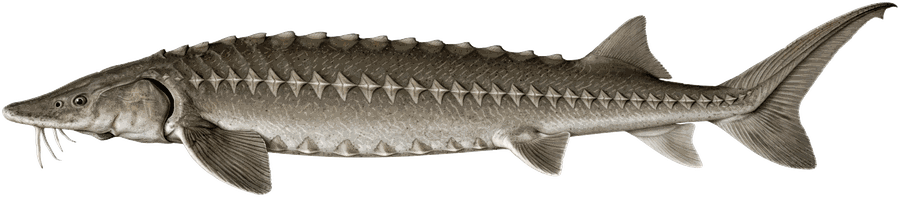
Bump Board's tactics library for Lake Sturgeon — where to fish, what to tie on and how to fish it, season by season. In the app, these tips adapt live to the weather, the front and the light.
Lake Sturgeon — Prespawn
Where to fish
- Prespawn sturgeon are travellers held back by cold: telemetry fish made no movement through shallow rapids and falls below about 6.8 °C, and the spring pattern builds as the water climbs toward the roughly 10 °C spawning onset. Fish the deep holding water below the spawning reaches and the travel routes between winter and spawning water.
- Fish this season as an encounter, not a harvest: in Manitoba lake sturgeon are catch-and-release only, with a zero daily and possession limit province-wide — every prespawn fish you meet is a fish to release. A big prespawn female may be well over 24 years old — that is the usual age of first maturity — and she spawns only once every 4–9 years.
- The spawning reaches they are travelling toward are specific water: the 48-site record puts peak suitability at a depth-averaged flow near 0.6 m/s over cobble of about 64–256 mm, in roughly 0.55–0.85 m of water in smaller systems and 0.75–5.25 m in larger ones. Prespawn effort belongs in the staging water below that kind of reach, not on the cobble itself.
What to tie on
- No lure is named for lake sturgeon in the research behind this entry, and none is invented here: the supported menu is bottom food — chironomids, burrowing mayflies of the Hexagenia kind, amphipods, crayfish and molluscs — found by a fish that feeds without sight, using barbels, taste, touch and electrosense over mud, sand and silt-clay. Bottom presentations carrying natural scent and flavour are the diet applied to tackle; visual flash is a language this fish does not feed by.
- Know the selectivity under the generalist label: in the Ft. Loudoun juvenile work, chironomids were 93–96% of prey by number and were taken selectively, even where other invertebrates were abundant. Small and chironomid-like on the bottom is a measured starting point, not a guess.
How to fish it
- Let the thermometer pace the search: adult movement tracks water temperature closely — the Black Lake telemetry correlation was about 0.94 — so each degree of spring warming is literally more fish moving, farther. Cover the staging water more widely as the water rises; fish it as a few holding spots while it stays cold.
- Do not build the prespawn day around a feeding window: the only adult telemetry found no daily rhythm at all, and the model's adult shape is near-flat with only a slight night lean. Fish the hours you can fish, thoroughly — the adult record does not support waiting for dark.
If it's still tough
- If prespawn fish will not take, leave the spawning run its room anyway: only about 10–20% of adults spawn in any given season, the rest are feeding fish somewhere else in the system, and the honest move is to look for the non-spawning majority in holding and feeding water rather than pressing the concentrated travellers.
- In the coldest prespawn water — below the roughly 6.8 °C movement line — expect fish to be where winter left them, moving little. Fish the deep pools slowly and close; covering water is a warm-water tactic.
Lake Sturgeon — Spawn
Where to fish
- Spawning runs April–June, starting near 10 °C with the main band at roughly 12–18 °C depending on latitude — and the conservation frame is part of the location, prominently: Manitoba is zero-limit catch-and-release only for this fish, province-wide, and the Winnipeg River has been under a full conservation closure since 1994, with no fishing for sturgeon at all in that system. A high rating in the spawn window is an activity rating, never a harvest opportunity.
- Spawning fish are concentrated in shallow, fast water — the species at its most encounterable and its most protected at the same moment. Encounterability at the spawn is aggregation, not feeding, and this entry scores it as a location fact with no feeding bonus — and treats the beds themselves as water to stay off.
- On the spawning reaches, the measured address is cobble of about 64–256 mm at a peak-suitability flow near 0.6 m/s, within a suitable band of roughly 0.5–1.5 m/s, in water from under a metre deep in smaller systems to several metres in large ones. Fish the staging and resting water beside that cobble, where travelling and spent fish hold, rather than the active bed.
What to tie on
- There is no spawn bait story to tell honestly: whether spawning sturgeon fast has never been measured for this species — no stomach or ration study spans the migration — so no spawn offering and no spawn suppression are invented here. Keep the bottom menu of the prespawn entry — chironomids and other benthic invertebrates — for the feeding, non-spawning share of the population.
- The same honesty runs the other way: with only 10–20% of adults spawning in a season, most fish in spawn-season water are not spawners at all, and a bottom offering fished in staging and feeding water is fishing for those fish — not a technique aimed at fish on the beds.
How to fish it
- Handle spawn-season fish as the conservation block directs, because these are the breeders: keep the fish in the water, support it horizontally, never lift it by the gills or tail alone, and release it immediately. A female you release this spring may not spawn again for 4–9 years — the release, done right, is the whole value of the encounter.
- Fish the spawn as a migration to intercept, not a bed to work: fish move up to the reaches, spawn, and disperse to feeding areas, and the telemetry pattern is travel and staging. The resting pools and slower holding water beside the runs are where a bottom presentation meets a fish that is pausing, not performing.
If it's still tough
- If the spawn water is crowded with fish that will not take, remember the designations before you press harder: the Manitoba-relevant units — Nelson River, Red–Assiniboine–Lake Winnipeg, and Winnipeg River–English River among them — are assessed Endangered, within a national picture of Endangered (DU1–5), Special Concern (DU6–7) and Threatened (DU8). Concentrated spawners that refuse are a population to admire and leave; the feeders are the dispersed fish.
- If nothing is on the reaches yet, check the temperature against the band: onset is near 10 °C and the main band is roughly 12–18 °C, falling with latitude. Early is a staging pattern in deep water below; late is a postspawn pattern — the calendar alone does not open this season.
Lake Sturgeon — Postspawn
Where to fish
- Post-spawn fish disperse to feeding areas — that is the telemetry chronology — and non-spawners, the majority in any year, never left the feeding water at all. The postspawn pattern is a spreading one: start near the spawning reaches and work outward into the summer feeding water as the days pass.
- The release rule does not relax after the spawn: Manitoba's zero limit is province-wide and year-round, and a spent female leaving the beds may not spawn again for 4–9 years. Every postspawn encounter is still catch-and-release, handled in the water and let go at once.
- The temperature is now entering the model's plateau at roughly 16–19 °C — the top of the agency preference family (about 10–18 °C) and the top of the spring migration band (13–19 °C). Postspawn fish in this band are the most active sturgeon of the year so far.
What to tie on
- Feed the recovering fish the full benthic menu: the Black Lake adult summer diet by biomass ran to Hexagenia burrowing mayflies, leeches, chironomids, crayfish and caddis larvae — a rich bottom menu over the muck and soft bottoms the fish prefer. Bottom offerings with natural scent, sized to that menu, are the supported pattern; no specific lure is named in the research.
- Keep the offering on the bottom and in contact with it: this fish finds food by barbel chemistry, touch and electrosense, including prey hidden beneath sandy substrate. A presentation travelling up in the column is fishing past the senses that do the feeding.
How to fish it
- Cover water now: summer-bound adults ranged widely in the telemetry record — daily movements ran from tens of metres to nearly 6.9 km, rising with temperature. A postspawn search is a mobile search along soft-bottom feeding water, not a vigil over one pool.
- Do not wait for clear water — this fish is built for the opposite: sturgeon feed by smell, touch and electrosense, and in the controlled contrast, young fish foraged more at about 22.5 NTU than in clear water at 0.1 NTU. Postspawn fish in stained water are not disadvantaged feeders; fish the bottom food where it lives, clear or not.
If it's still tough
- If postspawn fish are scattered and hard to pin, that is the dispersal working: use the diet to find them — where burrowing mayflies and chironomids are thick in soft bottom, feeding sturgeon are plausible; over hard, clean bottom with little benthos, they are not.
- A postspawn fish in poor condition is a fish to release fastest of all — in the water, supported horizontally, no lift by gills or tail. The rating brought you to an encounter; the conservation frame decides how it ends, every time.
Lake Sturgeon — Summer
Where to fish
- Summer is the feeding plateau — the model's July and August values are 1.0 — and it is also where the conservation frame must be read plainly, in the entry's own words: this is an encounter-and-release fish. Manitoba allows no recreational harvest, zero limit, catch-and-release only province-wide; COSEWIC assesses the western and Manitoba units Endangered (DU1–5), others Special Concern (DU6–7) and Threatened (DU8); and a summer rating is not a harvest opportunity in any water the app serves.
- Summer adults ranged widely over soft bottom, with a Black Lake depth preference around 10.3 m over muck, tracking crayfish and mayfly food; in Lake Champlain, juveniles and adults overlapped in shallow water under 10 m through summer and fall. There is no single summer depth — there is soft bottom with benthic food, at the depth your system keeps it.
- The plateau ends early for a fish this size: Manitoba laboratory fish showed metabolic suppression of about 28% at 20 °C and 42% at 24 °C against 16 °C fish, the northern population's stress threshold sat at 20 °C, and sustained 24 °C acclimation killed fish in the lab. In a hot summer, the pattern moves to the coolest deep water available — and the rating falls with the temperature, honestly.
What to tie on
- The summer bottom menu, again with its selectivity: benthic invertebrates dominate wherever stomachs were taken, chironomids first in most systems, with amphipods, Hexagenia, crayfish and molluscs varying by water. Bottom offerings carrying natural scent, matched to the local benthos, are the supported summer pattern — no specific lure is named in the research, and none is invented here.
- This is also a gorger — daily consumption in the juvenile ration work varied up to 15-fold day to day on patchy prey — so a blank hour beside a good one is this species' normal variance, not necessarily a wrong bait. Stay on good bottom longer than catfish habits suggest before you change anything.
How to fish it
- Read every summer number here as the entry reads its own rating: this is a DERIVED set, capped at Low confidence. No measured adult feeding response exists for this species at any factor — the temperature curve is telemetry movement (correlation about 0.94) and laboratory physiology wearing an activity label, and the prose says so rather than dressing distribution up as a feeding study.
- Fish the day straight through if you like: adults in the only adult telemetry study showed no daily rhythm, and the near-flat shape (day 0.75, night 1.0) is a slight lean built from conflicted evidence — juveniles are night-active in the lab and in northern gillnets, adults were not rhythmic at all. Never let anyone sell you a best-at-night claim as an adult pattern; this entry does not.
If it's still tough
- If summer fish shut down in a heat wave, believe the physiology: above the 16–19 °C plateau the curve falls through the suppression zone, and by the low 30s the juvenile chronic record shows feeding down 20–35% past about 31.7 °C and near zero close to the thermal maximum. There is no lethal point to quote — the thermal maximum is a juvenile range of about 33–35 °C and no adult lethal has been measured — so the honest move is cooler, deeper water, not a bigger offering.
- If you do connect in the heat, shorten the encounter: warm water is already a physiological cost to this fish, so keep it in the water, support it horizontally, skip any lift by gills or tail, and release it immediately. In summer especially, the release is part of the pattern, not an afterthought.
Lake Sturgeon — Fall
Where to fish
- Fall brings consolidation: fish feed through the summer plateau's tail (September's season value is 0.90), make fall tributary movements in regulated systems as flows rise, and then gather toward overwintering water as the temperature falls. Early fall is feeding water; late fall is the road to the winter pool.
- In river systems the fall move is measured, not guessed: Missouri tributary fish made fall migrations at rising and high discharge, and South Saskatchewan fish were still moving about 0.9 km/day in November before the mid-winter collapse. Fish the travel routes and the deep pools they lead to while the move is on.
- The fall fish are next year's — and next decade's — population: females mature most often at 24–26 years and spawn every 4–9 years, so an adult you release this fall carries spawning seasons far into the future. Manitoba's catch-and-release-only rule, zero limit province-wide, applies in fall exactly as in spring.
What to tie on
- The fall bottom menu is the summer menu cooling: chironomids, burrowing mayflies, amphipods and crayfish over soft bottom, taken by a fish whose consumption swings widely day to day. Keep natural bottom offerings on the feeding flats while the fish are still dispersed, and on the staging pools as they gather.
- As the water cools toward the winter floor, slow the bottom presentation down with it: fall activity is a movement-and-temperature construction in the model, and cooling fish in the telemetry record move less and hold tighter. The menu does not change in fall; the delivery does.
How to fish it
- Track the temperature down as you tracked it up: movement rose with temperature all year (correlation about 0.94), so cooling water means shorter moves and tighter groups. Slow the search through fall — by late fall you are fishing addresses, not covering water.
- Stained fall water is not a sturgeon problem: the turbidity response is the model's only inverted one — foraging measured higher in turbid water than clear in the juvenile contrast, on a non-visual feeding mechanism — and the model's turbidity anchors stay flat-to-positive far beyond any visual fish's range. Fish the bottom food in the murk with confidence; clarity is for the angler, not the fish.
If it's still tough
- If early-fall fish have left the summer flats, follow the consolidation rather than changing baits: the chronology says dispersed feeding gives way to gathering, and a flat that was right in August is honestly empty in November.
- If a fall fish is bound for a closed system, the closure travels with the water, not the season — the Winnipeg River has been closed to sturgeon fishing entirely since 1994. Check the system before the tackle, in fall as in every season.
Lake Sturgeon — Winter
Where to fish
- Winter sturgeon are an aggregation, not a population spread out: South Saskatchewan telemetry fish compressed into a single deep pool — under 0.1% of 1,100 km of available habitat — moving about 0.2 km/day from mid-November to mid-March against 0.9 km/day at the season's shoulders, with neighbours about 313 m apart instead of 575 m. Find the deep, slow winter pool and you have found the fish.
- Hold the pattern loosely by system: in Lake Champlain, juveniles ranged wider in winter — some into water over 25 m deep, moving 18–34 km — while adults stayed shallow near the spawning-river mouth. Sedentary is the measured adult pattern; young fish in lake systems may be somewhere else entirely.
What to tie on
- Winter food is stomach-verified, not presumed: February Winnebago stomachs held chironomid-dominated benthic invertebrates, and Black Lake winter stomachs ran to crayfish and Hexagenia by biomass. Small-to-moderate natural bottom offerings, matching that menu, are the winter tackle the evidence supports — no winter lure is named in the research.
How to fish it
- Fish winter as presence at a low rate: fed young fish in the laboratory still held food in the gut at 1 °C, so feeding persists — inside a movement bottleneck, at a fish that has down-regulated its metabolism for the season. Slow, close, patient presentations over the aggregation are the whole winter technique the record supports.
- Winter encounters carry the same rule as summer ones: catch-and-release only in Manitoba, zero limit, fish kept in the water, supported horizontally, released immediately — and some systems, the Winnipeg River since 1994, are closed to fishing for them at all, ice included.
If it's still tough
- If the winter pool is silent, do not conclude the fish are gone: movement at 0.2 km/day means the population is present and barely moving, and winter feeding, while real, has never had its rate measured. A blank day on a located aggregation is inside this species' evidence.
- Know what the winter pattern rests on: one full-winter telemetry bottleneck study, corroborating movement lines, and stomachs from two systems. That is a real pattern with thin numbers — fish it, and hold it at the Low confidence the set itself carries.
Lake Sturgeon on the ice — Through the ice season
Where to fish
- The ice set for lake sturgeon is PROVISIONAL, at the Low confidence cap of a derived set, and the entry carries both flags openly: winter movement collapse and single-pool aggregation are telemetry-measured, and winter feeding is stomach-verified in two systems — February stomachs with chironomid-dominated contents, and Black Lake winter stomachs with crayfish and burrowing mayflies — but no under-ice daily rhythm, feeding-rate or oxygen-risk measurement exists for this species. Fish the deep, slow pool where the population gathered in the fall.
- Ice season changes nothing about the frame: Manitoba is catch-and-release only, zero limit, province-wide, and the Winnipeg River has been under a full conservation closure since 1994 — no fishing for sturgeon there, through the ice or otherwise. An ice rating is an activity estimate for an encounter-and-release fish, not a harvest opportunity.
What to tie on
- Through the ice, stay on the stomach record: chironomids first, with crayfish and Hexagenia in the winter diet by biomass — natural bottom offerings presented right on the soft bottom over the aggregation. No ice-specific lure or presentation has ever been measured for this species, and none is invented here.
How to fish it
- Do not wait for dark under the ice: the under-ice daily shape has never been measured, so the ice shape here is the open-water shape carried across and flattened — and the one direct winter-encounter record, the February spear fishery on Lake Winnebago, shows fish moving beneath the ice in daylight. That fishery proves presence and daytime movement, not appetite — its harvest tracks water clarity, because spearers must see the fish — and this entry uses it for presence only.
- Fish the aggregation, not the open basin: at about 0.2 km/day of mid-winter movement, a sturgeon pattern through the ice is a located pool fished patiently, with presentations kept close to fish that are barely travelling.
If it's still tough
- If the ice pool is silent, the honest first suspect is rate, not location: winter feeding is verified as present and unmeasured as to amount, inside a derived set capped at Low. Give a located aggregation time across days before moving — and never read a silent week as proof the winter pool is empty.
- Any fish that does come through the ice gets the full conservation handling, in the coldest conditions of the year: kept in the water as far as the hole allows, supported horizontally, never lifted by the gills or tail alone, and released immediately. A winter female may be decades old and years from her next spawning; the release is the point of the encounter.
Manitoba Master Angler
A Lake Sturgeon of 109 cm (43 in) or better qualifies for Manitoba's Master Angler Program.
Where Lake Sturgeon live
212 waters in the Bump Board dataset hold Lake Sturgeon. A selection:
Manitoba
Ontario
- Abazotikichuan Lake
- Abitibi River
- Adam Creek
- Albany River
- Allumette Lake
- Amable du Fond River
- Attawapiskat River
- Ball Lake
- Barron River
- Batchawana River
- Bear Lake
- Berens River
- Big Canoe River
- Big Fox Lake
- Big Grassy River
- Big Sand Lake
- Big Turtle River
- Bill L.
- Birch Lake
- Black River
- Black Sturgeon Lake
- Black Sturgeon Lakes
- Black Sturgeon River
- Black Sturgeon River
Plus 159 more Ontario waters — browse Ontario lakes.
Michigan
Minnesota
- Big Pine Lake
- Big Stone Lake
- Crane Lake
- Cross Lake
- Deer Lake
- Detroit Lake
- East Lost Lake
- Hoot Lake
- Kabetogama Lake
- Lake of the Woods
- Lake Pepin
- Many Point Lake
- Namakan Lake
- Otter Tail Lake
- Pokegama Lake
- Round Lake
- Rush Lake
- Sand Point Lake
- Upper Red Lake
- White Earth Lake
- Wright Lake