Fishing tips & tactics
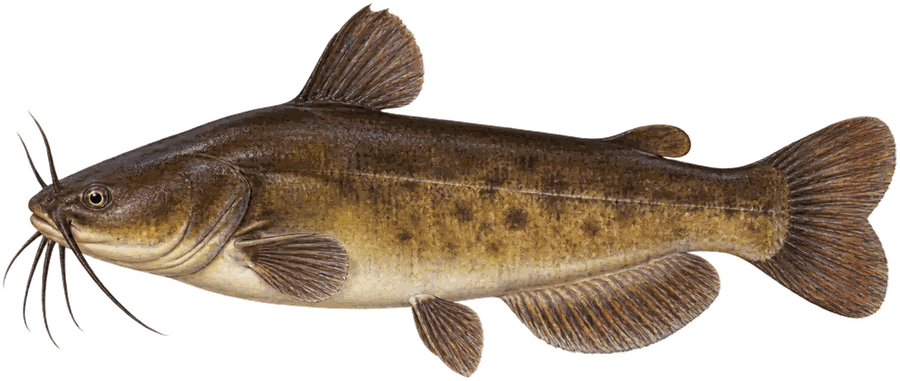
How to catch Brown Bullhead
Ameiurus nebulosus
Bump Board's tactics library for Brown Bullhead — where to fish, what to tie on and how to fish it, season by season. In the app, these tips adapt live to the weather, the front and the light.
Brown Bullhead — Prespawn
Where to fish
- This is among the earliest spring feeders in its community: in the Ontario field work, brown bullhead feeding was already under way at 6.5 °C when the study started, while pumpkinseed and rock bass in the same water waited until 8.5 °C. Fish the warming, still, vegetated shallows and soft-bottom feeding water as soon as the water climbs past the mid-single digits — the spring shallow and inflow concentration the agency material describes (expert consensus, Grade C) fits that measured head start.
- In creeks and slow river water, the same rule in miniature: the early feeding the field work recorded was creek fish in slow water. Fish the pools, backwaters and soft edges, not the current — no flow response has ever been measured in this genus, and still water is its documented address.
What to tie on
- The full benthic-omnivore menu is back in play as the water warms: chironomids and other aquatic insects, crustaceans, molluscs, worms, detritus and plant material, fish and fish eggs all appear in the diet work. Bottom presentations sized to that menu, scent forward, are the supported tackle story — the studies name the food, not a lure.
How to fish it
- Fish the climb, not the calendar: activity is steady through the teens, and the spawn season below is gated by temperature (onset around 18 °C, core 20–25 °C), so prespawn effort pays hardest on warming trends toward that band. Keep the species' clock — dusk and night over midday — even in spring.
If it's still tough
- If prespawn shallows are silent, check the temperature before the bait: below about 7 °C this species' spontaneous activity measurably falls away, and a cold snap puts the shelter-and-wait half of its winter behaviour back in charge until the water recovers.
Brown Bullhead — Spawn
Where to fish
- The best-documented bullhead spawn in the literature: in the four-year Michigan field study, spawning ran late May into early June, with most egg-laying inside a tight 10–15-day window; the compilation's optimum spawning temperature is 21.1 °C, and the model's core band is 20–25 °C, May through July in the north. Nests are saucers excavated in sand, gravel or mud under roots, logs and vegetation. Fish the water around the nesting cover — because of who is and isn't eating there (see How).
What to tie on
- No spawn-specific bait is measured for this species. Keep the scent-led bottom presentations of the feeding seasons and work them along the nesting banks and the first soft-bottom feeding water off them, where the fish that are feeding actually are.
How to fish it
- This species carries the programme's only directly observed spawn-feeding suppression in a catfish — and it is sex-specific: in Blumer's field work the males, the principal care-givers, did little or no feeding through breeding and care (care runs up to about 20 days after the eggs are laid, at most about 29), while the females increased their feeding over the same period. How much that lowers the population's bite has never been quantified, so the entry carries the dip as real but unmeasured in size: expect an uneven spawn bite, fish the edges and the females' feeding water, and don't read a guarding male's refusal as the whole lake turning off.
If it's still tough
- If the banks are dead, slide off them to the nearest feeding flats rather than working the nests harder — and ignore the popular line that this fish spawns only once the water reaches 80 °F (27 °C): every primary source contradicts it (the Michigan field spawn, the 21.1 °C compilation optimum, a measured European spawning population at 15–21 °C). That figure is a growth value misfiled as a spawn threshold, and the library lists it as do-not-use.
Brown Bullhead — Summer
Where to fish
- A warm fish, measured three ways: the compilation's final temperature preferendum is 26.2 °C and its optimum growth temperature 30.0 °C, so the productive plateau runs 26–30 °C — individual preferendum studies spread 23.5–31.0 °C by season and method, which is why this entry fishes a plateau and never quotes one point as 'the' optimum. The controlled bioenergetics work measured consumption and growth across 10–30 °C, the backbone under that dome. Summer addresses are the species' own: still, muddy or silty, vegetated water over soft bottom. Above the plateau the fall is steep — an upper incipient lethal of 33.4 °C and a critical thermal maximum of 37.9 °C bracket the low-to-mid 30s as stress water, not feeding water.
What to tie on
- Fish by smell, theirs: searching behaviour guided by taste alone — over distances of many body lengths, in turbid water and clear — was measured with brown bullhead itself as a subject (Bardach, Todd & Crickmer 1967), and the behaviour was the same in every bullhead tested. No brown-specific taste-bud count exists, and none is claimed here. What is brown's own is the diet: a broad benthic omnivore — insects, crustaceans, molluscs, worms, detritus, fish. Scent-forward bottom offerings sized to that menu are the supported presentation; the literature names no lure for this fish.
How to fish it
- Night is not a preference in this species, it is a measured threshold. In the scotokinesis experiments the fish shelter by day and start exploring only when the light drops hard — a relative illuminance drop of 95% or more triggers the response (in as little as 3 seconds), weaker drops get no response at all; at a scotophase illuminance of 1,400 lx locomotor activity fell to near zero, and time-to-feed was fastest at about 100 lx. Daylight fish adopt a sleep posture with slowed heart and breathing and reduced response to sound and touch. So build the summer trip backwards from dark: be set up on the feeding water before the light fails, and treat a bright midday as this fish's off shift, not a bait problem. One caution against over-reading the warm dome: in pairwise feeding trials on chironomids, this species' efficiency was lower at 25 °C than at 18 °C against a competitor — the plateau is a preference-and-growth structure, not a promise that feeding rate peaks at the top of it on every prey.
If it's still tough
- If summer fish won't go in daylight, believe the experiments and wait for the drop in light rather than cycling baits — the trigger is the darkness itself. If nights on good water still fail in a heat wave, check where the water sits against the low-30s stress band before changing anything else.
Brown Bullhead — Fall
Where to fish
- Fall is the long slide between the two measured halves of this fish: spontaneous activity holds from 17 °C down to 7 °C, then the burial and sleep-like behaviour grows as the water falls below it — cold-acclimated fish given a gradient still moved to water above 25 °C within a day, which tells you the preference doesn't change, only the fish's willingness to go and get it. Fish the warmest still, sheltered, soft-bottom water your lake offers, close to cover, and shorten your search radius as it cools.
What to tie on
- The summer scent-led bottom menu, smaller and slower as the temperature drops. Cooling shortens this night fish's already-dark feeding day; nothing in the fall evidence supports bigger or faster.
How to fish it
- Concentrate everything into dusk and the first dark hours, and give each sheltered spot real time — a cooling brown bullhead near its cover is catchable, but it is not travelling to a bait. As the water crosses below about 7 °C, expect the cold pattern (previous entry) to take over within days.
If it's still tough
- A fall spot going quiet week over week is usually the temperature story, not an emptied spot — this is a sedentary, home-ranging fish in everything the literature records (no telemetry study exists for any bullhead, so no migration is claimed here). Move toward warmth and shelter before you move lakes.
Brown Bullhead — Cold
Where to fish
- Cold water splits this fish into two documented halves, and the entry keeps both: spontaneous activity holds relatively constant from 17 °C down to 7 °C and then falls away, with fish burying in mud and dropping into a sleep-like, discontinuous-breathing state — and yet feeding itself does not stop there. Fish the still, soft-bottomed, vegetated water where they shelter, and expect a low, erratic bite, not a shut-down one and not a summer one.
- Oxygen is rarely the cold-season address it is for other fish: in the winterkill syntheses, bullheads and fathead minnows are the most tolerant guild in the lake, and chronic-winterkill basins become bullhead-dominated. That tolerance is a survival record, not a feeding measurement — no study measures this species feeding against dissolved oxygen at any concentration — so use it to keep a low-oxygen basin on your list, never as a promise the fish in it are feeding.
What to tie on
- Scent-led, still and on the bottom. The genus locates food by taste at a distance — measured in the experiment where brown bullhead itself was a subject (Bardach, Todd & Crickmer 1967) — so a bait that puts scent into still water is fishing the measured sense. Match the measured diet at its smallest cold-season size: chironomid larvae and other aquatic insects, small crustaceans, worms. No lure is named in the brown bullhead literature, and none is invented here.
How to fish it
- Keep the night shift even now — especially now. In controlled winter trials this species preyed at temperatures as low as 3 °C, almost exclusively at night, with consumption rising steeply from 3 °C to 4.5 °C. A buried cold fish is not an immobilised one (disturbed fish emerge), but it is not looking for a midday bait either: fish slow, fish close to shelter, and weight the dark hours.
If it's still tough
- Two opposite claims about this fish in cold water are both wrong as absolutes. 'Dormant and does not feed all winter' is contradicted by stomachs with food in them from fish netted under the ice at 4 °C, and by the 3 °C night-predation trials — which also supersede the older published claim that feeding ceases at 3.5 °C. And 'active all winter' ignores the measured collapse in spontaneous activity below 7 °C. The honest cold pattern is a real but low, nocturnal, opportunistic one.
Brown Bullhead on the ice — Through the ice season
Where to fish
- PROVISIONAL — and the flag is part of the entry, the way this library carries lower-confidence ice sets. Brown bullhead is the only bullhead with any under-ice evidence at all: fish netted from under the ice at 4 °C in an Ontario lake included individuals with food in their stomachs (feeding described as erratic), and its winterkill record puts it among the last fish alive in a depleting basin. What does not exist is any observation of free fish under a lake's ice — no telemetry, no under-ice diel curve, no snow-or-light response — so this set is built from under-ice sampling, laboratory winter trials and dormancy physiology, and it is flagged provisional wherever it appears. Fish deep, still, soft-bottom water near shelter; oxygen is a weaker location rule here than for any other ice species in this library, on survival evidence only.
What to tie on
- No ice presentation is measured for this species. Small, scent-led, still bottom offerings are the open-water evidence carried under the ice as a labelled transfer — nothing stronger can honestly be claimed.
How to fish it
- Fish the night shape, knowing exactly where it comes from: in controlled winter trials at 3–4.5 °C this species preyed almost exclusively at night — laboratory fish, not fish under lake ice, and the distinction is kept on purpose. The dormancy physiology fills in the rest of the day: spontaneous activity and willingness to arouse fall as temperature falls, and buried fish respond when disturbed but are not roaming. Slow, close to shelter, after dark is the provisional pattern; bright midday under the ice is its trough.
If it's still tough
- Treat a silent provisional pattern as an open question, not a failed one — the evidence under this set is sampling and laboratory work, and your lake is allowed to disagree with it. The proven cold-season brown bullhead fishing is the open-water cold entry: low, erratic, and nocturnal, on a fish that never fully stops.
Where Brown Bullhead live
5,169 waters in the Bump Board dataset hold Brown Bullhead. A selection:
Manitoba
Ontario
- Abitibi River
- Acheson Lake
- Adams Lake
- Adams Lake
- Adelard Lake
- Agnew Lake
- Ahmic Lake
- Ainslie Lake
- Airy Lake
- Alaska's Lake
- Alder Lake
- Allan Lake
- Allen Lake
- Allumette Lake
- Alluring Lake
- Anderson Lake
- Angel Lake
- Animoosh Lake
- Annies Lake
- Anstruther Lake
- Antoine Lake
- Apsley Lake
- Arab Lake
- Armstrong Lake
Plus 1,881 more Ontario waters — browse Ontario lakes.
Nova Scotia
- AGARD
- ALLEN
- ALMA
- AMEROS
- AMIRAULT
- ANDREW
- ANNIS
- ANTIDAM
- ARMSTRONG
- ARTHURS
- AYLESFORD
- BACK
- BARNIE
- BARRETT
- BAYER
- BEACH
- BEAR
- BEAVER
- BEAVER DAM #2
- BEAVERBANK
- BEAVERDAM
- BEAVERHOUSE
- BEAVERTAIL
- BEAVERTAIL BASIN
Plus 372 more Nova Scotia waters — browse Nova Scotia lakes.
California
- Antelope Lake
- Baltimore Lake
- Blue Lake
- Bullpen Lake
- Butt Valley Reservoir
- Carr Lake
- Crooked Lakes
- Culbertson Lake
- Domingo Lake
- Elephant Rock Lake
- Flora Lake
- Frenchman Lake
- Grassy Lake
- Huysink Lake
- Island Lake
- Kilborn Lake
- Lake Almanor
- Lake Davis
- Lake of The Woods
- Lindsey Lakes
- Loney Lake
- Meadow Lake
- Milk Lake
- Morris Lake
Plus 10 more California waters — browse California lakes.
Connecticut
- Alexander Lake
- Amos Lake
- Amston Lake
- Anderson Pond
- Andover Lake
- Angus Park Pond
- Ashland Pond
- Aspinook Pond
- Avery Pond
- Babcock Pond
- Ball Pond
- Bantam Lake
- Barkhamsted Reservoir
- Bashan Lake
- Batterson Park Pond
- Baummer Pond
- Beach Pond
- Beachdale Pond
- Beseck Lake
- Bigelow Pond
- Billings Lake
- Birge Pond
- Black Pond
- Black Pond
Plus 166 more Connecticut waters — browse Connecticut lakes.
Delaware
- Abbotts Pond
- Andrews Lake
- Chipman Pond
- Concord Pond
- Derby Pond
- Garrisons Lake
- Hearns Pond
- Horseys Pond
- Killen Pond
- McColley Pond
- McGinnis Pond
- Millsboro Pond
- Moores Lake
- Portsville Millpond
- Raccoon Pond
- Records Pond
- Trap Pond
- Tubmill Pond
Florida
Iowa
Idaho
- Anderson Lake
- Black Canyon Reservoir
- Black Lake
- Blue Lake
- Blue Lake
- C J Strike Reservoir
- Cave Lake
- Chase Lake
- Cocolalla Lake
- Crane Creek Reservoir
- Crane Falls Lake
- Dawson Lake
- Dierkes Lake
- Elk Creek Reservoir
- Freeman Lake
- Hauser Lake
- Kelso Lake
- Killarney Lake
- Lake Cascade
- Lake Hayden
- Lake Lowell
- Lake Pend Oreille
- Lapwai Lake
- Lucky Peak Lake
Plus 17 more Idaho waters — browse Idaho lakes.
Indiana
- Adams Lake
- Atwood Lake
- Banning Lake
- Barton Lake
- Bear Lake
- Beaver Dam Lake
- Bell Lake
- Big Chapman Lake
- Big Long Lake
- Big Otter Lake
- Bixler Lake
- Black Lake
- Blue Lake
- Bower Lake
- Brokesha Lake
- Buck Lake
- Cass Lake
- Cedar Lake
- Center Lake
- Cook Lake
- Cree Lake
- Dewart Lake
- Dixon Lake
- Emma Lake
Plus 88 more Indiana waters — browse Indiana lakes.
Massachusetts
- Aldrich Lake
- Althea Lake
- Alum Pond
- Ames Long Pond
- Arcadia Lake
- Ashfield Pond
- Ashland Reservoir
- Ashmere Lake
- Ashumet Pond
- Asnacomet Pond
- Baddacook Pond
- Badluck Lake
- Baker Pond
- Bare Hill Pond
- Barret Pond
- Barrett Pond
- Bartlett Pond
- Bassett Pond
- Beaver Pond
- Beck Pond
- Bell Pond
- Benedict Pond
- Benton Pond
- Berry Pond
Plus 220 more Massachusetts waters — browse Massachusetts lakes.
Maryland
- Adkins Pond
- Blairs Valley Lake
- Tuckahoe Lake
- Unicorn Mill Pond
- Urieville Community Lake
- Wye Mills Community Lake
Maine
- Allen Pond
- Anderson Pond
- Bartlett Pond
- Basin Pond
- Beaver Pond
- Beddington Lake
- Beech Pond
- Belden Pond
- Berry Pond
- Berry Pond
- Berry Pond
- Big Bennett Pond
- Big Pine Pond
- Biscay Pond
- Black Pond
- Black Pond
- Black Pond
- Bonny Eagle Pond
- Boody Pond
- Bowler Pond
- Boyd Pond
- Bradbury Lake
- Brainard Pond
- Brettuns Pond
Plus 224 more Maine waters — browse Maine lakes.
Michigan
- Aleck Lake
- Ambrose Lake
- Andrus Lake
- Archer Lake
- Au Sable Lake
- Au Train Lake
- Backus Lake
- Bailey Lake
- Baker Lake
- Barlow Lake
- Barneys Lake
- Bass Lake
- Bass Lake
- Bass Lake
- Bass Lake
- Bass Lake
- Bass Lake
- Bassett Lake
- Batteese Lake
- Bay City Lake
- Beadle Lake
- Bear Lake
- Bear Lake
- Bear Lake
Plus 350 more Michigan waters — browse Michigan lakes.
Minnesota
- Adney Lake
- Aitkin Lake
- Albert Lake
- Albion Lake
- Alice Lake
- Amelia Lake
- Andrew Lake
- Andrusia Lake
- Ann Lake
- Anna Lake
- Annie Battle Lake
- Arrowhead Lake
- Arrowhead Lake
- Bachelor Lake
- Bad Axe Lake
- Bagley Lake
- Bald Eagle Lake
- Ball Bluff Lake
- Balm Lake
- Balsam Lake
- Bang Lake
- Barrett Lake
- Bass Lake
- Bass Lake
Plus 947 more Minnesota waters — browse Minnesota lakes.
North Carolina
North Dakota
New Hampshire
- Angle Pond
- Ashuelot Pond
- Ayers Pond
- Baboosic Lake
- Back Lake
- Badger Pond
- Bagley Pond
- Bailey Pond
- Balch Pond
- Barrett Pond
- Barrett Pond
- Barville Pond
- Baxter Lake
- Bear Hill Pond
- Bear Pond
- Bearcamp Pond
- Beaver Lake
- Beaver Pond
- Beaver Pond
- Bellamy Reservoir
- Berry Bay
- Berry Pond
- Black Pond
- Blaisdell Lake
Plus 282 more New Hampshire waters — browse New Hampshire lakes.
Nevada
New York
- Ann Lee Pond
- Arnold Lake
- Ballston Lake
- Big Pond
- Black Lake
- Black River Pond
- Bradley Lake
- Buck Pond
- Burden Lake
- Canada Lake
- Canadarago Lake
- Canadice Lake
- Canandaigua Lake
- Canopus Lake
- Cassadaga Lakes
- Cayuga Lake
- Cayuta Lake
- Cazenovia Lake
- Chazy Lake
- Chenango Lake
- Collins Lake
- Conesus Lake
- Copake Lake
- Cranberry Pond
Plus 51 more New York waters — browse New York lakes.
Ohio
Oregon
- Agate Reservoir
- Agency Lake
- Applegate Lake
- Aspen Lake
- Barney Reservoir
- Big Swamp Reservoir
- Bonner Lake
- Bradley Lake
- Bully Creek Reservoir
- Bybee Lake
- Cape Meares Lake
- Chapman Ponds
- Cleawox Lake
- Coffenbury Lake
- Cold Springs Reservoir
- Collard Lake
- Commonwealth Lake
- Cottage Grove Lake
- Cow Lakes
- Crane Prairie Reservoir
- Crump Lake
- Cullaby Lake
- Detroit Lake
- Devil Lake
Plus 81 more Oregon waters — browse Oregon lakes.
Pennsylvania
- Conneaut Lake
- Dutch Fork Lake
- Foster Joseph Sayers Lake
- Frances Slocum Lake
- Francis E Walter Reservoir
- Hammond Lake
- Hopewell Lake
- Kyle Lake
- Lake Canadohta
- Lake Perez
- Lake Wallenpaupack
- Leaser Lake
- LeBoeuf Lake
- Lily Lake
- Loyalhanna Lake
- Mauch Chunk Lake
- Pymatuning Reservoir
- Scotts Run Lake
- Shenango River Lake
- Speedwell Forge Dam
- Tamarack Lake
- Tuscarora Lake
Rhode Island
Virginia
- Echo Lake
- Harrison Lake
- Hunting Run Reservoir
- Lake Brittle
- Lake Chesdin
- Shields Lake
- Swift Creek Lake
- Waller Mill Reservoir
Washington
- Battle Ground Lake
- Bay Lake
- Beaver Lake
- Big Lake
- Bitter Lake
- Black Lake
- Blackmans Lake
- Bonney Lake
- Bonnie Lake
- Boundary Lake
- Carlisle Lake
- Chapman Lake
- Clear Lake
- Clear Lake
- Coffeepot Lake
- Coffin Lake
- Cottage Lake
- Cow Lake
- Davis Lake
- Deep Lake
- Deer Lake
- Diamond Lake
- Dry Lake
- Eloika Lake
Plus 74 more Washington waters — browse Washington lakes.