Fishing tips & tactics
How to catch Bluegill
Lepomis macrochirus
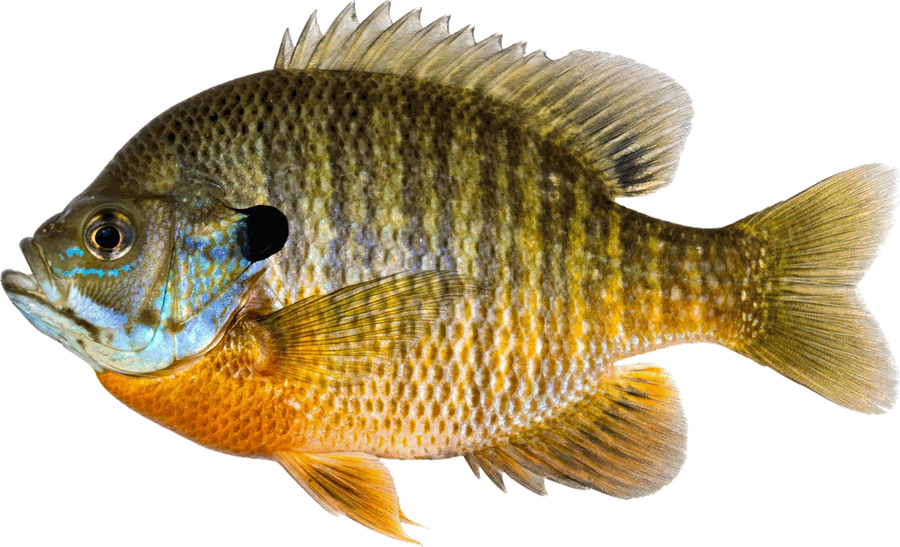
Bump Board's tactics library for Bluegill — where to fish, what to tie on and how to fish it, season by season. In the app, these tips adapt live to the weather, the front and the light.
Bluegill — Prespawn
Where to fish
- As the water climbs through the teens toward about 19–21 °C, bluegill move toward the shallow bedding areas they'll use for a long, protracted season. Fish the shallow flats and the edges just off them — this species stages close to where it will nest.
What to tie on
- Small offerings matched to what a sight-feeding panfish eats — this fish hunts by eye, and its measured reaction distance grows with light up to a low saturation point. Natural, small and visible beats large: turbid water shortens its reaction distance (measured), so in stained water put the bait closer and slower.
How to fish it
- Fish it as a daylight pattern — because it is one, measurably: activity builds through the morning. Prespawn afternoons on the warming flats are real fishing, not a warm-up for dusk.
If it's still tough
- If the flats are empty, the temperature hasn't arrived — this spawn is temperature-gated, so drop to the first deeper edge and wait for the water, not a different bait.
Bluegill — Spawn
Where to fish
- The spawn is a colony season: onset around 19–21 °C, the main band 22–27 °C, in repeated bouts over a protracted stretch — there is almost always a wave of nesting fish somewhere in the window. Males guard the nests; a strike on a nest is guarding behaviour as much as feeding, and the honest entry says so.
What to tie on
- Small offerings worked in and around the beds. Size to the insect-and-larvae food the diet work documents for the shallows; a bedding colony is a sight-fishing game played in daylight.
How to fish it
- Fish the colonies through the middle of the day with confidence — the stomach-fullness peak for this species lands around 18:00–19:00, the end of a day-long build, and night is its daily minimum. Daylight is not the compromise shift for bluegill; it's the shift.
If it's still tough
- Between bouts, the colonies thin out — check the edges just off the bedding flats, where the next wave stages, before you conclude the spawn is over. It rarely is; it pulses.
Bluegill — Summer
Where to fish
- Summer bluegill are warm-water fish in their element — their temperature preference runs to about 27–31 °C, the warmest plateau in this library — holding around weed edges and structure, feeding by sight through the day.
What to tie on
- Small, visible offerings at the fish's level. Two measured refinements: turbidity cuts reaction distance, so dirter water wants the bait nearer and slower; and oxygen is a hard address — avoidance begins around 1.5–3.0 mg/L, so in a summer low-oxygen basin the fish are in the oxygenated layer, not on the bottom structure.
How to fish it
- Build the day like the fish does: steady morning, solid midday, best late — the measured fullness peak is early evening. One tested surprise to save you a trick: steady artificial light at night did NOT extend their feeding (the night minimum is an internal programme, not a light shortage), so dock lights are not the pattern the evidence supports.
If it's still tough
- If summer fish look but won't take, shrink and slow in place — a sight feeder refusing a bait it can see is a size-and-speed verdict. And check the oxygenated layer before you blame the bait in hot, still weather.
Bluegill — Fall
Where to fish
- Fall bluegill slide from the shallows toward deeper, stiller water as it cools — the start of a winter pattern that is reduced and oxygen-gated, not dormant. Fish the deep edges off the summer water.
What to tie on
- The small summer offerings, a step slower and deeper. Cooling shortens the day this daylight fish feeds, so concentrate effort in the warm, bright middle hours.
How to fish it
- Fish the brightest part of the day hardest — in fall, light and warmth peak together at midday, and so does this species.
If it's still tough
- If the deep edges are quiet, look for the warmest still water — that is the winter address arriving early, and fall fish are already sorting toward it.
Bluegill — Winter
Where to fish
- Winter bluegill keep feeding — measured at 4 °C — at a reduced, oxygen-gated level: the telemetry puts them in the warmest still water that still holds dissolved oxygen above about 2 mg/L. 'Bluegill don't feed in winter' is a rejected claim in the research, not a pattern.
What to tie on
- Small and slow, in the warm still water. Winter consumption is a fraction of summer's, so a presentation has to arrive close and stay — this is not a searching season.
How to fish it
- Fish the middle of the day, when what light there is gets through, and give each located pocket real time. Winter bluegill move little; finding them is most of the catch.
If it's still tough
- If a winter pocket is dead, check oxygen before effort — below the gate the fish simply aren't there, and the next warm, oxygenated pocket is the fix.
Bluegill on the ice — Through the ice season
Where to fish
- The ice set for bluegill is issued at lower confidence, and the entry carries that flag openly: the under-ice diel curve has never been measured, so the daylight shape below is the open-water pattern carried under the ice as a labelled within-species transfer. What is measured under ice: winter feeding continues, and winter fish hold in warm, still water with oxygen above roughly 2 mg/L.
What to tie on
- Small offerings, fished close in the warm, oxygenated pockets. No ice-specific presentation is measured for this species — small and slow is the open-water evidence applied honestly, not an ice finding.
How to fish it
- Fish the bright middle hours hardest, on the transferred daylight pattern, and treat oxygen as the location rule: in a depleting basin, the fish are at the oxygen, not at the structure.
If it's still tough
- Mid-winter silence in a shallow basin is usually the oxygen gate closing. Move to deeper, better-oxygenated water before you change baits.
Where Bluegill live
5,542 waters in the Bump Board dataset hold Bluegill. A selection:
Ontario
- Adams Lake
- Adelard Lake
- Agnes Lake
- Anderson Lake
- Arab Lake
- Arts L.
- Augusta Lake
- Ausable River
- Balmer Lake
- Balsam Lake
- Baptiste Creek
- Baptiste Lake
- Barbut Creek
- Bart Lake
- Basin Lake
- Bass Lake
- Bass Lake
- Bass Lake
- Bass Lake
- Bassoon Lake
- Basswood Lake
- Baxter Lake
- Beak Lake
- Bear Creek
Plus 473 more Ontario waters — browse Ontario lakes.
Alabama
- Aliceville Lake
- Bear Creek Reservoir
- Claiborne Lake
- Gantt Lake
- Guntersville Lake
- Jordan Lake
- Lake Tuscaloosa
- Martin Lake
- Mitchell Lake
- Point A Lake
- R L Harris Reservoir
- Thurlow Reservoir
Arkansas
- Beaver Lake
- Blue Mountain Lake
- Greers Ferry Lake
- Harris Brake
- Lake Atkins
- Lake Chicot
- Lake Dardanelle
- Lake Greeson
- Lake Maumelle
- Lake Monticello
- Lake Ouachita
- Nimrod Lake
Arizona
California
- Diamond Valley Lake
- Don Castro Reservoir
- Horseshoe Lake
- Jordan Pond
- Lake Anza
- Lake Chabot
- Lake del Valle
- Lake Temescal
- Perris Reservoir
- Rock Lake
- Round Valley Reservoir
- Shinn Pond
- Silverwood Lake
- Skinner Reservoir
- White Pines Lake
Colorado
- Aurora Reservoir
- Banner Lakes
- Bear Creek Lake
- Beckwith Reservoir
- Berkeley Lake
- Boyd Lake
- Bufflehead Lake
- Carter Lake Reservoir
- Chatfield Lake
- Cherry Creek Lake
- Croke Reservoir
- Crown Hill Lake
- Dawn Reservoir
- Denny Lake
- Dixon Reservoir
- Douglass Lake
- Eaglewatch Lake
- Erie Lake
- Garfield Lake
- Harriman Lake
- Heinricy Lake
- Highline Lake
- Hine Lake
- Horsetooth Reservoir
Plus 51 more Colorado waters — browse Colorado lakes.
Connecticut
- Alexander Lake
- Amos Lake
- Amston Lake
- Anderson Pond
- Andover Lake
- Angus Park Pond
- Ashland Pond
- Aspetuck Reservoir
- Aspinook Pond
- Avery Pond
- Babcock Pond
- Baldwins Pond
- Ball Pond
- Baltic Reservoir
- Bantam Lake
- Barber Pond
- Barkhamsted Reservoir
- Bashan Lake
- Batterson Park Pond
- Baummer Pond
- Beach Pond
- Beachdale Pond
- Beseck Lake
- Besse Park Pond
Plus 206 more Connecticut waters — browse Connecticut lakes.
Delaware
- Abbotts Pond
- Andrews Lake
- Becks Pond
- Blairs Pond
- Chipman Pond
- Concord Pond
- Coursey Pond
- Craigs Pond
- Derby Pond
- Garrisons Lake
- Griffith Lake
- Hearns Pond
- Horseys Pond
- Ingram Pond
- Killen Pond
- Lums Pond
- McColley Pond
- McGinnis Pond
- Millsboro Pond
- Moores Lake
- Mud Millpond
- Portsville Millpond
- Raccoon Pond
- Records Pond
Plus 4 more Delaware waters — browse Delaware lakes.
Florida
- Alligator Lake
- Blue Cypress Lake
- Crescent Lake
- Dead Lakes
- Deer Point Lake
- Hurricane Lake
- Lake George
- Lake Istokpoga
- Lake Jackson
- Lake Kissimmee
- Lake Monroe
- Lake Okeechobee
- Lake Panasoffkee
- Lake Parker
- Lake Rousseau
- Lake Rowell
- Lake Sampson
- Lake Talquin
- Lake Tarpon
- Lake Tohopekaliga
- Lake Trafford
- Lake Victor
- Lake Weir
- Lake Weohyakapka
Plus 7 more Florida waters — browse Florida lakes.
Georgia
- Allatoona Lake
- Blue Ridge Lake
- Hamburgh Millpond
- High Falls Lake
- J. Strom Thurmond Reservoir
- Jackson Lake
- Lake Blackshear
- Lake Oliver
- Lake Rabun
- Lake Seminole
- Lake Sidney Lanier
- Lake Sinclair
- Randy Poynter Lake
Hawaii
Iowa
- Ada Hayden Heritage Park Lake
- Alice Wyth Lake
- Alligator Lake
- Arrowhead Lake
- Backbone Lake
- Badger Lake
- Beaver Lake
- Beeds Lake
- Big Creek Lake
- Big Lake
- Big Woods Lake
- Black Hawk Lake
- Blue Lake
- Browns Lake
- Brushy Creek Lake
- Bussey Lake
- Butler Lake
- Cedar Lake
- Cedar Lake
- Center Lake
- Central Park Lake
- Clear Lake
- Cold Springs
- Coralville Lake
Plus 105 more Iowa waters — browse Iowa lakes.
Idaho
- American Falls Reservoir
- Anderson Lake
- Avondale Lake
- Ben Ross Reservoir
- Black Canyon Reservoir
- Black Lake
- Brush Lake
- C J Strike Reservoir
- Carey Lake
- Cocolalla Lake
- Condie Reservoir
- Crane Creek Reservoir
- Crane Falls Lake
- Crowthers Reservoir
- Dawson Lake
- Dierkes Lake
- Dog Creek Reservoir
- Dunes Lake
- Dworshak Reservoir
- Elk Creek Reservoir
- Emerald Lake
- Fernan Lake
- Glendale Reservoir
- Granite Lake
Plus 28 more Idaho waters — browse Idaho lakes.
Illinois
- Argyle Lake
- Baldwin Lake
- Braidwood Power Plant Cooling Pond
- Canton Lake
- Carlyle Lake
- Cedar Lake
- Coffeen Lake
- Crab Orchard Lake
- Dawson Lake
- Devils Kitchen Lake
- Eureka Lake
- Forbes Lake
- Governor Bond Lake
- Heidecke Lake
- Horseshoe Lake
- Kinkaid Lake
- Lake Decatur
- Lake Glenn Shoals
- Lake Jacksonville
- Lake Le-Aqua-Na
- Lake Lou Yaeger
- Lake Mattoon
- Lake Murphysboro
- Lake of the Woods
Plus 18 more Illinois waters — browse Illinois lakes.
Indiana
- Adams Lake
- Appleman Lake
- Atwood Lake
- Ball Lake
- Banning Lake
- Barr Lake
- Barton Lake
- Bass Lake
- Baugher Lake
- Bear Lake
- Beaver Dam Lake
- Bell Lake
- Big Chapman Lake
- Big Lake
- Big Long Lake
- Big Otter Lake
- Bixler Lake
- Black Lake
- Blue Lake
- Bower Lake
- Brokesha Lake
- Buck Lake
- Cass Lake
- Cedar Lake
Plus 135 more Indiana waters — browse Indiana lakes.
Kansas
- Big Hill Lake
- Clinton Lake
- Coffey County Lake
- Council Grove Lake
- Douglas Lake
- El Dorado Lake
- Elk City Lake
- Fall River Lake
- Hillsdale Lake
- Kanopolis Lake
- Keith Sebelius Lake
- Kirwin Reservoir
- La Cygne Lake
- Lovewell Reservoir
- Marion Reservoir
- Melvern Lake
- Milford Lake
- Perry Lake
- Pomona Lake
- Toronto Lake
- Tuttle Creek Lake
- Waconda Lake
- Webster Reservoir
- Wilson Lake
Kentucky
- Beaver Lake
- Beulah Lake
- Boltz Lake
- Briggs Lake
- Buckhorn Lake
- Bullock Pen Lake
- Cap Mauzy Lake
- Carpenters Lake
- Cave Run Lake
- Cedar Creek Lake
- Clear Creek Lake
- Combs Lake
- Corinth Lake
- Dewey Lake
- Elmer Davis Lake
- Fagan Branch Lake
- Fishpond Lake
- Fishtrap Lake
- Grayson Lake
- Green River Lake
- Greenbo Lake
- Guist Creek Lake
- Herrington Lake
- Kincaid Lake
Plus 17 more Kentucky waters — browse Kentucky lakes.
Louisiana
- Anacoco Lake
- Bayou D'Arbonne Lake
- Black Lake
- Caddo Lake
- False River
- Lake Bistineau
- Lake Chicot
- Lake Maurepas
- Lake Saint Joseph
- Mill Creek Reservoir
- Saline Lake
Massachusetts
- Aldrich Lake
- Althea Lake
- Alum Pond
- Ames Long Pond
- Arcadia Lake
- Ashfield Pond
- Ashland Reservoir
- Ashmere Lake
- Asnacomet Pond
- Baddacook Pond
- Badluck Lake
- Baldpate Pond
- Bare Hill Pond
- Barrett Pond
- Bartlett Pond
- Beaver Pond
- Bell Pond
- Benedict Pond
- Benton Pond
- Big Bearhole Pond
- Bloody Pond
- Brigham Pond
- Browning Pond
- Buffumville Lake
Plus 201 more Massachusetts waters — browse Massachusetts lakes.
Maryland
- Adkins Pond
- Blairs Valley Lake
- Deep Creek Lake
- Johnson Pond
- Lake Artemesia
- Liberty Lake
- Little Seneca Lake
- Loch Raven Reservoir
- Piney Run Lake
- Prettyboy Reservoir
- Rising Sun Community Pond
- Saint Marys Lake
- Tuckahoe Lake
- Unicorn Mill Pond
- Urieville Community Lake
- Wheatley Lake
- Wye Mills Community Lake
Maine
Michigan
- Ackerman Lake
- Adams Lake
- Alderman Lake
- Algoe Lake
- Algoe Lake
- Algonquin Lake
- Allen Lake
- Alma Lake
- Amaung Lake
- Ambrose Lake
- Anderson Lake
- Andrus Lake
- Appleton Lake
- Archer Lake
- Armstrong Lake
- Arnold Lake
- Ashford Lake
- Atodd Lake
- Au Sable Lake
- Austin Lake
- Avalon Lake
- Avery Lake
- Badger Lake
- Bailey Lake
Plus 1,092 more Michigan waters — browse Michigan lakes.
Minnesota
- Achman Lake
- Adams Lake
- Adney Lake
- Agnes Lake
- Ahsub Lake
- Airport Lake
- Aitkin Lake
- Albert Lake
- Albert Lea Lake
- Albion Lake
- Alden Lake
- Alice Lake
- Amber Lake
- Amelia Lake
- Anderson Lake
- Anderson Lake
- Andrew Lake
- Andrusia Lake
- Ann Lake
- Ann Lake
- Anna Lake
- Annie Battle Lake
- Antler Lake
- Apple Lake
Plus 1,809 more Minnesota waters — browse Minnesota lakes.
Missouri
- Atkinson Lake
- Binder Lake
- Blind Pony Lake
- Crowder Lake
- Edwin A Pape Lake
- Fellows Lake
- Hamilton Reservoir
- Higginsville Reservoir
- Hunnewell Lake
- Kellogg Lake
- Lake Jacomo
- Lake of the Ozarks
- Lake Taneycomo
- Lawson Lake
- Limpp Lake
- Little Dixie Lake
- Marceline Old Reservoir
- New Marceline City Lake
- Perry County Community Lake
- Pomme de Terre Lake
- Sims Valley State Community Lake
- Sterling Price Community Lake
- Stockton Lake
- Table Rock Lake
Plus 3 more Missouri waters — browse Missouri lakes.
Mississippi
- Aberdeen Lake
- Aliceville Lake
- Bailey Lake
- Bay Springs Lake
- Bee Lake
- Choctaw Lake
- Chotard Lake
- Columbus Lake
- Enid Lake
- Geiger Lake
- Grenada Lake
- Horseshoe Lake
- Jefferson Davis Lake
- Lake Bill Waller
- Lake Bogue Homo
- Lake Claude Bennett
- Lake Columbia
- Lake Ferguson
- Lake Lamar Bruce
- Lake Lowndes
- Lake Mary Crawford
- Lake Monroe
- Lake Tangipahoa
- Lake Washington
Plus 11 more Mississippi waters — browse Mississippi lakes.
Montana
- Anita Reservoir
- Arapooish Pond
- Bighorn Lake
- Bull Lake
- Butch Reservoir
- Canyon Ferry Lake
- Carters Pond
- Castle Rock Lake
- Don Reservoir
- Dry Lake Reservoir
- East Fork Reservoir
- Fort Peck Lake
- Fort Peck Trout Pond
- Gartside Reservoir
- Hauser Lake
- Hollecker Lake
- Hump Reservoir
- Lake Elmo
- Lake Josephine
- McChesney Reservoir
- Sagebrush Reservoir
- Sophie Lake
- Spotted Eagle Lake
- Taint Reservoir
Plus 5 more Montana waters — browse Montana lakes.
North Carolina
North Dakota
- Arnegard Dam
- Belfield Pond
- Blacktail Lake
- Bowman-Haley Lake
- Braddock Dam
- Brush Lake
- Camels Hump Lake
- Clearwater Lake
- Crown Butte Lake
- Dion Lake
- Fish Creek Lake
- Fordville Dam
- Gravel Lake
- Gullys Slough
- Harmon Lake
- Heckers Lake
- Hiddenwood Lake
- Horseshoe Lake
- Jamestown Reservoir
- Kalina Lake
- Kettle Lake
- Lake Ashtabula
- Lake Elsie
- Lake LaMoure
Plus 25 more North Dakota waters — browse North Dakota lakes.
Nebraska
- Agate Dam Reservoir
- Alexandria Reservoir
- Ansley Reservoir
- Arnold Lake
- Atkinson Lake
- Big Alkali Lake
- Birdwood Lake
- Blue Lake
- Bluestem Lake
- Board Gate Dam Reservoir
- Bowling Lake
- Bowman Lake
- Box Butte Reservoir
- Branched Oak Lake
- Buckskin Hills Lake
- Burchard Lake
- Carter Lake
- Clear Lake
- Clear Lake
- Conestoga Lake
- Cottonmill Reservoir
- Cottonwood Lake
- Cozad Lake
- Crane Lake
Plus 75 more Nebraska waters — browse Nebraska lakes.
New Hampshire
- Ayers Pond
- Baboosic Lake
- Beaver Lake
- Beaver Pond
- Brindle Pond
- Canobie Lake
- Captain Pond
- Center Pond
- Chesham Pond
- Cheshire Pond
- Childs Bog
- Cobbetts Pond
- Contoocook Lake
- Country Pond
- Crooked Pond
- Daniels Lake
- Darrah Pond
- Drew Lake
- Everett Lake
- Forest Lake
- French Pond
- Frost Pond
- Grassy Pond
- Great Pond
Plus 53 more New Hampshire waters — browse New Hampshire lakes.
Nevada
- Chimney Reservoir
- Comins Lake
- Fort Churchill Cooling Ponds
- Hinkson Slough
- Lake Mead
- Nesbitt Lake
- Rye Patch Reservoir
- South Fork Reservoir
- Zunino Reservoir
New York
- Alexander Lake
- Ann Lee Pond
- Arnold Lake
- Ballston Lake
- Black Lake
- Bradley Lake
- Brant Lake
- Buck Pond
- Burden Lake
- Canadarago Lake
- Canadice Lake
- Canandaigua Lake
- Canopus Lake
- Cassadaga Lakes
- Cayuga Lake
- Cayuta Lake
- Cazenovia Lake
- Chenango Lake
- Collins Lake
- Conesus Lake
- Copake Lake
- Cranberry Pond
- Cross Lake
- Deep Pond
Plus 53 more New York waters — browse New York lakes.
Ohio
- Adams Lake
- Alum Creek Lake
- Buckeye Lake
- Burr Oak Reservoir
- Caldwell Lake
- City Reservoir
- Clark Lake
- Delaware Lake
- Dow Lake
- Findlay Reservoir
- Friendship Park Lake
- Grant Lake
- Greenfield Lake
- Hargus Lake
- Harrison Lake
- Knox Lake
- Lake Ann
- Lake Hope
- Lake La Su An
- Lake Park
- Lake Snowden
- Lake Vesuvius
- Lake White
- Lampson Reservoir
Plus 21 more Ohio waters — browse Ohio lakes.
Oklahoma
Oregon
- Agate Reservoir
- Agency Lake
- Applegate Lake
- Azalea Lake
- Beale Lake
- Ben Irving Reservoir
- Blue Lake
- Blue River Lake
- Bybee Lake
- Cape Meares Lake
- Carpenter Pond
- Cemetery Lake
- Clear Lake
- Cleawox Lake
- Cody Ponds
- Coffenbury Lake
- Cold Springs Reservoir
- Collard Lake
- Commonwealth Lake
- Cottage Grove Lake
- Crane Prairie Reservoir
- Creep and Crawl Lake
- Devils Lake
- Dexter Reservoir
Plus 50 more Oregon waters — browse Oregon lakes.
Pennsylvania
- Acme Lake
- Bear Gap Reservoir
- Beechwood Lake
- Beltzville Lake
- Black Moshannon Lake
- Blue Marsh Lake
- Boyertown Reservoir
- Briar Creek Reservoir
- Bridgeport Reservoir
- Canoe Creek Lake
- Canonsburg Lake
- Carbaugh Reservoir
- Carsonia Lake
- Chapman Dam Reservoir
- City Reservoir
- Clear Lake
- Cloe Lake
- Colver Reservoir
- Colyer Lake
- Conemaugh River Lake
- Conneaut Lake
- Cooks Pond
- Cowans Gap Lake
- Cranberry Glade Lake
Plus 129 more Pennsylvania waters — browse Pennsylvania lakes.
Rhode Island
South Carolina
- Ashwood Lake
- Jonesville Town Pond
- Lake Brown
- Lake Cherokee
- Lake George Warren
- Lake John D Long
- Lake Wallace
- Lancaster Reservoir
- Star Fort Pond
- Sunrise Lake
- Thicketty Creek WCD Lake Number Twenty-six
South Dakota
- Amsden Lake
- Angostura Reservoir
- Bear Butte Lake
- Beaulieu Lake
- Bismark Lake
- Brakke Dam
- Brant Lake
- Bullhead Lake
- Byre Lake
- Clear Lake
- Cottonwood Lake
- Curlew Lake
- Dog Ear Lake
- Durkee Lake
- Eagle Butte Lake
- Elm Lake
- Enemy Swim Lake
- Eureka Lake
- Fairfax Lake
- Fate Dam
- Flat Creek Lake
- Hanson Lake
- Hayes Lake
- Herrick Lake
Plus 48 more South Dakota waters — browse South Dakota lakes.
Tennessee
- Center Hill Lake
- Cherokee Lake
- Chickamauga Lake
- Douglas Lake
- Fort Loudoun Lake
- Fort Patrick Henry Lake
- Kentucky Lake
- Lake Ocoee
- Melton Hill Lake
- Norris Lake
- Reelfoot Lake
- South Holston Lake
- Tellico Lake
- Watauga Lake
Texas
- Bonham State Park Lake
- Ellison Creek Reservoir
- Houston County Lake
- Lake Conroe
- Lake Davy Crockett
- Lake Houston
- Lake Livingston
- Sheldon Reservoir
- Somerville Lake
- Welsh Reservoir
Utah
- Adams Reservoir
- Brough Reservoir
- Burriston Ponds
- Deer Creek Reservoir
- Gunlock Reservoir
- Holmes Reservoir
- Huntington Lake
- Kaysville Ponds
- Kens Lake
- Lake Powell
- Mantua Reservoir
- Newton Reservoir
- Pelican Lake
- Pineview Reservoir
- Quail Creek Reservoir
- Recapture Reservoir
- Red Fleet Reservoir
- Salem Lake
- Sand Hollow Reservoir
- Spring Lake
- Starvation Reservoir
- Steinaker Reservoir
- Twenty First Street Pond
- Utah Lake
Plus 3 more Utah waters — browse Utah lakes.
Virginia
- Abbott Lake
- Airfield Pond
- Amelia Lake
- Banister Lake
- Bear Creek Lake
- Beaver Creek Reservoir
- Beaverdam Swamp Reservoir
- Braley Pond
- Briery Branch Reservoir
- Burke Lake
- Chandlers Millpond
- Chris Greene Lake
- Claytor Lake
- Clifton Forge Reservoir
- Conner Lake
- Curtis Park Lake
- Diascund Creek Reservoir
- Echo Lake
- Elkhorn Lake
- Fairy Stone Lake
- Fluvanna Ruritan Lake
- Gardys Millpond
- Gatewood Reservoir
- Germantown Lake
Plus 52 more Virginia waters — browse Virginia lakes.
Washington
- Banks Lake
- Battle Ground Lake
- Bay Lake
- Billy Clapp Lake
- Bonney Lake
- Carlisle Lake
- Clark Pond
- Cow Lake
- Dry Lake
- Duck Lake
- Fivemile Lake
- Florence Lake
- Fort Borst Lake
- Franklin D Roosevelt Lake
- Hammond Lake
- Harts Lake
- Hicks Lake
- Hideaway Lake
- Horseshoe Lake
- Horseshoe Lake
- Horsethief Lake
- Hummel Lake
- Island Lake
- Kitsap Lake
Plus 50 more Washington waters — browse Washington lakes.