Fishing tips & tactics
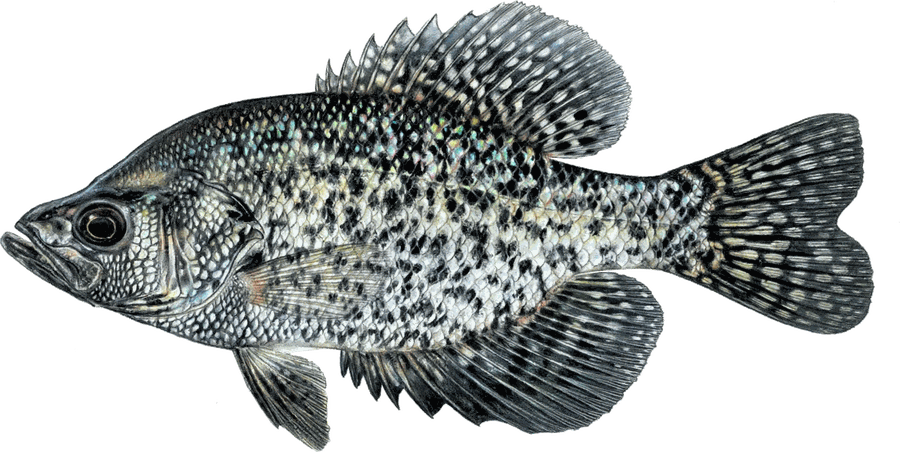
How to catch Black Crappie
Pomoxis nigromaculatus
Bump Board's tactics library for Black Crappie — where to fish, what to tie on and how to fish it, season by season. In the app, these tips adapt live to the weather, the front and the light.
Black Crappie — Prespawn
Where to fish
- Black crappie stage toward the spawning shallows as the water climbs toward 13–14 °C. Within a lake they hold shallower and on steeper, more vegetated water than white crappie — fish the vegetated shallows' edges and the first breaks off them.
What to tie on
- Small offerings matched to the plankton-and-minnow forage, fished at the schools' depth. The direct experiments are the colour story here: black crappie ate least in clear water and showed no clear-water preference in any test — the draw is vegetation and structure, not clarity, so don't pass up stained, vegetated water for a clear flat.
How to fish it
- Fish the edges slowly at school depth. Adults already run a dusk-and-night clock, so prespawn evenings on the staging edges outfish the midday hours.
If it's still tough
- If the vegetated edges are quiet, check the first deeper break — staging fish hold a step off the shallows until the temperature says go.
Black Crappie — Spawn
Where to fish
- Spawning starts at 13–14 °C and peaks at 16–20 °C, in nest colonies in the vegetated shallows — in the north the run lags, into late May in Manitoba. One measured detail worth fishing: wind matters to the nests, not the day — colonies favour wind-protected sites, so the sheltered side of the spawning shallows is the percentage water.
What to tie on
- Small, slow, at nest depth in the vegetation. Nothing in the spawn evidence supports big or fast; the colonies are the location, and small forage-matching offerings are the presentation.
How to fish it
- Work the protected shallows methodically while the window runs, and weight your effort to dusk — the adults' feeding clock peaks then even in the spawn season.
If it's still tough
- If one colony is quiet, move along the protected shore rather than deeper — spawning colonies are patchy, and the next sheltered stretch can be loaded while yours is empty.
Black Crappie — Summer
Where to fish
- Ignore the calendar canon here — telemetry from Kentucky Lake has black crappie staying shallow into summer after the spawn, the opposite of the generic crappie calendar and of white crappie in the same water. Fish the shallow vegetation and structure, suspended at the schools' level.
What to tie on
- Plankton-and-minnow forage matching, at exact school depth. Turbidity is a tested non-story for this species — three experiments converge on no turbidity preference — so clarity should never talk you out of a vegetated spot.
How to fish it
- The adult clock: dusk and night elevated, a midday trough, juveniles peaking at dawn — competent studies conflict on the exact peak hour, and the library keeps that conflict visible rather than picking one. What doesn't conflict: low light is when adults feed, so build the trip around dusk.
If it's still tough
- A dead midday is this fish's trough, not a verdict on the spot. Fish the same vegetation at dusk before you move lakes.
Black Crappie — Fall
Where to fish
- Fall fish use the same shallow vegetation and structure story, cooling toward the winter pattern: deeper as it gets cold, with oxygen becoming the address that matters most as winter approaches.
What to tie on
- Small forage-matching offerings at school depth, slowing as the water drops through the teens Celsius.
How to fish it
- Keep the dusk emphasis and start checking the deeper edges near the summer vegetation — the winter move is a short one in this species, from shallow structure toward the nearest deep, oxygenated water.
If it's still tough
- If fall spots empty, follow the oxygen logic early: the fish are setting up where winter oxygen will hold, not where summer put them.
Black Crappie — Winter
Where to fish
- Winter black crappie are an oxygen story with a hard number: under ice, about 2 mg/L is the gate. Fish the deep, oxygenated basins near the summer structure — and in a winterkill-prone lake, the fish are wherever the oxygen survives.
What to tie on
- Small and slow at the schools' depth. Open-water oxygen response was never measured for this species — the winter gate is the measured anchor, and the open-water entries don't pretend otherwise.
How to fish it
- Locate first, fish second: winter schools are tight, and the difference between a school and empty water can be a short move. The under-ice entries below carry the detailed pattern.
If it's still tough
- In a low-oxygen winter, technique is not the problem — basin choice is. Move to the deepest, best-oxygenated water in the lake before changing a single bait.
Black Crappie on the ice — Early ice
Where to fish
- Black crappie is a genuine ice species — one of the few in this library with A-grade under-ice evidence for the species itself. Early ice: the deep, oxygenated water near the summer vegetation and structure, with oxygen already the governing fact (the gate sits near 2 mg/L).
What to tie on
- Small offerings at the schools' exact depth. The under-ice evidence is about location, oxygen and timing — it does not name a lure, and the entry won't invent one.
How to fish it
- Fish the clock the ice evidence gives: under-ice feeding peaks in the creel synthesis include a midnight-to-2 a.m. window, matching the nocturnal plankton (Chaoborus) mechanism — a synthesis at Grade C, labelled as such, but it's the only under-ice diel guidance that exists for this fish. Dusk remains a primary window.
If it's still tough
- If early-ice fish won't go, verify the basin's oxygen story before the bait: below the gate, there is no presentation fix.
Black Crappie on the ice — Mid ice
Where to fish
- Mid-winter is the oxygen squeeze: stay on the deepest oxygenated basins, and expect fish to have shifted toward whatever water still carries oxygen as the season's depletion runs.
What to tie on
- Small and slow, presented at the school's level in the basin. Mid-winter black crappie are a location problem solved on electronics, then a patience problem.
How to fish it
- Keep the low-light and night windows — dusk, and the late-night window the synthesis reports. Bright midday under thick ice and snow is the trough of this fish's day.
If it's still tough
- A silent mid-winter basin is usually an oxygen verdict. Move basins, not baits.
Black Crappie on the ice — Late ice
Where to fish
- Late ice loosens the pattern: fish slide from the deep basins back toward the vegetated shallows they'll spawn in, as light and meltwater return. Fish the route — the first breaks and edges between basin and spawning shallows.
What to tie on
- The small school-depth offerings of mid-winter, fished a step more actively as the fish start travelling.
How to fish it
- Check shallower every trip now. Late-ice black crappie are moving one direction — toward the spawn — and staging fish on the edges are the catchable ones.
If it's still tough
- If the edges are quiet, they're still deep — but re-check the shallows at dusk before you leave; the move can happen within days at late ice.
Manitoba Master Angler
A Black Crappie of 33 cm (13 in) or better qualifies for Manitoba's Master Angler Program.
Where Black Crappie live
4,536 waters in the Bump Board dataset hold Black Crappie. A selection:
Manitoba
- Betula Lake
- Brereton Lake
- Caddy Lake
- Falcon Lake
- Goudney Reservoir
- Gull Lake
- Gull Lake
- Jackfish Lake
- Jessica Lake
- Kingfisher Lake
- Lake Minnewasta
- Lake of the Woods
- Mary Jane Reservoir
- Moose Lake
- North Cross Lake
- Persse Lake
- Red Rock Lake
- South Cross Lake
- St. Malo Lake
- Star Lake
- Tees Lake
- Vermilion Reservoir
- White Lake
Ontario
- Ahmic Lake
- Alcock Lake
- Alder Creek
- Andy Lake
- Apungsisagen Lake
- Arrowhead Lake
- Ash Lake
- Balsam Lake
- Bannister Lake
- Baptiste Creek
- Baptiste Lake
- Barbut Creek
- Barnum Lake
- Bass Lake
- Bass Lake
- Bass Lake
- Bass Lake
- Basswood Lake
- Baxter Lake
- Beaver Lake
- Beaver Lake
- Beaver River
- Bell Lake
- Bell Lake
Plus 463 more Ontario waters — browse Ontario lakes.
Alabama
- Coffeeville Lake
- Jordan Lake
- Logan Martin Lake
- Martin Lake
- Mitchell Lake
- Point A Lake
- R E 'Bob' Woodruff Reservoir
- Thurlow Reservoir
- Walter F George Reservoir
- William 'Bill' Dannelly Reservoir
- Yates Reservoir
Arkansas
Arizona
California
Colorado
- Banner Lakes
- Barr Lake
- Beckwith Reservoir
- Berkeley Lake
- Boyd Lake
- Brush Hollow Reservoir
- Chatfield Lake
- Cherry Creek Lake
- Cottonwood Lake
- Crawford Reservoir
- Crown Hill Lake
- Dixon Reservoir
- Echo Canyon Reservoir
- Erie Lake
- Garfield Lake
- Heinricy Lake
- Highline Lake
- Horsetooth Reservoir
- Hunters Glen Lake
- Jackson Lake
- Joe Moore Reservoir
- John Martin Reservoir
- Johnson Reservoir
- Johnstown Reservoir
Plus 33 more Colorado waters — browse Colorado lakes.
Connecticut
- Alexander Lake
- Amston Lake
- Anderson Pond
- Andover Lake
- Ashland Pond
- Aspetuck Reservoir
- Aspinook Pond
- Avery Pond
- Bailey Pond
- Ball Pond
- Baltic Reservoir
- Bantam Lake
- Bashan Lake
- Batterson Park Pond
- Beach Pond
- Beachdale Pond
- Beseck Lake
- Bigelow Pond
- Billings Lake
- Birge Pond
- Black Pond
- Black Pond
- Black Rock Lake
- Black Rock Pond
Plus 138 more Connecticut waters — browse Connecticut lakes.
Delaware
- Abbotts Pond
- Andrews Lake
- Becks Pond
- Blairs Pond
- Chipman Pond
- Concord Pond
- Coursey Pond
- Craigs Pond
- Derby Pond
- Garrisons Lake
- Griffith Lake
- Hearns Pond
- Horseys Pond
- Ingram Pond
- Killen Pond
- Lums Pond
- McColley Pond
- McGinnis Pond
- Moores Lake
- Mud Millpond
- Noxontown Lake
- Raccoon Pond
- Records Pond
- Trap Pond
Plus 3 more Delaware waters — browse Delaware lakes.
Florida
- Alligator Lake
- Blue Cypress Lake
- Crescent Lake
- Deer Point Lake
- Lake George
- Lake Istokpoga
- Lake Jackson
- Lake Kissimmee
- Lake Monroe
- Lake Okeechobee
- Lake Panasoffkee
- Lake Parker
- Lake Rousseau
- Lake Rowell
- Lake Sampson
- Lake Talquin
- Lake Tarpon
- Lake Tohopekaliga
- Lake Trafford
- Lake Victor
- Lake Weir
- Lake Weohyakapka
- Lochloosa Lake
- Merritts Mill Pond
Plus 5 more Florida waters — browse Florida lakes.
Georgia
- Allatoona Lake
- Carters Lake
- Hartwell Lake
- J. Strom Thurmond Reservoir
- Lake Blackshear
- Lake Oconee
- Lake Oliver
- Lake Seminole
- Lake Sidney Lanier
- Nottely Lake
- Randy Poynter Lake
- Richard B Russell Lake
Iowa
- Ada Hayden Heritage Park Lake
- Alice Wyth Lake
- Alligator Lake
- Arrowhead Lake
- Backbone Lake
- Badger Lake
- Beeds Lake
- Big Creek Lake
- Big Lake
- Big Woods Lake
- Black Hawk Lake
- Browns Lake
- Brushy Creek Lake
- Bussey Lake
- Butler Lake
- Cedar Lake
- Center Lake
- Central Park Lake
- Clear Lake
- Coralville Lake
- Corydon Lake
- Crystal Lake
- Dakins Lake
- Diamond Lake
Plus 86 more Iowa waters — browse Iowa lakes.
Idaho
- Anderson Lake
- Avondale Lake
- Ben Ross Reservoir
- Black Canyon Reservoir
- Black Lake
- Blue Lake
- C J Strike Reservoir
- Carey Lake
- Cave Lake
- Cocolalla Lake
- Coeur d'Alene Lake
- Crane Creek Reservoir
- Crane Falls Lake
- Dawson Lake
- Dierkes Lake
- Dog Creek Reservoir
- Elk Creek Reservoir
- Fernan Lake
- Freeman Lake
- Gamlin Lake
- Glendale Reservoir
- Granite Lake
- Hauser Lake
- Jewel Lake
Plus 28 more Idaho waters — browse Idaho lakes.
Illinois
- Argyle Lake
- Baldwin Lake
- Canton Lake
- Carlyle Lake
- Cedar Lake
- Coffeen Lake
- Crab Orchard Lake
- Dawson Lake
- Evergreen Lake
- Governor Bond Lake
- Heidecke Lake
- Horseshoe Lake
- Lake Clinton
- Lake Decatur
- Lake Jacksonville
- Lake Mattoon
- Lake Murphysboro
- Lake of the Woods
- Lake Pittsfield
- Lake Sara
- Lake Shelbyville
- Lake Springfield
- Lake Storey
- Mermet Lake
Plus 8 more Illinois waters — browse Illinois lakes.
Indiana
- Appleman Lake
- Atwood Lake
- Ball Lake
- Banning Lake
- Barr Lake
- Barton Lake
- Bass Lake
- Baugher Lake
- Bear Lake
- Beaver Dam Lake
- Big Chapman Lake
- Big Long Lake
- Bixler Lake
- Black Lake
- Blue Lake
- Bower Lake
- Cedar Lake
- Cedar Lake
- Center Lake
- Cook Lake
- Crane Lake
- Cree Lake
- Crooked Lake
- Dallas Lake
Plus 98 more Indiana waters — browse Indiana lakes.
Kansas
- Big Hill Lake
- Coffey County Lake
- Council Grove Lake
- Hillsdale Lake
- Keith Sebelius Lake
- La Cygne Lake
- Melvern Lake
- Pomona Lake
Kentucky
- Barren River Lake
- Dewey Lake
- Herrington Lake
- Lake Barkley
- Lake Cumberland
- Laurel River Lake
- Paintsville Lake
- Yatesville Lake
Louisiana
- Anacoco Lake
- Bayou D'Arbonne Lake
- Black Bayou Lake
- Black Lake
- Caddo Lake
- False River
- Ivan Lake
- John K. Kelly Grand Bayou Reservoir
- Kepler Creek Lake
- Lake Bistineau
- Lake Maurepas
- Lake Rodemacher
- Lake Saint Joseph
- Mill Creek Reservoir
Massachusetts
- Aldrich Lake
- Althea Lake
- Ames Long Pond
- Arcadia Lake
- Ashfield Pond
- Ashland Reservoir
- Ashmere Lake
- Baddacook Pond
- Badluck Lake
- Baldpate Pond
- Bare Hill Pond
- Barrett Pond
- Bartlett Pond
- Bassett Pond
- Beaver Pond
- Beck Pond
- Bell Pond
- Benedict Pond
- Brigham Pond
- Brookline Reservoir
- Browning Pond
- Buffumville Lake
- Cedar Pond
- Chebacco Lake
Plus 141 more Massachusetts waters — browse Massachusetts lakes.
Maryland
- Adkins Pond
- Blairs Valley Lake
- Leonard Pond
- Rising Sun Community Pond
- Tuckahoe Lake
- Unicorn Mill Pond
- Wye Mills Community Lake
Maine
- Bonny Eagle Pond
- Browns Pond
- Buker Pond
- Dundee Pond
- Halfmoon Pond
- Little Indian Pond
- Middle Range Pond
- Mower Pond
- Nokomis Pond
- Oaks Pond
- Salmon Lake
- Sibley Pond
- Tracy Pond
- Upper Range Pond
Michigan
- Algoe Lake
- Algonquin Lake
- Allen Lake
- Alma Lake
- Appleton Lake
- Archer Lake
- Arnold Lake
- Au Sable Lake
- Austin Lake
- Bailey Lake
- Baker Lake
- Bald Eagle Lake
- Baldwin Lake
- Baldy Lake
- Bankers Lake
- Baptist Lake
- Barlow Lake
- Barton Lake
- Base Line Lake
- Bass Lake
- Bass Lake
- Bass Lake
- Bass Lake
- Bass Lake
Plus 597 more Michigan waters — browse Michigan lakes.
Minnesota
- Achman Lake
- Adney Lake
- Airport Lake
- Aitkin Lake
- Albert Lake
- Albert Lea Lake
- Albion Lake
- Alden Lake
- Alice Lake
- Amber Lake
- Amelia Lake
- Anderson Lake
- Anderson Lake
- Andrew Lake
- Andrusia Lake
- Ann Lake
- Ann Lake
- Anna Lake
- Annie Battle Lake
- Antler Lake
- Apple Lake
- Armstrong Lake
- Arrowhead Lake
- Arrowhead Lake
Plus 1,720 more Minnesota waters — browse Minnesota lakes.
Missouri
- Binder Lake
- Blind Pony Lake
- Blue Springs Lake
- Crowder Lake
- Fellows Lake
- Hamilton Reservoir
- Harry S Truman Reservoir
- Hunnewell Lake
- Lake Jacomo
- Lake of the Ozarks
- Lake Taneycomo
- Long Branch Lake
- Marceline Old Reservoir
- Mark Twain Lake
- New Marceline City Lake
- Perry County Community Lake
- Pomme de Terre Lake
- Pony Express Lake
- Sterling Price Community Lake
- Stockton Lake
- Table Rock Lake
- Unionville Reservoir
- Valley Water Mill Pond
- Watkins Mill Lake
Mississippi
- Aberdeen Lake
- Aliceville Lake
- Arkabutla Lake
- Bay Springs Lake
- Choctaw Lake
- Columbus Lake
- Enid Lake
- Grenada Lake
- Horseshoe Lake
- Lake Ferguson
- Lake Lowndes
- Lake Tangipahoa
- Mayes Lake
- Okatibbee Lake
- Okhissa Lake
- Ross R Barnett Reservoir
- Sardis Lake
- Simpson Legion State Fishing Lake
- Tippah County Lake
Montana
- Anita Reservoir
- Arapooish Pond
- Bighorn Lake
- Blanchard Lake
- Broadview Pond
- Bull Lake
- Castle Rock Lake
- Cow Creek Reservoir
- Dailey Lake
- Ester Lake
- Flat Lake
- Flathead Lake
- Fort Peck Lake
- Frenchman Reservoir
- Fresno Reservoir
- Gartside Reservoir
- Halfmoon Lake
- Hollecker Lake
- Hubbart Reservoir
- Hump Reservoir
- Lake Blaine
- Lake Elmo
- Lake Josephine
- Little Warm Reservoir
Plus 14 more Montana waters — browse Montana lakes.
North Carolina
North Dakota
- Bowman-Haley Lake
- Devils Lake
- Elm Lake
- Fish Creek Lake
- Fordville Dam
- Grass Lake
- Harmon Lake
- Homme Lake
- Jamestown Reservoir
- Lake Ashtabula
- Lake Elsie
- Lake Josephine
- Lake LaMoure
- Lake Renwick
- Lake Sakakawea
- Lake Tewaukon
- Lake Trenton
- Lake Tschida
- Lake Upsilon
- Metigoshe Lake
- Nelson Lake
- Pheasant Lake
- Pipestem Lake
- Silver Lake
Plus 2 more North Dakota waters — browse North Dakota lakes.
New Hampshire
- Angle Pond
- Ayers Pond
- Balch Pond
- Bear Hill Pond
- Beaver Lake
- Beaver Pond
- Bellamy Reservoir
- Bolster Pond
- Brindle Pond
- Canobie Lake
- Cheshire Pond
- Cobbetts Pond
- Contoocook Lake
- Country Pond
- Crescent Lake
- Crooked Pond
- Crystal Lake
- Crystal Lake
- Danforth Ponds
- Drew Lake
- Everett Lake
- Forest Lake
- Gile Pond
- Gilman Pond
Plus 76 more New Hampshire waters — browse New Hampshire lakes.
Nevada
New York
- Ann Lee Pond
- Ballston Lake
- Black Lake
- Buck Pond
- Burden Lake
- Canada Lake
- Canadarago Lake
- Canadice Lake
- Canandaigua Lake
- Canopus Lake
- Cassadaga Lakes
- Cayuga Lake
- Cayuta Lake
- Cazenovia Lake
- Church Pond
- Collins Lake
- Copake Lake
- Cossayuna Lake
- Cranberry Lake
- Cranberry Pond
- Cross Lake
- Deep Pond
- Delta Reservoir
- Dryden Lake
Plus 67 more New York waters — browse New York lakes.
Ohio
Oklahoma
- Atoka Reservoir
- Birch Lake
- Canton Lake
- Fort Gibson Lake
- Greenleaf Lake
- Hugo Lake
- Lake Arcadia
- Lake Hudson
- Lake Thunderbird
- Robert S Kerr Reservoir
- Skiatook Lake
- Tenkiller Ferry Lake
- Webbers Falls Reservoir
- Wister Lake
Oregon
- Agate Reservoir
- Applegate Lake
- Ben Irving Reservoir
- Blue Gill Lake
- Blue Lake
- Brownlee Reservoir
- Bumphead Reservoir
- Bybee Lake
- Cemetery Lake
- Chapman Ponds
- Cleawox Lake
- Commonwealth Lake
- Cottage Grove Lake
- Crabapple Lake
- Crump Lake
- Cullaby Lake
- Cunningham Lake
- Devils Lake
- Dorena Lake
- Drews Reservoir
- Eel Lake
- Emigrant Lake
- Fall Creek Lake
- Galesville Reservoir
Plus 43 more Oregon waters — browse Oregon lakes.
Pennsylvania
- Acme Lake
- Allegheny Reservoir
- Beechwood Lake
- Black Moshannon Lake
- Blue Marsh Lake
- Briar Creek Reservoir
- Bridgeport Reservoir
- Canoe Creek Lake
- Canonsburg Lake
- Carsonia Lake
- Clear Lake
- Cloe Lake
- Colver Reservoir
- Colyer Lake
- Conemaugh River Lake
- Conneaut Lake
- Cooks Pond
- Cowanesque Lake
- Cowans Gap Lake
- Cranberry Glade Lake
- Crooked Creek Lake
- Curwensville Lake
- Duman Lake
- Dutch Fork Lake
Plus 109 more Pennsylvania waters — browse Pennsylvania lakes.
South Dakota
- Amsden Lake
- Angostura Reservoir
- Bear Butte Lake
- Beaulieu Lake
- Beaver Lake
- Beaver Lake
- Belle Fourche Reservoir
- Bismark Lake
- Blue Dog Lake
- Brakke Dam
- Brant Lake
- Brush Lake
- Bullhead Lake
- Byre Lake
- Clear Lake
- Clear Lake
- Corsica Lake
- Cottonwood Lake
- Cottonwood Lake
- Cottonwood Springs Lake
- Curlew Lake
- Dog Ear Lake
- Durkee Lake
- Eagle Butte Lake
Plus 65 more South Dakota waters — browse South Dakota lakes.
Tennessee
- Boone Lake
- Calderwood Lake
- Cherokee Lake
- Kentucky Lake
- Lake Ocoee
- Nickajack Lake
- Reelfoot Lake
- South Holston Lake
- Tellico Lake
- Tims Ford Lake
- Watts Bar Lake
Utah
- Baker Reservoir
- Cutler Reservoir
- Deer Creek Reservoir
- East Canyon Reservoir
- Echo Reservoir
- Gunlock Reservoir
- Holmes Reservoir
- Jordanelle Reservoir
- Lake Powell
- Newcastle Reservoir
- Newton Reservoir
- Pineview Reservoir
- Quail Creek Reservoir
- Recapture Reservoir
- Red Fleet Reservoir
- Sand Hollow Reservoir
- Starvation Reservoir
- Twenty First Street Pond
- Utah Lake
- Wide Hollow Reservoir
- Willard Bay Reservoir
Virginia
- Airfield Pond
- Amelia Lake
- Bark Camp Lake
- Bear Creek Lake
- Beaverdam Swamp Reservoir
- Burke Lake
- Chris Greene Lake
- Claytor Lake
- Conner Lake
- Diascund Creek Reservoir
- Douthat Lake
- Gardys Millpond
- Gatewood Reservoir
- Germantown Lake
- Harrison Lake
- Harwoods Mill Reservoir
- Hidden Valley Lake
- Horsepen Lake
- Hunting Run Reservoir
- Lake Albemarle
- Lake Anna
- Lake Brittle
- Lake Chesdin
- Lake Frederick
Plus 17 more Virginia waters — browse Virginia lakes.
Vermont
- Black Pond
- Breese Pond
- Bristol Pond
- Burr Pond
- Cedar Lake
- Lake Bomoseen
- Lake Carmi
- Lake Champlain
- Lake Dunmore
- Lake Hortonia
- Lake Saint Catherine
- Mud Creek Pond
- Richville Pond
- Shelburne Pond
- Sunset Lake
Washington
- Alder Lake
- Angle Lake
- Antilon Lake
- Banks Lake
- Bass Lake
- Battle Ground Lake
- Beaver Lake
- Big Lake
- Billy Clapp Lake
- Black Lake
- Blackmans Lake
- Bonnie Lake
- Boundary Lake
- Carlisle Lake
- Chain Lake
- Chapman Lake
- Clark Pond
- Clear Lake
- Clear Lake
- Coffeepot Lake
- Coffin Lake
- Cottage Lake
- Cow Lake
- Dalton Lake
Plus 85 more Washington waters — browse Washington lakes.