
Fishing tips & tactics
How to catch Warmouth
Lepomis gulosus
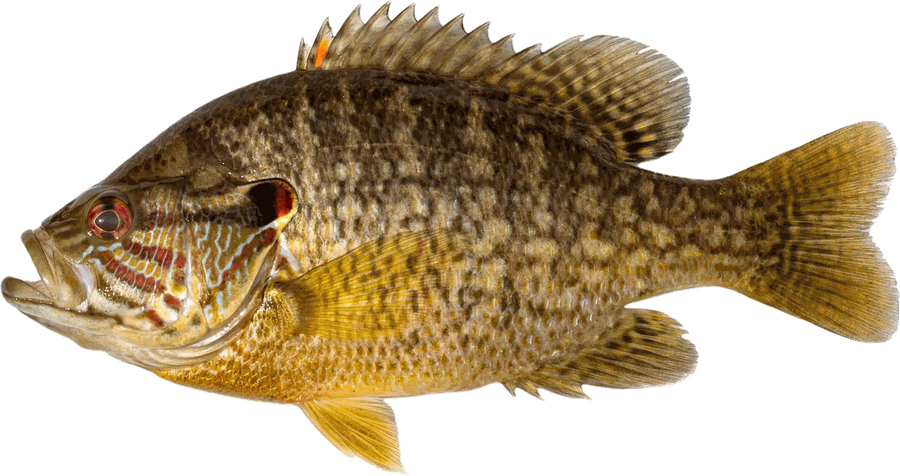
Bump Board's tactics library for Warmouth — where to fish, what to tie on and how to fish it, season by season. In the app, these tips adapt live to the weather, the front and the light.
Warmouth — Prespawn
Where to fish
- Start with what this entry is: warmouth's rating is a derived set, capped at Low confidence, and its prespawn is a construction on a measured spawn clock — nesting commences when temperatures exceed 21 °C, peaks late May to early June, and can extend through August. Ahead of that crossing, fish move into the shallow, vegetated, still water they nest in: solitary fish, tight to submerged objects and vegetation clumps, over silt and sand.
- In still water the cover numbers are stark: electrofishing caught 4.7 warmouth per hour along vegetated shoreline against 0.2 per hour in non-vegetated zones, and macrophyte availability was the largest factor in warmouth density across Florida lakes. Prespawn effort belongs on the vegetated shoreline itself — the cover is not one factor among many for this fish; on the record, it is the address.
- In moving water the occurrence record points the same way, to stillness: peak abundance at average velocities of about 10 cm/s or less, on near-zero gradients, in pools and backwaters, growing rare where gradients reach roughly 1.5–2.6 m/km. Fish the dead-still backwater cover, not the moving channel.
What to tie on
- Small offerings matched to the young and smaller fish's menu — plankton-sized beginnings give way to small insects — presented tight to cover, because this ambush fish seldom takes a motionless food item on the one observation the record offers: movement at close range is the trigger the literature supports. No lure is named in the warmouth literature, and none is invented here.
- For larger prespawn fish, begin the shift the diet work measures with size: insects give way to shrimp, crayfish and small fish as warmouth grow, so the biggest fish beside the heaviest cover want the largest natural-profile offerings of the prespawn set.
How to fish it
- Fish the warming as a threshold, not a trend: little in this species' measured year happens until the water crosses 21 °C, and then nesting commences. Through the teens, work the warmest vegetated shallows slowly; the prespawn pattern is a waiting pattern built around one number.
- Time the day by the constructed clock, and carry its flag: warmouth's diel shape is Grade C, built from two agency profiles that contradict each other outright — one says dusk, dawn and night with little midday activity; the other says morning feeding and a fish that sleeps at night. The model follows the dusk-and-dawn side, for the crayfish-prey reason given in the summer entry. Prespawn effort at the light changes is that construction applied, not a measured finding.
If it's still tough
- If the vegetated shallows are empty, the 21 °C crossing has not arrived — check the thermometer before the tackle, and drop to the first still, covered edge off the shallows while you wait for the temperature the spawn clock actually runs on.
Warmouth — Spawn
Where to fish
- Spawning runs from the 21 °C onset through August, with high spawning activity measured at 21–27 °C and the peak in late May and early June; multiple spawning in a season is documented. Unlike its colonial cousins, warmouth nests alone: a solitary nest beside a submerged object — a stump or a vegetation clump — at depths of about 5–152 cm, with most Illinois nests at 61–76 cm, over silt or sand and sometimes covered with debris. Fish single pieces of cover in the shallows, one at a time.
- A wider occurrence band exists and is kept separate, as the research keeps it: a Canadian synopsis family puts spawning occurrence at 18–32 °C. That is the outer envelope of where spawning has been reported, not the high-activity band — the pattern in this entry fishes 21–27 °C, and treats fish outside it as early or late, not as the peak.
What to tie on
- Offerings worked tight to the single nest's object, sized to the shallows menu of insects and small crustaceans. Nothing spawn-specific is measured for this species — no spawn bait is named in the warmouth literature, and none is invented here.
How to fish it
- Carry the guard-state discipline with its label showing: no warmouth study has measured how much a guarding male feeds, so the rule applied here — a male on the nest strikes by aggression, not feeding, and gets no feeding bonus — is a labelled family pattern, honestly weaker here than where it was measured. Males build, guard and fan; the feeding fish are the ones off the nests, in the neighbouring cover.
- Work the spawn as a search problem: a solitary nester beside one object means the pattern is covering vegetated shoreline and checking each stump, clump and debris pile, at the light changes the constructed clock favours. Repeated spawning through August means fresh nests keep appearing — a flat that was empty in June is worth re-checking in July.
If it's still tough
- If a nest fish swats rather than eats, you are seeing guarding, not a feeding mood the research can price — move to the next piece of cover and the feeding fish around the nesting shallows instead of working one nest harder.
Warmouth — Summer
Where to fish
- Summer warmouth are the cover pattern at full strength: shallow, vegetated, often swampy still water, holding beside submerged objects in silt and vegetation — the habitat model for its northern bay put depth first (about three-quarters of the model's importance), then substrate and minimum temperature, in shallow vegetated water over silt with low turbidity preferred. Fish the thick, shallow cover fields and their inside edges; open water is not this fish's summer address.
- The temperature frame needs its construction stated in the open: no preferred temperature has ever been measured for warmouth — the only published curve assumed largemouth bass values (25–30 °C excellent, poor below 15 °C and above 32 °C) and said so on its face. This entry's plateau (23–28 °C in the model) is centred on warmouth's own measured spawn band and bounded by its field maximum — fish collected to 33.9 °C, with a field tolerance estimate of 34.0 °C, an occurrence statistic, not a lethal. Inside the mid-20s you are on the construction's strong ground; past the low 30s you are on its tail.
What to tie on
- Fish the crayfish menu, because it is this species' defining diet science: in a seven-species river study warmouth occupied a distinctive position defined by crayfish, with shrimp and fish alongside, and the size series shows the largest fish turning dramatically more crayfish-heavy. Crayfish and shrimp profiles tight to cover are the supported summer presentation for adult fish; small fish take insects — midge and dragonfly larvae first. No lure is named in the warmouth literature, and none is invented here.
How to fish it
- Fish the light changes and the night, on the constructed clock — dawn 0.90, day 0.55, dusk 1.0, night 0.80 — and know exactly what it is: the Mississippi profile's shape (dusk, dawn or night; very little midday), followed over the Florida profile's opposite claim (morning feeding, sleeps at night) because the adult prey — crayfish and shrimp — are night-active, cover-dwelling prey. That reasoning is labelled inference in the research, the factor is Grade C, and it is the weakest scored factor in this set. Midday is the trough on the followed profile: the shaded, tannin-dark cover water is where a midday attempt belongs.
- Use this fish's one genuinely strong physiology chapter as a location rule: its critical oxygen level is measured at 3.6 mg/L at 20 °C for long-term survival and growth, while acute survival runs down to 0.3–1.0 mg/L — among the last fish to die when oxygen crashes. In a hot, still, swampy basin where other cover fish have vacated, warmouth may still be there, living moderately through the 2–3.6 mg/L band rather than collapsing. Survival is not a feeding rate — the feeding curve in the rating is fitted to this species' own measured consumption response (Larimore 1957) — and the address is its own.
If it's still tough
- If thick summer cover is silent, check the cover before the bait — the electrofishing split (4.7 against 0.2 per hour) says location in vegetation outweighs presentation for this fish by an order of magnitude. Move to denser, shallower, stiller cover; and if the water has pushed past the low 30s, you are off the construction's plateau and the fix is the coolest vegetated water in the system.
Warmouth — Fall
Where to fish
- Fall warmouth slide down the same construction the summer entry states: feeding continues in the vegetated shallows as the water cools through the plateau's lower edge, toward the still, non-flowing water the winter record points to. The fall decline itself is unmeasured in detail for this species — no consumption-versus-season dataset exists — so this entry fishes the spawn-and-temperature shape honestly: warmest vegetated shallows first, deeper still cover as it cools.
- In moving water the fall fish are where they always are on the occurrence record — the near-zero-gradient backwaters and pools at velocities of about 10 cm/s or less, tight to the submerged objects and vegetation. Cooling does not move this sedentary, solitary fish far; work the summer backwater cover more slowly before you search new water.
What to tie on
- The summer crayfish-and-shrimp menu, a step slower and tighter to cover: cooling shortens the effective day on the constructed crepuscular clock, so put the best presentations into dawn, dusk and the first dark hours. No fall-specific lure is named in the warmouth literature, and none is invented here.
How to fish it
- Concentrate the day at its edges: on the followed diel construction, fall effort belongs at dusk first, dawn second, and into the night — with the same Grade C flag the summer entry carries, because no primary diel study exists in any season. Give each piece of cover real time; a cooling ambush fish beside its object is not travelling to a bait.
- Let the thermometer pace the slide: the model's fall anchors step down through the teens toward the winter floor on interpolation, not measurement — there is no measured cold feeding threshold at any temperature for this fish. Log your own fall results against temperature; on this species, your notebook is genuinely adding to a thin record.
If it's still tough
- If the fall shallows go quiet, move toward warmth, stillness and the thickest remaining cover before you change baits — and hold the honest limit in view: below the mid-teens the construction is running on the habitat profile's poor boundary, not on measured feeding, so a silent cold flat may be the edge of the studied year, not a failed pattern.
Warmouth — Winter
Where to fish
- Winter is this species' honest blank, and the entry says so at the top: warmouth demonstrably overwinter under ice at their northern edge — the Canadian populations are Lake Erie fish that persist through Ontario winters — yet no under-ice feeding, movement or catch-rate study exists, and no cold activity threshold has ever been measured. What follows is the open-water winter pattern the fragments support, labelled as exactly that.
- The one winter posture on record is social, from simulation: warmouth stayed solitary through winter trials — no colonies, no aggregations — and often moved to non-flowing water. In open southern water, the winter address that supports is single fish in still, vegetated cover; in the ice belt, presence is documented and behaviour is not.
What to tie on
- Small, slow, natural offerings tight to still-water cover, sized to the insect end of the diet — a winter presentation built by shrinking the measured menu, not from any winter study. No winter-specific lure is named in the warmouth literature, and none is invented here.
How to fish it
- Fish the warmest part of the day in the stillest cover you can find, and give single located fish long, close presentations: a solitary ambush fish in cold water is a located-fish game in every season, and winter adds no searching pattern the research can offer.
- Do not import a cousin's winter: its two closest relatives point opposite ways in the cold — one feeds all winter on measurement, the other goes near-dormant in the laboratory — and the research refuses both as warmouth loans for exactly that reason. Warmouth's winter feeding is unmeasured, and this entry leaves it unmeasured rather than borrowing a posture.
If it's still tough
- If winter cover is silent, that silence is the documented state of the science, not evidence you fished it wrong: the proven warmouth year is the warm season from the 21 °C crossing through August. Cold-season effort is honestly better spent on species with a measured winter pattern.
Warmouth on the ice — Through the ice season
Where to fish
- No ice parameter set exists for this species, deliberately: warmouth overwinter under ice across the northern part of their range, but no under-ice feeding, movement or catch-rate study exists for it, so no ice rating is issued rather than an invented one. If your water is ice-covered, the honest guidance is the winter open-water pattern in this guide — single fish in still, vegetated cover — labelled as exactly that, not as ice science.
- The northern presence is the reason this is not-covered and not not-applicable: a species whose Canadian fish persist through Lake Erie winters has an ice season — it simply has no measured ice behaviour. The only winter posture on record anywhere is solitary fish favouring non-flowing water in simulation, which is a posture, not a pattern to fish through ice.
What to tie on
- No ice presentation is sourced for warmouth. Nothing here is borrowed from another species to fill the space.
How to fish it
- Treat ice-season warmouth as unstudied water: fish the winter open-water cover pattern if you fish them at all, and know the library has no ice science to check your results against — any under-ice feeding study, cold-activity threshold or multi-lake ice-catch dataset would reopen this disposition, and none exists yet.
- Do not borrow a cousin's ice set for this hole: the research refuses congener winter shapes for warmouth in both directions, because its relatives' own winter records contradict each other. A borrowed ice pattern would be invention with a citation attached, and this entry will not do it.
If it's still tough
- The sourced warmouth seasons are the 21 °C spawn crossing, the warm vegetated summer and the cooling fall. The ice season is, on present evidence, a gap — the entry says so rather than papering over it.
Where Warmouth live
350 waters in the Bump Board dataset hold Warmouth. A selection:
Ontario
Florida
Idaho
Illinois
Indiana
- Adams Lake
- Appleman Lake
- Atwood Lake
- Ball Lake
- Banning Lake
- Barton Lake
- Baugher Lake
- Bear Lake
- Beaver Dam Lake
- Bell Lake
- Big Chapman Lake
- Big Lake
- Big Long Lake
- Big Otter Lake
- Bixler Lake
- Blue Lake
- Bower Lake
- Brokesha Lake
- Buck Lake
- Cass Lake
- Cedar Lake
- Cedar Lake
- Center Lake
- Cook Lake
Plus 119 more Indiana waters — browse Indiana lakes.
Louisiana
Michigan
- Algonquin Lake
- Archer Lake
- Austin Lake
- Baker Lake
- Baldwin Lake
- Barnes Lake
- Bassett Lake
- Batteese Lake
- Beadle Lake
- Bear Lake
- Bertha Lake
- Big Cedar Lake
- Big Crooked Lake
- Big Evans Lake
- Big Fish Lake
- Big Lake
- Big Pine Island Lake
- Blind Lake
- Briggs Lake
- Burke Lake
- Campbell Lake
- Carter Lake
- Chief Noonday Lake
- Chippewa Lake
Plus 126 more Michigan waters — browse Michigan lakes.
Minnesota
Mississippi
- Aberdeen Lake
- Aliceville Lake
- Bay Springs Lake
- Bee Lake
- Columbus Lake
- Geiger Lake
- Horseshoe Lake
- Jefferson Davis Lake
- Lake Bill Waller
- Lake Bogue Homo
- Lake Lamar Bruce
- Lake Lowndes
- Lake Washington
- Moon Lake
- Okatibbee Lake
- Perry Lake
- Ross R Barnett Reservoir
- Spring Lake
Oregon
Pennsylvania
Tennessee
Virginia
- Airfield Pond
- Burke Lake
- Gardys Millpond
- Harrison Lake
- Harwoods Mill Reservoir
- Lake Kilby
- Lake Orange
- Swift Creek Lake