
Fishing tips & tactics
How to catch Tiger Trout
Salmo trutta × Salvelinus fontinalis
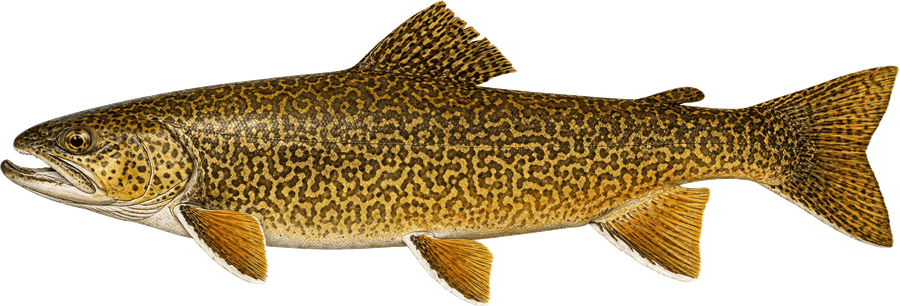
Bump Board's tactics library for Tiger Trout — where to fish, what to tie on and how to fish it, season by season. In the app, these tips adapt live to the weather, the front and the light.
Tiger Trout — Summer
Where to fish
- Summer water inside the blended 13–17 °C plateau is this set's prime band — a construction between the parents' plateaus, not a measured tiger preference, and the entry never quotes it as one. The season values hold near the year's top through the band (June and July at 0.90, August at 0.85), so the summer search is for water holding in the teens rather than for a special hour or a special shore.
- In stocked lakes, the adult address follows the forage fish: at Scofield Reservoir, stocked adult tigers ate Utah chub at up to 80% of diet depending on season, and the population's consumption exceeded the chub's annual production (Winters et al. 2017). Where a stocked lake holds dense small-bodied forage fish, adult tigers are piscivores working that forage — fish the water the forage schools use, at the depths they hold.
What to tie on
- Lead with the piscivore tier for adult fish in forage-rich water — a fish-profile presentation is diet-supported for this hybrid in a way it is not for most trout, on the Scofield record above — and keep small invertebrate presentations for smaller fish on the juvenile menu. No lure is named in the tiger literature; the menu tiers are the supported tackle story.
How to fish it
- Fish the flat clock as flat: dawn, day and dusk sit within 0.05 of each other on the blend, with night lower at 0.70. A summer plan built on coverage of plateau-temperature water will out-fish a plan built on waiting for a peak hour this hybrid has never been shown to have.
- Do not fish the famous aggression claim, because the one controlled test contradicts it: in laboratory trials, rainbow trout initiated 10.2 times more aggressive interactions than tiger trout, and tigers initiated only 1.9 times more than cutthroat (Hafen & Budy 2015) — and tiger aggression against its own two parents has never been tested at all. What anglers read as aggression is most parsimoniously piscivory plus stocked, naïve fish; there is no aggression bonus anywhere in this entry or its rating.
If it's still tough
- If plateau water is quiet, check the warm limb before the tackle: the blended curve falls to 0.75 at 19 °C and 0.50 at 21 °C. Warming past the plateau is a measured-direction problem on the parent curves — move toward cooler water rather than cycling presentations in water the curve is already leaving.
- On clarity, the honest limit: no tiger turbidity measurement exists, and the rating carries no turbidity term for this fish at all. This entry offers no tiger clarity rule of its own, because there is none to offer.
Tiger Trout — Fall
Where to fish
- Fall is a feeding season that simply continues, and that continuity is the one place tiger-specific evidence changes a number in this whole set: the season values hold at 0.85 through September and October and ease to 0.75 in November, declining with temperature only. Fish the cooling stocked lakes as a long feeding shoulder, on the same forage and invertebrate addresses as summer, as the water falls back through the plateau.
- What fall is not, for this fish: a spawning season. Tiger trout are a sterile hatchery hybrid — survivors are not reproductively viable, and modern production induces triploidy to guarantee it. There is no spawning migration, no redd, no guarding and no pre-spawn aggregation to stage below, and both parents' October–November spawning shapes were deliberately removed from the derived season curve rather than inherited.
What to tie on
- The adult piscivore tier stays first in fall: the Scofield diet record was seasonal, with chub share varying by season but piscivory present across them (Winters et al. 2017), so a fish-profile presentation for large adults remains diet-supported as the water cools, alongside the invertebrate menu for smaller fish. Nothing fall-specific beyond that diet record is measured, and no spawn pattern is borrowed from either parent to fill this section.
How to fish it
- Fish the temperature decline as the schedule: as long as the water holds in or near the 13–17 °C plateau the season value stays high, and the fall-off after that is the cold limb, not a behavioural switch. There is also no flow trigger to wait for — the only flow responses evidenced in either parent are spawning-migration triggers, a sterile fish has no spawning migration, and the rating carries flow at zero for exactly that hybrid-specific reason.
- Keep fall hours spread across the day on the flattened blend (dawn 0.80, day 0.80, dusk 0.85, night 0.70): because the spawning structure was removed from this season, there is no special fall hour hiding in the parents' spawning behaviour either — the honest fall pattern is ordinary feeding hours on cooling water, with dusk holding only the blend's small lean.
If it's still tough
- If fall fish go quiet, do not wait for a spawning peak that will never come and do not read the quiet as a spawn fast — this fish does not spawn. Check the temperature against the cold limb (0.55 at 7 °C on the blend) and fish the warmest holding water; late-fall quiet in a sterile hybrid is a temperature story, told at a feeding rate that declines toward the winter floor.
Tiger Trout — Winter
Where to fish
- Winter is the derived floor: season values sit at 0.50 in December and 0.40 through January and February, between the parents' measured winters — brook feeding in the littoral all winter on its own telemetry, and the brown parent's under-ice consumption running at roughly a tenth to a sixth of its summer peak in its one lake study. Those are parent numbers, labelled as the blend's ingredients; no tiger winter feeding rate exists. In open winter water, fish the holding water the fish already occupy and expect a low rate, not a shutdown.
- Cold water itself is not the barrier the floor might suggest: the blended cold limb holds 0.40 at 4 °C and 0.30 at 1 °C, so a winter tiger in near-freezing water is a slow fish on this curve, not an absent one — the through-ice pattern for stocked lakes is covered in the ice entry below.
What to tie on
- Small and slow on the winter menu: the invertebrate tier at its smallest, delivered close to holding fish that are not travelling far to a bait on a floor-rate season. No winter-specific lure is named for this hybrid, and the fish-profile tier belongs to active adult feeding in warmer water, not to a winter claim.
How to fish it
- Use the same flattened clock, carried into winter without embellishment: dawn 0.80, day 0.80, dusk 0.85, night 0.70 is a blend of two conflicting parent shapes, and no winter diel measurement of any kind exists for the hybrid to sharpen it. Spend winter effort on position — the right stocked lake, the right holding water — rather than on hour-picking a curve that was built to claim as little as possible.
- Fish a winter lake like its fish may have been educated, because catchability is learned in the parent record this set leans on: in the brown parent's work, anglers took 11–23% of a heavily fished population per trip series against up to 47% of a naïve one (Young & Hayes 2004), a caution the study carries over to stocked tigers in kind. A winter lake that fished easily at stocking and harder since is showing that learning curve, not a vanished population.
If it's still tough
- A quiet winter session is the arithmetic of this set, not necessarily a wrong lake: a derived floor built from two parents' low winter rates promises few chances. Shorten the session, fish the warmest holding water perfectly, and save the long efforts for the spring climb back toward the plateau.
Tiger Trout — Spring
Where to fish
- Start with what kind of entry this is, because it governs everything below: tiger trout's rating is a DERIVED set, confidence capped at Low, and 0 of its 100 open-water points rest on a tiger-measured response function — no activity, diel, thermal or weather study of this hybrid exists at all. No other fish's curve is used for it: temperature, time of day and season are carried flat and neutral, and oxygen and turbidity are not scored — the rating rests on the generic terms, and the prose says so wherever a number is used.
- Spring is a temperature climb toward a blended plateau: the derived curve reaches 0.80 at 10 °C on its way to a 13–17 °C plateau built point by point between brook's 13–16 °C and brown's 14–18 °C plateaus, and the season values rise with it — 0.50 in March, 0.70 in April, 0.85 in May. Fish the stocked-lake water that is warming into that band first; the coldest water in the system is the last water this curve rewards.
What to tie on
- Fish the diet tiers the tiger record actually measures: juveniles and smaller fish take zooplankton and aquatic invertebrates, and adults shift toward fish prey where small-bodied forage fish are available, with crayfish and insects in the agency diet accounts. Small invertebrate presentations for ordinary fish and a fish-profile option for large adults are the diet-supported tiers — and that is the whole supported statement, because no lure, fly pattern or size is named for tiger trout in the research behind this entry, and none is invented here.
How to fish it
- Time the day by a deliberately flattened clock, and know why it is flat: the parents conflict — brook is the day-led trout, brown the dusk- and night-led one — so the derived diel is a midpoint blend (dawn 0.80, day 0.80, dusk 0.85, night 0.70) that claims no real peak. That blend is flagged in the study as the set's largest structural risk. Fish across the day with a slight lean to dusk, and do not fish this hybrid as either parent's clock.
- Expect lake-to-lake results to vary for a stocked-fish reason that is measured: in seven Colorado subalpine lakes, age-1 tiger size ran from 115 to 229 mm and the strongest predictor was the cohort's own stocking density, mediated by system productivity (Hansen et al. 2022). A lake whose tigers grow slowly is often a stocking-density story, not a presentation story.
If it's still tough
- If spring shallows are silent, check the temperature against the cold limb before changing baits: the blended curve sits at 0.55 at 7 °C and 0.40 at 4 °C, so a cold spring lake is a slow lake on this evidence — fish the warmest water that is climbing toward the plateau and give it real time.
Tiger Trout — Warm
Where to fish
- Above the plateau this is a relocation problem on borrowed numbers, stated as such: the blended curve falls through 0.75 at 19 °C, 0.50 at 21 °C, 0.25 at 23 °C and 0.05 at 25 °C. Find water back inside 13–17 °C — the coolest, deepest holding water a shallow stocked lake offers, and any inflow-cooled corner — before spending effort anywhere else.
- On oxygen, the honest limit: no tiger oxygen response has ever been measured, so the rating scores no oxygen term for this fish. Tiger occupancy of stocked lakes with large low-oxygen portions of the water column (Hansen et al. 2022) is an occurrence fact, not a response curve, and it does not make warm, low-oxygen water a feeding address.
What to tie on
- The menu does not change in warm water — invertebrates for smaller fish, fish prey for adults — and the presentation question is honestly secondary to the address. No warm-water lure or tactic is named for this hybrid, and none is invented here to fill the space.
How to fish it
- Compress effort toward dusk, the blend's one slight lead at 0.85 — and do not import the brown parent's night pattern to rescue a warm day: on the tiger blend, night at 0.70 is the lowest quarter of the clock, because the other parent is a day fish. Warm tiger water is a temperature problem with a small dusk lean, not a night fishery anyone has measured.
- Once you find a cool band that still carries oxygen, work it thoroughly instead of searching the warm surface between spots: the fishable warm-season water in a shallow stocked lake can be a thin layer — a found layer fished carefully is worth more than a lake searched quickly.
If it's still tough
- If the whole lake sits at 23 °C or warmer with no cooler band reachable, there is no presentation fix on this evidence — and do not let anyone quote you a tiger lethal temperature to decide by: none has been measured, the parents' incipient lethals are different measurements on different fish (brook 25.3 °C, brown 24.7 °C), and the study refused to average them into a fabricated 25.0 °C. Travel to cooler water or wait for the fall cooling, which is this set's next strong season.
Tiger Trout on the ice — Through the ice season
Where to fish
- PROVISIONAL — flagged in the entry the way the study flags the set: tiger trout are demonstrably caught through the ice, and that fishery record is all the ice evidence there is. Manitoba's Parkland stocked lakes produce Master Angler tigers through the ice (Twin Lakes fish of 26.5 in on 25 Jan 2025 and 26.35 in on 6 Apr 2025), and a North Dakota state-record tiger was taken through the ice on 4 Jan 2026 — but no under-ice feeding, diel or oxygen study of this hybrid exists in any system, so this whole entry is provisional and capped at the set's Low confidence.
- The signature water shows the class to fish: Twin Lakes is a small, shallow stocked lake (43.2 ha, maximum depth 6.4 m, aerated, catch-and-release) in the Duck Mountain Parkland. Shallow stocked lakes of that class are the winter address — with the oxygen caution that belongs to shallow water under ice: no tiger oxygen measurement exists, so the rating scores none, and better-oxygenated water is the prudent search — stated as prudence, not as a tiger curve.
What to tie on
- No ice lure, jig or bait is named for tiger trout in any source behind this entry, and none is invented here. The diet-supported shape carried under ice, labelled as a transfer from the open-water record, is the two tiers at their smallest and slowest: invertebrate presentations for ordinary fish, and a fish-profile option for the largest adults on the measured adult piscivory — a diet fact, not an ice finding.
How to fish it
- Fish the flattened blend, because that is literally what the ice clock is: the open-water diel (dawn 0.80, day 0.80, dusk 0.85, night 0.70) carried under ice as a labelled within-set transfer, never measured beneath it. No hour is a proven tiger hour under ice; dusk holds the blend's small lean, the day is its equal within a few points, and a located school of stocked fish matters more than the clock on every piece of evidence available.
- Set expectations by the winter arithmetic and the stocking reality together: the season floor is low, and a given lake's tiger size and density are outputs of its stocking programme and productivity (Hansen et al. 2022) as much as of the fish — a slow lake through the ice may simply be a lightly stocked or crowded one.
If it's still tough
- If a provisional ice pattern is silent, treat it as an open question rather than a failed one — the evidence under this entry is fishery records plus neutral terms, and your lake is allowed to disagree with both. Move first toward better-oxygenated water in the shallow stocked lake before changing presentations; and if the whole basin is quiet, the honest reading is the floor rate of a derived set, not a tactic you have not tried yet.
Manitoba Master Angler
A Tiger Trout of 51 cm (20 in) or better qualifies for Manitoba's Master Angler Program.
Where Tiger Trout live
282 waters in the Bump Board dataset hold Tiger Trout. A selection:
Manitoba
- Bell Lake
- Bell Pond
- Blueberry Pond
- Camp Lake
- Corstophine Lake
- Elgin Reservoir
- Foot Print Lake
- Gass Lake
- Gull Pond
- Hunt Lake
- Kingfisher Lake
- Lac Du Bonnet
- Lac Du Bonnet Ponds
- Lafarge Pit 1
- Limestone Pond
- Lyons Lake
- McHugh Lake
- Mid Lake
- One Lake
- Perch Lake
- Persse Lake
- Pybus Lake
- Quartz Pond
- Scotty Lake
Plus 5 more Manitoba waters — browse Manitoba lakes.
Nova Scotia
Arizona
Colorado
- Antero Reservoir
- Deep Slough Reservoir
- Heart Lake
- Joe Wright Reservoir
- Meadow Creek Reservoir
- Monument Lake
- Neversweat Reservoir
- North Lake
- Officers Gulch Pond
- Porter Reservoir Number 4
- Sackett Reservoir
- Saint Marys Lake
- Williams Creek Reservoir
- Yankee Doodle Lake
Connecticut
Idaho
Montana
North Dakota
Nebraska
Nevada
- Angel Lake
- Blue Lake
- Comins Lake
- Dorsey Reservoir
- Eagle Valley Reservoir
- Hinkson Slough
- Hobart Creek Reservoir
- Island Lake
- Knott Creek Reservoir
- Lamoille Lake
- Onion Valley Reservoir
- Rose Creek Reservoir
- Ruby Lake Unit Twenty-one
- Silver Creek Reservoir
- South Fork Reservoir
- Spooner Lake
- Topaz Lake
- Wild Horse Reservoir
Oregon
South Dakota
Utah
- Academy Mill Reservoir
- Birch Creek Reservoirs
- Blue Lake
- Browne Lake
- Causey Reservoir
- Crouse Reservoir
- Currant Creek Reservoir
- Duck Fork Reservoir
- East Canyon Reservoir
- Electric Lake
- Fish Lake
- Forsyth Reservoir
- Grassy Lake
- Huntington Reservoir
- Joes Valley Reservoir
- Kolob Reservoir
- Koosharem Reservoir
- Long Park Reservoir
- Lost Creek Reservoir
- Lower Bowns Reservoir
- Maple Lake
- Matt Warner Reservoir
- Mill Hollow Reservoir
- Mill Meadow Reservoir
Plus 25 more Utah waters — browse Utah lakes.
Washington
- Aeneas Lake
- Aspen Lake
- Blue Lake
- Clear Lake
- Clear Lake
- Coffin Lake
- Conners Lake
- Cougar Lake
- Dry Falls Lake
- Dry Lake
- Dusty Lake
- Fish Lake
- Franklin D Roosevelt Lake
- Gillette Lake
- Lake Heritage
- Lake Thomas
- Loon Lake
- Patterson Lake
- Putters Lake
- Reflection Pond
- Roses Lake
- Sacheen Lake
- Sherry Lake
- Squalicum Lake
Plus 2 more Washington waters — browse Washington lakes.
Wyoming
- Bosler Reservoir
- Burlington Lake
- Cliff Lake
- Cloud Peak Reservoir
- Dipper Lake
- Dollar Lake
- Dome Rock Reservoir
- Fish Lake
- Flaming Gorge Reservoir
- Granite Lake
- Hauser Lake
- High Savery Reservoir
- Jim Bridger Reservoir
- Lake Viva Naughton
- Long Lake
- Lower Sunshine Reservoir
- Meeks Lake
- Newton Lakes
- North Crow Diversion Reservoir
- Rainbow Lake
- Rawlins Reservoir
- Ringbone Lake
- Sand Lake
- Saratoga Lake
Plus 5 more Wyoming waters — browse Wyoming lakes.
Alberta
- Athabasca
- Barrhead
- Bear Pond
- Beaumont Pond
- Beaver Lake
- Big Iron Lake
- Black Nugget Mine
- Black Nugget Mine Pit
- Blood Indian Creek
- Boulder Lake
- Camrose
- Captain Eyre Lake
- Captain Eyre Lake (Capt
- Cardiff Park Pond
- Castaway Trout Pond
- Chain Lakes
- Chatwin Lake
- Cold Lake
- Coronation Reservoir
- Dickson Trout
- Dickson Trout Pond
- Dillberry Lake
- Diplomat Mine
- Diplomat Mine Pond
Plus 59 more Alberta waters — browse Alberta lakes.
Saskatchewan
- Atchison Lake S of Keeley Lake, N of Meadow Lake
- Coal Pit-SPC-C 9 km SW of Estevan
- Exner Lake 8 km S of Loon Lake (town)
- Lady Lake 8 km NE of Preeceville
- Lisieux Pond 1 km S of Lisieux
- Mekewap Lake 47 km N of La Ronge
- Nesland Lake 3 km W of Mount Nebo
- Picnic Lake 6 km NE of Edam
- Round Lake 20 km SW of Loon Lake (town)
- Tea Creek 35 km NW of Big River (town)
- Vimy Creek 25 km N of Leoville, Hwy #946
- Vivian Lake Meadow Lake Prov. Park