
Fishing tips & tactics
How to catch Striped Bass
Morone saxatilis
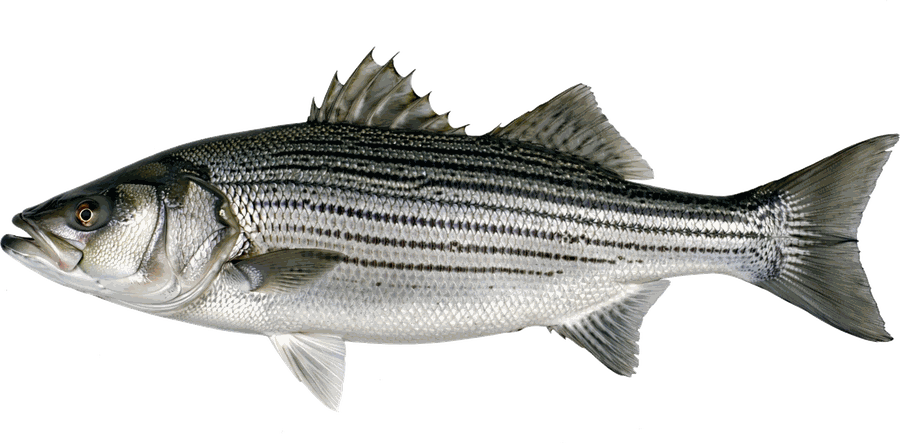
Bump Board's tactics library for Striped Bass — where to fish, what to tie on and how to fish it, season by season. In the app, these tips adapt live to the weather, the front and the light.
Striped Bass — Summer
Where to fish
- Summer is the squeeze, and the squeeze is the whole location rule: warm surface water above, low-oxygen depths below, and the fish compressed into the cool, oxygenated layer between. The ladder is measured, not a single threshold: refuges above 5 mg/L are best, distribution limits near 4, fish will occupy water at 2 — but feeding and growth are already impaired there — and below 2 they avoid entirely. In Badin telemetry the fish stayed on the oxycline even after they no longer had to. Find that layer; the fish are in it, not at a depth.
What to tie on
- Present at the layer, exactly: a bait running above or below the oxythermal band is not fishing this species in summer, whatever it catches in spring. Match the layer's forage — shad-type profiles are the reservoir standard this fish's diet work supports.
How to fish it
- Keep the temperature side of the squeeze in view too: the plateau is 20–23 °C, decline sets in above about 25 °C, and 27 °C is a soft stress anchor, not the 'stop feeding' law it's sold as (that claim failed verification — fish with prey in their stomachs were documented above it). In warm periods the movement pattern shifts night-ward: dawn, dusk and night outfish the midday squeeze hours.
If it's still tough
- If the layer won't produce, the layer is what to re-find, not the bait to change: re-locate the cool, oxygenated band after any big weather or water-level change — the squeeze moves, and the fish move with it to the hour.
Striped Bass — Fall
Where to fish
- Fall releases the squeeze: as the surface cools, the whole column opens back up and movement rises to its spring-like high. Fish the expanding water — the fish are redistributing from the summer refuge layer toward the bait and the shallows.
What to tie on
- Forage-matching offerings through the column again — fall is the one season you can fish this species at every depth and be right somewhere. Follow the bait schools; fall stripers are where the forage concentrates.
How to fish it
- Dawn and dusk stay the movement peaks. Cover water while the fish are travelling — fall is a searching season, the reverse of summer's sit-on-the-layer discipline.
If it's still tough
- If fall fish are scattered, they're on the move between refuges and feeding water — intercept the routes (points, creek channels, the edges of the summer refuge) rather than casting open water.
Striped Bass — Winter
Where to fish
- Winter is the low season in most of the telemetry: movement bottoms out and fish hold in the deep, stable water. One honest discrepancy the monograph keeps: a Lake Gaston study found no significant seasonal movement difference at all — so 'winter low' is the majority pattern, not a law.
What to tie on
- Slow, deep, forage-matching presentations in the holding water. Winter stripers are a located-fish game: sonar first, casts second.
How to fish it
- Fish the warmest, most stable part of the day over located fish and give a school time — winter movement is minimal, so a found school stays found.
If it's still tough
- If deep schools won't take, wait for the light changes — even in winter, dawn and dusk are the movement periods the synthesis supports.
Striped Bass — Springrun
Where to fish
- The spring run is the season: as the water rises through about 13–18 °C, landlocked stripers run up the rivers and tributary arms. Fish the running water and the staging water below it. Committed runs are robust — tracked fish held their run through a front-scale temperature drop and a doubling of flow — so a weather blip doesn't cancel the run.
What to tie on
- Match the forage moving with them. The monograph's evidence is movement and habitat, not baits — it names no lure, and this entry follows it: size and profile to the baitfish in the river with you.
How to fish it
- Fish the run's clock: dawn and dusk are the elevated movement periods in the telemetry synthesis (a movement pattern, one step removed from feeding — the entry labels it rather than dressing it as a bite window). Set up on the travel lanes at the light changes.
If it's still tough
- The staging pools between the lake and the spawning water hold the catchable concentrations.
- If one arm is quiet, move along the run — running fish are distributed along the route, and the staging pools hold the catchable concentrations.
Striped Bass on the ice — Through the ice season
Where to fish
- No ice parameter set exists for this species, deliberately: no under-ice study of landlocked striped bass exists, and issuing the generic ice template would invent one. If your water is ice-covered, the honest guidance is the winter open-water pattern — deep, stable holding water — labelled as exactly that.
What to tie on
- No ice presentation is sourced for landlocked striped bass. Nothing here is borrowed from another species to fill the space.
How to fish it
- Treat ice-season stripers as unstudied water: fish the winter holding pattern if you fish them at all, and know the library has no ice science to check your results against.
If it's still tough
- The sourced striper seasons are the spring run, the summer squeeze layer and the fall release. The ice season is, on present evidence, a gap — the entry says so rather than papering over it.
Where Striped Bass live
133 waters in the Bump Board dataset hold Striped Bass. A selection:
Ontario
- Alder Creek
- Black Creek
- Brandy Creek
- Bronte Creek
- Buckshot Lake
- Cascaden Lake
- Fleetwood Creek
- Maitland River
- Thames River
- Theriault Lake
- Usshers Creek
Nova Scotia
Alabama
- Bankhead Lake
- Bartletts Ferry Lake
- Claiborne Lake
- Coffeeville Lake
- H Neely Henry Lake
- Jordan Lake
- Lake Tuscaloosa
- Lay Lake
- Lewis Smith Lake
- Logan Martin Lake
- Martin Lake
- Mitchell Lake
- Thurlow Reservoir
- Weiss Lake
- Wheeler Lake
- Wilson Lake
- Yates Reservoir
Arkansas
Arizona
California
Connecticut
Florida
Georgia
- Allatoona Lake
- Carters Lake
- Hartwell Lake
- High Falls Lake
- J. Strom Thurmond Reservoir
- Jackson Lake
- Lake Blackshear
- Lake Oconee
- Lake Oliver
- Lake Seminole
- Lake Sidney Lanier
- Lake Sinclair
- Nottely Lake
- Richard B Russell Lake
- West Point Lake
Illinois
Kansas
Kentucky
Louisiana
Maryland
Missouri
North Carolina
Nevada
Ohio
Oklahoma
Pennsylvania
- Beltzville Lake
- Blue Marsh Lake
- Cowanesque Lake
- Lake Nockamixon
- Lake Redman
- Lake Wallenpaupack
- Lake Williams
- Raystown Lake
South Carolina
Tennessee
- Boone Lake
- Cheatham Lake
- Cherokee Lake
- Chickamauga Lake
- Cordell Hull Reservoir
- Douglas Lake
- Fort Loudoun Lake
- Fort Patrick Henry Lake
- J Percy Priest Reservoir
- Melton Hill Lake
- Nickajack Lake
- Norris Lake
- Old Hickory Lake
- Tellico Lake
- Tims Ford Lake
- Watts Bar Lake
Texas
Utah
Virginia
- Claytor Lake
- John H. Kerr Reservoir
- John W. Flannagan Reservoir
- Lake Anna
- Lake Chesdin
- Lake Meade
- Lake Prince
- Leesville Reservoir
- Little Creek Reservoir
- Smith Mountain Lake
- Waller Mill Reservoir