Fishing tips & tactics
How to catch Smallmouth Bass
Micropterus dolomieu
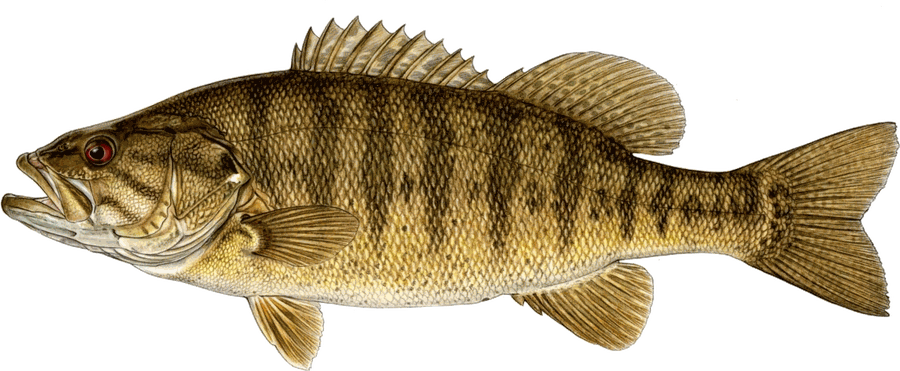
Bump Board's tactics library for Smallmouth Bass — where to fish, what to tie on and how to fish it, season by season. In the app, these tips adapt live to the weather, the front and the light.
Smallmouth Bass — Prespawn
Where to fish
- South-facing bays warm quickest, and in stable weather prespawn smallmouth feed in 2–6 ft. The biggest females stage a step away, on secondary points and 'stickouts' beside the spawning areas at the backs of bays and coves, in little packs — that's the trophy pattern. On the Great Lakes they're shallow until the water reaches the mid-60s °F; in the cold 40s °F they're confined to harbours and wind-protected bays.
- If cold pushes in — an offshore wind, heavy waves rolling in — they retreat to 15–25 ft.
- In rivers in the 50s °F they're bunched in the deeper bank eddies and pools; keep moving until you find the bunch.
What to tie on
- Tubes are the all-season staple — jigheads up to 1/4 oz. In the coldest trophy windows (water in the high 40s to low 50s °F) it's small tubes and hair jigs fished painfully slow. A jig-and-grub swum slowly and horizontally covers the 40–58 °F window. After a jerkbait finds a pack, a 1/16-oz green pumpkin Ned rig is the clean-up follow-up.
How to fish it
- Fish the warmest pocket you can find — on the big lakes the trophy water is usually right where a light wind blows directly into shore. Slow is the whole prespawn technique: painfully slow tubes, then slower.
If it's still tough
- When they won't move in cold water, repeat-cast rule: five, six or more presentations to the same spot before you give up on it. Cold prespawn smallmouth often eat the cast that looks exactly like the four they ignored.
Smallmouth Bass — Spawn
Where to fish
- Smallmouth spawn on sand mixed with pea gravel, nests built beside a log or boulder, in 2–5 ft. The males guard; the biggest bass hold the tallest, fastest-growing new cabbage nearby once the spawn ends.
- River bass nest entirely out of the current, on sand mixed with pea gravel, nests built beside a log or boulder, in 2–5 ft. The males guard.
What to tie on
- The sight-fishing kit: a 3-in hair jig — black is the best colour day in and day out — pitched to visible fish, and tubes. In June, pods of big bass feed in 1–3 ft on young baitfish where you can see them work.
How to fish it
- Fish the sun at your back and your shadow off the water. A 1/16-oz black marabou hair jig pitched to standing cabbage clumps is the Shield-country sight-fishing standard.
- During the spawn itself, poppers fished slow and quiet — the opposite of summer topwater style — are a season-specific play.
If it's still tough
- Guarding males that ignore everything are guarding, not feeding — note the spot and come back after the spawn, when those same fish bunch on the postspawn rock pattern, hungry.
Smallmouth Bass — Postspawn
Where to fish
- The postspawn funk lasts about a week — slow retrieves, deeper water than the spawn. Then the rock hunt begins: the biggest boulders, reefs and rocky points, and the 'elevator' — the sharp breaks the fish ride between deep and shallow. On the big lakes there's also the chalk line: fish suspended high over 40–50 ft of water, halfway between the spawning bay and the summer islands.
- On sunny days, postspawn fish suspend in the new cabbage — and the biggest bass dominate the tallest, fastest-growing cabbage in the area.
What to tie on
- Tubes, hair jigs and drop-shot rigs for the funk; then the rock baits — football jigs and craws on the breaks. For the suspended chalk-line fish, baits that hang in the column: jerkbaits and drop-shots fished high.
How to fish it
- Slow down through the funk — deeper and slower than the spawn. When it breaks, hunt rock systematically: boulders first, then reef edges, then the break lines.
If it's still tough
- Deadstick a soft plastic in place for one to three full minutes. In the postspawn funk, a bait that does nothing, for longer than feels sane, is a legitimate and proven presentation.
Smallmouth Bass — Summer
Where to fish
- Summer smallmouth feed on top of reefs and humps in 2–10 ft. Wind blowing into a spot pulls them into 2–3 ft and keeps them there until the water clears. Late summer is the scatter season — the forage glut spreads them out, and the answer is to search faster and finesse more.
What to tie on
- Tubes everywhere; lipless crankbaits and blade baits ripped over rock humps in 15–35 ft when they're chasing; suspending jerkbaits as the search bait on Shield lakes. Topwater over the early-summer cabbage flats.
How to fish it
- Cover water in the scatter season — the pods are small and spread. When a jerkbait finds a pack, drop the Ned rig or a tube on them immediately; packs feed competitively for a minute and then it's over.
If it's still tough
- Finesse is the late-summer answer: smaller tubes, drop-shots held still, deadsticked plastics. When bait is everywhere, your bait has to be the one that acts hurt, not the one that acts loud.
Smallmouth Bass — Early fall
Where to fish
- As the water drops below about 60 °F, smallmouth gather on steep-breaking shorelines, main-lake points and rock humps, packed in pods — and they stay active shallow until the water cools into the 40s °F. Steep and rocky is the fall address.
What to tie on
- The depth ladder does the searching: square-bill crankbaits across the rocks in 4–8 ft, fast; then mid-divers on the 12-ft contour; then deeper divers touching bottom on the 16-ft break — moving deeper in 4-ft steps until you find the pod's level. Lipless baits and blade baits rip over the humps.
- Fall livebait is its own system: a lively minnow or chub dragged tight to bottom on a 1- to 1½-oz no-snagg sinker, the bait a foot off bottom, hooks #4 to 2/0 for 3–8 in baits — on low-stretch mono, not braid; the fish feel braid's resistance and drop the bait.
How to fish it
- Pods feed hard — when you find them, work fast and stay on them. Deep-diving suspending jerkbaits with long pauses are deadly in near-white-cap fall weather.
If it's still tough
- If the ladder finds nothing shallow, the pod is one step deeper — keep stepping down in 4-ft increments rather than changing lakes. Fall pods are somewhere on the break; the ladder is how you prove where.
Smallmouth Bass — Fall
Where to fish
- Steep breaks, main-lake points and rock humps, in pods, active shallow on the warmest part of the day. Fall smallmouth bunch tighter than at any other open-water time — find one and you've found the group.
What to tie on
- The crankbait depth ladder, blade baits over the humps, and the dragged live-minnow system on mono. Hair jigs and tubes for when they want it slow.
How to fish it
- Fish the pods you've found thoroughly before searching for new ones — a fall pod is worth an hour. Slow down as the water falls through the 40s °F: tubes and jig-and-pigs are the cold formula (a 3½-in tube on a 1/4-oz head; 1/8 oz in lower, clearer water).
- Slow down as the water falls through the 40s °F: tubes and jig-and-pigs are the cold formula (a 3½-in tube on a 1/4-oz head; 1/8 oz in lower, clearer water), and above about 42 °F, slow-rolled spinnerbaits and 3½-in jerkbaits in the deep pools join in.
If it's still tough
- Hunt the warmest water — a creek mouth or bay 2 °F warmer than the main lake is a magnet in the cold months. Cold smallmouth gather where the water is least cold.
Smallmouth Bass — Late fall
Where to fish
- Wintering water: on the Great Lakes, the ends of large points, deep reefs and rockpiles over 40–45 ft flats, around 40 ft down.
- Wintering water: in northern rivers, deep, slow water around clay, rock and boulders. (In the biggest northern rivers these fish migrate — 70 miles and more has been tracked — while in smaller Ozark-style water they barely travel at all; know which kind of river you're on.)
What to tie on
- The cold-water formula: tubes and jig-and-pigs — a 3½-in tube on a 1/4-oz head (1/8 oz in lower, clearer water). Everything else is a warm-day bonus.
How to fish it
- Slow, deep and patient. Fish the warmest pocket of the wintering area and give a spot many presentations — cold smallmouth do not move far for food.
If it's still tough
- A 2 °F difference is the whole game now — hunt the slightly warmer water (an inflow, a protected bay) before you change a single bait.
Smallmouth Bass on the ice — Through the ice season
Where to fish
- Where smallmouth winter is well taught: deep water — around 40 ft on the Great Lakes, off the ends of big points and over deep reefs and rockpiles.
- Where smallmouth winter is well taught: in northern rivers, the deep, slow pools around clay, rock and boulders.
What to tie on
- Here we have to be straight with you: none of the smallmouth books behind this app covers fishing for them through the ice. There's no book-taught ice lure or rig for smallmouth to pass on, and we'd rather tell you that than make one up.
How to fish it
- What the books do cover is their cold open water, right up to freeze-up and right after ice-out: tubes and jig-and-pigs fished painfully slowly in the deep pools (a 3½-in tube on a 1/4-oz head) — that's the sourced winter pattern, for open water.
If it's still tough
- If smallmouth are the goal in the cold months, the honest advice from this library is to fish them in open water — river mouths, below dams, the last open pools — with the cold-water tube formula, and hunt your ice fish among the species the ice books actually cover.
Manitoba Master Angler
A Smallmouth Bass of 46 cm (18 in) or better qualifies for Manitoba's Master Angler Program.
Where Smallmouth Bass live
6,494 waters in the Bump Board dataset hold Smallmouth Bass. A selection:
Manitoba
- Barren Lake
- Betula Lake
- Bird Lake
- Black Lake
- Booster Lake
- Brereton Lake
- Caddy Lake
- Clear Lake (Riding Mountain)
- Crowduck Lake
- Deloraine Reservoir
- Falcon Lake
- Happy Lake
- Hunt Lake
- Inland Lake
- Jessica Lake
- Lake Athapapuskow
- Lake of the Prairies
- Lake of the Woods
- Lake St. Andrews
- Lake Wahtopanah
- Manigotagan Lake
- Minnedosa Lake
- Moose Lake
- Nutimik Lake
Plus 20 more Manitoba waters — browse Manitoba lakes.
Ontario
- 5PB10-102, L.
- A.Y. Jackson Lake
- Abamategwia Lake
- Abbess Lake
- Aberarder Creek
- Abes Lake
- Abie Lake
- Abram Lake
- Achigan Lake
- Ada Lake
- Adams Lake
- Addie Lake
- Adelaide Lake
- Agate Lake
- Agimak Lake
- Agnes Lake
- Agnew Lake
- Aguasabon Lake
- Ague Lake
- Ahmic Lake
- Aileen Lake
- Aird Lake
- Ajax Lake
- Al's L.
Plus 3,369 more Ontario waters — browse Ontario lakes.
Nova Scotia
- ABRAHAMS
- AGARD
- AINSLIE
- ALBRO
- ALLEN
- ANDREW
- ANNIS
- AYLESFORD
- BARRETT
- BEAVERBANK
- BEAVERHOUSE
- BECKS
- BIG
- BIG MOLLY UPSIM
- BIG MUSHAMUSH
- BISETT
- BLACK DUCK
- BLACK RIVER
- BLACKETTS
- BLYSTEINER
- BRENTON
- BUNKERS
- BUTLER
- CAMP
Plus 140 more Nova Scotia waters — browse Nova Scotia lakes.
Alabama
Arkansas
Arizona
- Apache Lake
- Bear Canyon Lake
- Becker Lake
- Black Canyon Lake
- C.C. Cragin Reservoir
- Chevelon Canyon Lake
- Horseshoe Reservoir
- Knoll Lake
- Lake Havasu
- Show Low Lake
- Theodore Roosevelt Lake
- Willow Springs Lake
- Woods Canyon Lake
California
- Antelope Lake
- Butt Valley Reservoir
- Diamond Valley Lake
- Horseshoe Lake
- Lake Almanor
- Lake del Valle
- Tuttle Lake
Colorado
- Aurora Reservoir
- Bear Creek Lake
- Blackrock Lake
- Boyd Lake
- Brush Hollow Reservoir
- Chatfield Lake
- Cheesman Lake
- Daigre Reservoir
- Eaglewatch Lake
- Frantz Lake
- Highline Lake
- Horsetooth Reservoir
- John Martin Reservoir
- Johnson Reservoir
- Johnstown Reservoir
- Juniata Reservoir
- Lake Loveland
- Lon Hagler Reservoir
- Martin Lake Reservoir
- McIntosh Lake
- McPhee Reservoir
- Narraguinnep Reservoir
- Navajo Reservoir
- Pueblo Reservoir
Plus 12 more Colorado waters — browse Colorado lakes.
Connecticut
- Alexander Lake
- Amos Lake
- Andover Lake
- Aspinook Pond
- Ball Pond
- Baltic Reservoir
- Bantam Lake
- Barkhamsted Reservoir
- Bashan Lake
- Batterson Park Pond
- Beach Pond
- Beseck Lake
- Billings Lake
- Black Pond
- Bolton Lakes
- Cedar Swamp Pond
- Chapman Pond
- Colebrook River Lake
- Columbia Lake
- Compensating Reservoir
- Cream Hill Lake
- Crystal Lake
- Crystal Pond
- Eagleville Lake
Plus 71 more Connecticut waters — browse Connecticut lakes.
Georgia
Hawaii
Iowa
- Alligator Lake
- Big Creek Lake
- Big Lake
- Butler Lake
- Center Lake
- Coralville Lake
- Dakins Lake
- Dead Lake
- East Okoboji Lake
- Frenchtown Lake
- Gimmel Lake
- Half Moon Lake
- Martelle Lake
- Minnewashta Lake
- Mud Hen Lake
- Spirit Lake
- West Okoboji Lake
- Yeager Lake
Idaho
- Alexander Reservoir
- American Falls Reservoir
- Anderson Lake
- Arrowrock Reservoir
- Ben Ross Reservoir
- Benewah Lake
- Black Canyon Reservoir
- Black Lake
- Blackfoot Reservoir
- Blue Lake
- C J Strike Reservoir
- Cave Lake
- Chatcolet Lake
- Cocolalla Lake
- Coeur d'Alene Lake
- Devil Creek Reservoir
- Dworshak Reservoir
- Elk Creek Reservoir
- Fernan Lake
- Hauser Lake
- Kelso Lake
- Killarney Lake
- Lake Cascade
- Lake Hayden
Plus 23 more Idaho waters — browse Idaho lakes.
Illinois
- Baldwin Lake
- Heidecke Lake
- Lake Shelbyville
- LaSalle County Nuclear Station Cooling Pond
- Pierce Lake
- Powerton Cooling Lake
- Shabbona Lake
Indiana
- Adams Lake
- Crooked Lake
- Dallas Lake
- Jimmerson Lake
- Koontz Lake
- Lake Gage
- Lake Maxinkuckee
- Myers Lake
- Olin Lake
- Oliver Lake
- Pretty Lake
- South Twin Lake
- Wall Lake
- Waubee Lake
- Westler Lake
Kansas
- Cedar Bluff Reservoir
- Clinton Lake
- El Dorado Lake
- Milford Lake
- Perry Lake
- Waconda Lake
- Webster Reservoir
- Wilson Lake
Kentucky
- Barren River Lake
- Beulah Lake
- Cannon Creek Lake
- Cave Run Lake
- Fishtrap Lake
- Grayson Lake
- Green River Lake
- Lake Barkley
- Lake Beshear
- Lake Cumberland
- Laurel River Lake
Massachusetts
- Alum Pond
- Ashland Reservoir
- Ashmere Lake
- Ashumet Pond
- Asnacomet Pond
- Baker Pond
- Bare Hill Pond
- Benton Pond
- Big Sandy Pond
- Bloody Pond
- Cedar Pond
- Center Pond
- Charge Pond
- Cliff Pond
- College Pond
- Congamond Lakes
- Cook Pond
- Coonamessett Pond
- Crystal Lake
- Curlew Pond
- Deep Pond
- East Waushacum Pond
- Fearing Pond
- Flax Pond
Plus 79 more Massachusetts waters — browse Massachusetts lakes.
Maryland
- Deep Creek Lake
- Lake Habeeb
- Liberty Lake
- Loch Raven Reservoir
- Prettyboy Reservoir
- Saint Marys Lake
- Wheatley Lake
Maine
- Adams Pond
- Allen Pond
- Beddington Lake
- Beech Pond
- Belden Pond
- Berry Pond
- Berry Pond
- Biscay Pond
- Bowler Pond
- Boyd Pond
- Brettuns Pond
- Buker Pond
- Chamberlain Pond
- Chickawaukie Pond
- Cochnewagon Lake
- Coffee Pond
- Coleman Pond
- Collins Pond
- Cooks Pond
- Crescent Lake
- Crystal Lake
- Crystal Pond
- Crystal Pond
- David Pond
Plus 106 more Maine waters — browse Maine lakes.
Michigan
- Ackerman Lake
- Allen Lake
- Anderson Lake
- Andrus Lake
- Appleton Lake
- Arnold Lake
- Ashford Lake
- Au Train Lake
- Avalon Lake
- Bald Eagle Lake
- Baptist Lake
- Barneys Lake
- Barton Lake
- Bass Lake
- Bass Lake
- Bat Lake
- Baw Beese Lake
- Bay City Lake
- Bear Lake
- Bear Lake
- Beaton Lake
- Beatons Lake
- Beaufort Lake
- Beaver Lake
Plus 407 more Michigan waters — browse Michigan lakes.
Minnesota
- Adams Lake
- Ahsub Lake
- Alden Lake
- Alder Lake
- Allen Lake
- Alpine Lake
- Alton Lake
- Amoeber Lake
- Anderson Lake
- Ann Lake
- Apple Lake
- Armstrong Lake
- Ash Lake
- Aspen Lake
- Baby Lake
- Bad Axe Lake
- Bad Medicine Lake
- Ban Lake
- Barnum Lake
- Bass Lake
- Bass Lake
- Bass Lake
- Bass Lake
- Bass Lake
Plus 462 more Minnesota waters — browse Minnesota lakes.
Missouri
Mississippi
Montana
- Bearpaw Lake
- Bighorn Lake
- Bull Lake
- Canyon Ferry Lake
- Castle Rock Lake
- Cottonwood Reservoir
- Dickey Lake
- Ester Lake
- Faber Reservoir
- Fennon Slough
- Flathead Lake
- Fort Peck Lake
- Fort Peck Trout Pond
- Fresno Reservoir
- Gartside Reservoir
- Glen Lake
- Hauser Lake
- Horseshoe Lake
- Hubbart Reservoir
- Lake Elmo
- Lake Five
- Lake Josephine
- Lake Koocanusa
- Little Bitterroot Lake
Plus 12 more Montana waters — browse Montana lakes.
North Carolina
North Dakota
- Alkali Lake
- Audubon Lake
- Blacktail Lake
- Bowman-Haley Lake
- Fish Creek Lake
- Heckers Lake
- Hiddenwood Lake
- Jamestown Reservoir
- Lake Ashtabula
- Lake Darling
- Lake Elsie
- Lake Sakakawea
- Lake Tschida
- Lake Williams
- Loon Lake
- Moon Lake
- Mooreton Pond
- Spiritwood Lake
Nebraska
- Blue Lake
- Box Butte Reservoir
- Chadron Reservoir
- Crane Lake
- East Sutherland Lake
- Elwood Reservoir
- Enders Reservoir
- Hugh Butler Lake
- Johnson Lake
- Lake Maloney
- Lake McConaughy
- Lake Minatare
- Merritt Reservoir
- Ogallala Lake
- Smith Lake
- Sutherland Reservoir
New Hampshire
- Angle Pond
- Ashuelot Pond
- Ayers Pond
- Back Lake
- Baxter Lake
- Beaver Lake
- Berry Bay
- Blaisdell Lake
- Bow Lake
- Bradley Lake
- Burns Pond
- Canobie Lake
- Cedar Pond
- Center Pond
- Chalk Pond
- Chesham Pond
- Chocorua Lake
- Christine Lake
- Cobbetts Pond
- Contoocook Lake
- Conway Lake
- Country Pond
- Crescent Lake
- Crescent Lake
Plus 147 more New Hampshire waters — browse New Hampshire lakes.
New Jersey
- Brushwood Pond
- Budd Lake
- Canistear Reservoir
- Clinton Reservoir
- Echo Lake
- Gatun Pool
- Glasmere Ponds
- Ingersoll Reservoir
- Lake Hopatcong
- Lake Marcia
- Little Swartswood Lake
- Monksville Reservoir
- Oak Ridge Reservoir
- Oradell Reservoir
- Point View Reservoir
- Ringwood Mill Pond
- Round Valley Reservoir
- Splitrock Reservoir
- Spruce Run Reservoir
- Steeny Kill Lake
- Swartswood Lake
- Union Lake
- Wawayanda Lake
- Weldon Brook Lake
Plus 2 more New Jersey waters — browse New Jersey lakes.
New Mexico
Nevada
- Chimney Reservoir
- Lake Mead
- Rye Patch Reservoir
- South Fork Reservoir
- Topaz Lake
- Wall Canyon Reservoir
- Wild Horse Reservoir
New York
- Amawalk Reservoir
- Arnold Lake
- Ashokan Reservoir
- Ballston Lake
- Basic Creek Reservoir
- Bear Lake
- Big Pond
- Black Lake
- Blue Mountain Lake
- Bog Brook Reservoir
- Brant Lake
- Burden Lake
- Butterfield Lake
- Canada Lake
- Canadarago Lake
- Canadice Lake
- Canandaigua Lake
- Cannonsville Reservoir
- Carry Falls Reservoir
- Cassadaga Lakes
- Cayuga Lake
- Cayuta Lake
- Cazenovia Lake
- Chautauqua Lake
Plus 124 more New York waters — browse New York lakes.
Ohio
- Alum Creek Lake
- Berlin Lake
- City Reservoir
- Clendening Lake
- Findlay Reservoir
- Forked Run Lake
- Hocking Hills Reservoir
- Lake Erie
- Lake Medina
- Lake Milton
- Lost Creek Reservoir
- Metzger Reservoir
- New London Upground Reservoir
- North Baltimore Reservoir
- Oberlin Reservoir
- Paulding Upground Reservoir
- Piedmont Lake
- Pleasant Hill Lake
- Powers Reservoir
- Riley Reservoir
- Salt Fork Lake
- Senecaville Lake
- Wellington Upground Reservoir
- Willard City Reservoir
Oklahoma
- Broken Bow Lake
- Eufaula Lake
- Foss Reservoir
- Lake Altus
- Lake Lawtonka
- Lake of the Arbuckles
- Tenkiller Ferry Lake
Oregon
- Applegate Lake
- Balm Creek Reservoir
- Brownlee Reservoir
- Bully Creek Reservoir
- Cold Springs Reservoir
- Dexter Reservoir
- Dorena Lake
- Galesville Reservoir
- Garrison Lake
- Gilchrist Log Pond
- Green Peter Lake
- Haystack Reservoir
- Henry Hagg Lake
- Howard Prairie Lake
- Hyatt Reservoir
- Lake Billy Chinook
- Lake of the Woods
- Lake Simtustus
- Lake Umatilla
- McKay Reservoir
- Ochoco Reservoir
- Oxbow Reservoir
- Pacific Plywood Log Pond
- Prineville Reservoir
Plus 5 more Oregon waters — browse Oregon lakes.
Pennsylvania
- Allegheny Reservoir
- Beechwood Lake
- Beltzville Lake
- Blue Marsh Lake
- Canoe Creek Lake
- Colyer Lake
- Conneaut Lake
- Cowanesque Lake
- Crooked Creek Lake
- Curwensville Lake
- East Branch Clarion River Lake
- Edinboro Lake
- Foster Joseph Sayers Lake
- Frances Slocum Lake
- Francis E Walter Reservoir
- George B Stevenson Reservoir
- Glendale Lake
- Hammond Lake
- Harveys Lake
- High Point Lake
- Hinckston Run Reservoir
- Howard Eaton Reservoir
- Hunters Lake
- Kettle Creek Lake
Plus 27 more Pennsylvania waters — browse Pennsylvania lakes.
Rhode Island
South Carolina
South Dakota
- Amsden Lake
- Angostura Reservoir
- Antelope Lake
- Bismark Lake
- Blue Dog Lake
- Brant Lake
- Clear Lake
- Clear Lake
- Cottonwood Lake
- Cottonwood Springs Lake
- Enemy Swim Lake
- Horseshoe Lake
- Lake Francis Case
- Lake Kampeska
- Lake Madison
- Lake Mitchell
- Lake Poinsett
- Lake Sharpe
- Lake Sinai
- Lake Thompson
- Lewis and Clark Lake
- Lynn Lake
- Minnewasta Lake
- Newell Lake
Plus 8 more South Dakota waters — browse South Dakota lakes.
Tennessee
- Boone Lake
- Calderwood Lake
- Center Hill Lake
- Cheatham Lake
- Cherokee Lake
- Chickamauga Lake
- Chilhowee Lake
- Cordell Hull Reservoir
- Dale Hollow Lake
- Fort Loudoun Lake
- Fort Patrick Henry Lake
- Great Falls Lake
- J Percy Priest Reservoir
- John Sevier Detention Reservoir
- Kentucky Lake
- Lake Ocoee
- Melton Hill Lake
- Nickajack Lake
- Normandy Lake
- Norris Lake
- Old Hickory Lake
- South Holston Lake
- Tellico Lake
- Tims Ford Lake
Plus 3 more Tennessee waters — browse Tennessee lakes.
Texas
- Amistad Reservoir
- Belton Lake
- Canyon Lake
- Lake Bridgeport
- Lake Georgetown
- O. H. Ivie Reservoir
- Stillhouse Hollow Lake
Utah
- Cutler Reservoir
- Deer Creek Reservoir
- East Canyon Reservoir
- Echo Reservoir
- Jordanelle Reservoir
- Lake Powell
- Mantua Reservoir
- Minersville Reservoir
- Mona Reservoir
- Newcastle Reservoir
- Otter Creek Reservoir
- Pineview Reservoir
- Piute Reservoir
- Quail Creek Reservoir
- Rockport Lake
- Sevier Bridge Reservoir
- Willard Bay Reservoir
Virginia
- Abbott Lake
- Claytor Lake
- Gatewood Reservoir
- John W. Flannagan Reservoir
- Lake Moomaw
- Laurel Bed Lake
- Otter Lake
- Philpott Lake
- Smith Mountain Lake
Vermont
- Amherst Lake
- Arrowhead Mountain Lake
- Berlin Pond
- Brownington Pond
- Buck Lake
- Charleston Pond
- Chittenden Reservoir
- Clyde Pond
- Colchester Pond
- Coles Pond
- Crystal Lake
- East Long Pond
- Echo Lake
- Echo Lake
- Emerald Lake
- Fairfield Pond
- Glen Lake
- Green River Reservoir
- Greenwood Lake
- Halls Lake
- Harriman Reservoir
- Indian Brook Reservoir
- Island Pond
- Joes Pond
Plus 56 more Vermont waters — browse Vermont lakes.
Washington
- Alder Lake
- American Lake
- Ashes Lake
- Banks Lake
- Billy Clapp Lake
- Black Lake
- Boundary Lake
- Chapman Lake
- Clear Lake
- Clear Lake
- Clear Lake
- Conconully Reservoir
- Curlew Lake
- Deer Lake
- Emma Lake
- Franklin D Roosevelt Lake
- Island Lake
- Lake Chelan
- Lake Dolloff
- Lake Entiat
- Lake Goodwin
- Lake Pateros
- Lake Samish
- Lake Sammamish
Plus 31 more Washington waters — browse Washington lakes.
Wisconsin
- 2780 Reservoir
- Afterglow Lake
- Albany Lake
- Alder Lake
- Alexander Lake
- Allequash Lake
- Allis Lake
- Alma Lake
- Altoona Lake
- Alva Lake
- Amacoy Lake
- Amber Lake
- Amik Lake
- Annabelle Lake
- Anvil Lake
- Apple Falls Flowage
- Armour Lake
- Arrowhead Lake
- Ashegon Lake
- Atkins Lake
- Auroraville Millpond 80
- Austin Lake
- Bad River Slough
- Bagley Flowage 1061
Plus 649 more Wisconsin waters — browse Wisconsin lakes.
West Virginia
- Bluestone Lake
- Cheat Lake
- Mount Storm Lake
- R. D. Bailey Lake
- Spruce Knob Lake
- Stonewall Jackson Lake
- Summersville Lake
- Summit Lake
- Tygart Lake
Wyoming
- Bighorn Lake
- Flaming Gorge Reservoir
- Fontenelle Reservoir
- Grayrocks Reservoir
- Keyhole Reservoir
- Sulphur Creek Reservoir