
Fishing tips & tactics
How to catch Rock Bass
Ambloplites rupestris
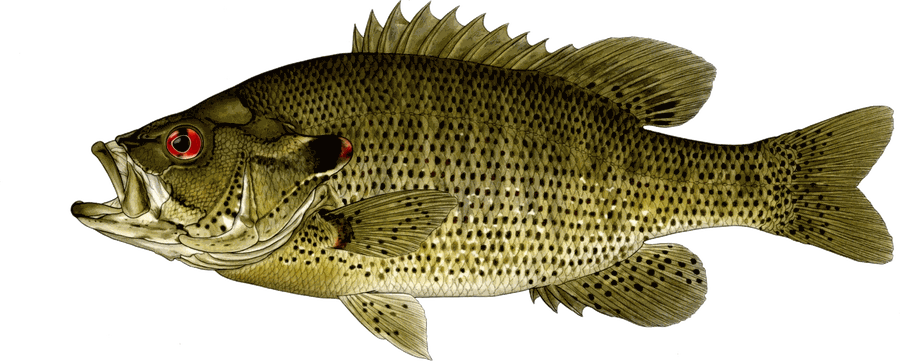
Bump Board's tactics library for Rock Bass — where to fish, what to tie on and how to fish it, season by season. In the app, these tips adapt live to the weather, the front and the light.
Rock Bass — Prespawn
Where to fish
- As the water climbs through the low teens, rock bass move onto the coarse spawning ground they share with smallmouth in northern lakes — sand and gravel with wood or rock cover nearby. Fish the rocky shallows and the cover beside them; prospecting begins around 13–15 °C, ahead of spawning proper.
- In rivers, prespawn fish hold the low-velocity cover they prefer all year — rootwads and woody structure in the slower water, more rootwad-oriented and slower than the smallmouth beside them. Locations are highly cover-correlated for this species; fish the cover, not the open pool.
What to tie on
- Offerings matched to the measured benthic diet: crayfish, large aquatic insect larvae (dragonfly nymphs and hellgrammites in the stream diet work) and small invertebrates, presented down at the rock and wood. Rock bass look down — the retinal study shows a high-acuity zone aimed at the benthos in front and below — so the bait belongs on the bottom in front of the cover, not over it. No lure is named in the rock bass literature, and none is invented here.
How to fish it
- Start with this species' clock, because it is the opposite of its cousins': rock bass feed most actively from dusk through the night, with dawn elevated and midday the floor. Prespawn effort spent at the light changes and after dark is fishing the measured peak; a midday prespawn trip is fishing the daily minimum. Below about 8.5 °C, expect the floor itself — the Ontario winter work puts the feeding onset near 8.5 °C, and cold prespawn fish barely move for food.
If it's still tough
- If the rocky shallows are empty, the water has not reached the prospecting band — drop to the deeper cover off the spawning ground and wait for the temperature, not a different bait. This spawn is temperature-gated, in May–June and late June at northern latitudes.
Rock Bass — Spawn
Where to fish
- Northern rock bass spawn at about 15–21 °C, on circular nests about 20–30 cm across that the male fans in sand and gravel near cover — wood or rock, the same coarse-substrate-plus-cover habitat smallmouth choose in the same lakes, with the two species' nesting overlapping in time. Larger, older males nest earliest. (The literature also carries wider, warmer southern bands, to 27 °C; the monograph keeps them separate and this entry fishes the northern band.)
What to tie on
- Small benthic offerings pitched to the nest edges and the cover beside them — crayfish and large-insect profiles from the diet ledger. Nothing spawn-specific beyond the nests themselves is rock-bass-measured, and no lure is named in the literature.
How to fish it
- Know what a nest strike is: guarding males do not eat while they guard — they fast on reserves, darken, fan and circle the nest, and their strikes are territorial defence, not feeding. Fish the nest fish if you choose, but read the entry honestly: the catchable feeders are the females and the males between cycles (males can complete more than one nesting cycle in a season), at the dusk-to-night feeding peak, on the cover around the nesting ground. Eggs hatch in about 3–4 days and fry leave the nest around 9–10 days after hatching, so a guarded nest is a short tenancy — note the spot and come back for the postspawn feed.
If it's still tough
- A nest male that swats everything and eats nothing is the guard state working exactly as documented — about a third of nests fail to predation despite the guard, which is why the defence is relentless. Move to the feeding fish on the adjacent cover rather than pestering the nest.
Rock Bass — Summer
Where to fish
- Summer rock bass are cover-bound and sedentary: rocky structure, rootwads and woody cover in clear water, holding in the shadow of the structure by day. Temperature frames the season — the field-measured preference is about 21 °C (20.7–21.3 °C across the two field studies), with the model's plateau running to about 24 °C; the growth-optimum compilation sits higher, at 27.7 °C, on the declining limb. Fish the rock and wood in the low-20s °C water first.
- River fish hold lower-velocity woody cover than smallmouth — rootwads over log complexes — and barely travel. A found river rock bass is a resident, not a traveller; work its cover thoroughly.
What to tie on
- Fish the diet, and know it splits by water: in streams, crayfish lead by calories, then small fish, then insects. In lakes, the big Lake Ontario stomach study (218 fish) is amphipod-and-insect-led — more caddis larvae than midges — with snails and crayfish significant and fish becoming important only in fish over about 200 mm. So the lake pattern is small benthic invertebrate and crayfish offerings at the rock; the river pattern leads with crayfish. Juveniles of both waters eat amphipods, copepods and aquatic insects — small fish want small offerings. No lure is named in the rock bass literature, and none is invented here.
How to fish it
- The day is upside down versus the other basses, and it is measured three ways — retinal anatomy built for dim-light benthic feeding, a river diel study peaking from 20:00 to 04:00, and the agency synthesis (most active late evening and early morning): dusk is the peak, night runs near it, dawn is elevated, and midday is the floor — but not a zero, because the study fish fed at low levels throughout the day and summer rock bass are famously catchable on structure at noon. Fish the cover all day if you must; fish it at dusk and after dark if you can.
- Clarity is a hard address for this fish: rock bass responded physiologically to silt at just 10 NTU, they are on record as preferring clear water and intolerant of turbidity and siltation — and the lake fish in the experiment showed no clear ability to compensate, while river fish adjusted within about an hour. After a silting rain, lake rock bass are the first fish to write off and the last to recover; give the lake a clearing window, and in a river, wait out the first hour of dirty water before judging the spot.
- A temperature honesty note the entry keeps visible: a laboratory preferendum of 29–31 °C exists for this species and was rejected as the activity anchor in the research — it came from mostly juvenile fish seined beside a power-plant thermal discharge that had run for 56 years, and the authors themselves flagged the bias. The 21 °C field figure above is the wild fish's number; do not let anyone sell you a rock bass pattern built on the lab fish.
If it's still tough
- If bright midday fish on the cover won't take, you are fishing the measured daily floor — shrink the offering, put it tight to the shaded side of the structure, and slow down; or bank the spot for dusk, when the same fish are the most catchable rock bass of the day. And check the oxygen in hot, still weather: the agency record calls this species intolerant of low dissolved oxygen (direction only — no threshold was ever measured), so in a stagnant basin the fish are in the oxygenated layer, not on the deep rock.
Rock Bass — Fall
Where to fish
- Fall feeding is directly documented, not assumed: the river diel study's fish were feeding in mid-October, on the same dusk-through-night pattern, so the season holds up through September and October and falls with temperature toward the winter floor rather than ending at Labour Day. Fish the summer rock and wood cover, sliding deeper and slower as the water cools.
What to tie on
- The summer benthic menu, slower and tighter to the cover: crayfish and large-insect offerings in the river pattern, amphipod-and-insect-sized offerings in lakes. Cooling compresses the feeding toward the dusk peak — save the best presentations for the light change.
How to fish it
- Fish the transitions and the early night hardest as the days shorten. As the water approaches about 8.5 °C the feeding floor arrives — the Ontario collections found rock bass abstaining from feeding for weeks at 6.5–8.5 °C — so late-fall effort belongs on the warmest afternoons in the deepest cover, in short, located-fish sessions.
If it's still tough
- If fall fish have gone silent, check the temperature before the tackle: below the 8.5 °C floor this species is measured to fast for weeks, and no presentation fixes a fasting fish. The deep wintering cover is the address that remains.
Rock Bass — Winter
Where to fish
- Winter rock bass are a trough, honestly stated: Ontario through-ice collections at 6.5–8.5 °C found fish that appeared not to have eaten for several weeks, and the centrarchid winter synthesis generalises that — greatly reduced feeding that does not universally cease. Fish school in winter. What feeding remains concentrates where the season's own notes put it: first in the shallows early, then mid-depth hard-bottom flats and drop-offs, reactivating toward the vegetated shallows late — that progression is the ice literature's description (expert consensus), not a measurement, and the entry labels it as such.
What to tie on
- Small, slow, bottom offerings over located fish on the hard-bottom flats. Winter consumption is minimal, so the bait has to arrive at a sedentary fish — no winter-specific lure is named in the rock bass literature.
How to fish it
- Fish the day's edges — early morning, late afternoon, and sometimes at night, per the ice literature, consistent with this species' open-water dusk-to-night signature — and give a located school real time. Rock bass are caught through the ice in Manitoba; the occurrence is documented, the catch rates are not, and the entry invents no numbers for them.
If it's still tough
- A dead mid-winter flat is usually the fast itself, compounded by low oxygen — the ice literature notes rock bass rarely feed during low-oxygen periods. Move toward better-oxygenated water and shallower late-season ground before you conclude the lake has none.
Rock Bass on the ice — Through the ice season
Where to fish
- PROVISIONAL — and the entry carries the flag the research requires: this ice set is a flagged provisional, not a validated one. What is species-own: rock bass are present and caught through the ice (including in Manitoba), Ontario collections show them winter-fasting at 6.5–8.5 °C, they school in winter, and the ice literature describes first-ice shallows, mid-winter mid-depth hard-bottom flats and drop-offs, and a late-ice reactivation toward vegetated shallows. What does not exist: any under-ice diel, light, oxygen-response or catch-rate study of this species — the shapes below are the programme ice scaffold, and the timing is the measured open-water dusk-to-night shape carried under ice, dampened and labelled a transfer.
What to tie on
- Small, slow, bottom offerings over the hard-bottom flats — the open-water benthic diet at winter size. No ice presentation is rock-bass-measured; this is the winter evidence applied honestly, not an ice finding.
How to fish it
- Fish the day's edges and into the early night on the transferred pattern (early morning, late afternoon, sometimes night, per the ice literature), set up on located schools on the mid-depth flats, and treat oxygen as a gate: rock bass are recorded as intolerant of low dissolved oxygen and the ice literature has them rarely feeding in low-oxygen periods, so a depleting basin's flats go quiet from the bottom up — move toward oxygenated water as the winter deepens, and toward the vegetated shallows as it ends.
If it's still tough
- Mid-winter silence on the flats is the documented fast more often than it is your presentation. The sourced moves are oxygen and timing, in that order — and if neither produces, the honest verdict is that this species' ice science runs out here: it has never been measured under ice well enough to promise more.
Manitoba Master Angler
A Rock Bass of 25.5 cm (10 in) or better qualifies for Manitoba's Master Angler Program.
Where Rock Bass live
3,899 waters in the Bump Board dataset hold Rock Bass. A selection:
Manitoba
- Betula Lake
- Bird Lake
- Caddy Lake
- Falcon Lake
- Gull Lake
- Gull Lake
- Jessica Lake
- Lake of the Prairies
- Lake Wahtopanah
- Mantagao Lake
- Minnedosa Lake
- St. Malo Lake
- Star Lake
- White Lake
Ontario
- Aberarder Creek
- Abitibi River
- Abram Lake
- Adams Lake
- Adelaide Lake
- Adelard Lake
- Agnes Lake
- Agnew Lake
- Ahmic Lake
- Aileen Lake
- Alder Creek
- Alder Lake
- Aleck Lake
- Alexander Lake
- Alexander Lake
- Allen Lake
- Allen Lake
- Allen Lake
- Allumette Lake
- Alma Lake
- Alma Lake
- Alonghill Lake
- Alps Creek
- Alva Lake
Plus 2,200 more Ontario waters — browse Ontario lakes.
Connecticut
- Amston Lake
- Ball Pond
- Bantam Lake
- Barkhamsted Reservoir
- Bashan Lake
- Batterson Park Pond
- Bunnells Pond
- Burr Pond
- Colebrook River Lake
- Compensating Reservoir
- Crystal Lake
- Dog Pond
- Eagleville Pond
- Easton Reservoir
- Gardner Lake
- Hanover Pond
- Hemlock Reservoir
- Highland Lake
- Indian Lake
- Keney Park Pond
- Lake Bethany
- Lake Candlewood
- Lake Chamberlain
- Lake Harwinton
Plus 34 more Connecticut waters — browse Connecticut lakes.
Iowa
Indiana
- Adams Lake
- Ball Lake
- Big Chapman Lake
- Big Otter Lake
- Blue Lake
- Cass Lake
- Cedar Lake
- Cedar Lake
- Crooked Lake
- Dewart Lake
- Eve Lake
- Fox Lake
- Golden Lake
- Green Lake
- Irish Lake
- James Lake
- Jimmerson Lake
- Kuhn Lake
- Lake Gage
- Lake Maxinkuckee
- Lake Wawasee
- Marsh Lake
- Martin Lake
- Messick Lake
Plus 13 more Indiana waters — browse Indiana lakes.
Massachusetts
- Ashmere Lake
- Center Pond
- Congamond Lakes
- Demond Pond
- East Waushacum Pond
- Fivemile Pond
- Flint Pond
- Lake Buel
- Lake Garfield
- Lake Quinsigamond
- Lake Whalom
- Laurel Lake
- Long Pond
- Lower Highland Lake
- Mansfield Pond
- Onota Lake
- Plunkett Reservoir
- Pontoosuc Lake
- Quabbin Reservoir
- Richmond Pond
- Russell Pond
- Shaw Pond
- Stockbridge Bowl
- Upper Highland Lake
Plus 4 more Massachusetts waters — browse Massachusetts lakes.
Michigan
- Adams Lake
- Albino Lake
- Andrus Lake
- Archer Lake
- Arnold Lake
- Ashford Lake
- Au Sable Lake
- Au Train Lake
- Avalon Lake
- Badger Lake
- Bailey Lake
- Baldy Lake
- Bankers Lake
- Baptist Lake
- Barlow Lake
- Barnes Lake
- Barnes Lake
- Barneys Lake
- Barton Lake
- Bass Lake
- Bass Lake
- Bass Lake
- Bass Lake
- Bass Lake
Plus 534 more Michigan waters — browse Michigan lakes.
Minnesota
- Adams Lake
- Adney Lake
- Alden Lake
- Alice Lake
- Alton Lake
- Amelia Lake
- Anderson Lake
- Andrusia Lake
- Annie Battle Lake
- Antler Lake
- Armstrong Lake
- Arrowhead Lake
- Arthur Lake
- Astrid Lake
- August Lake
- Baby Lake
- Bachelor Lake
- Bad Axe Lake
- Bad Medicine Lake
- Bald Eagle Lake
- Ball Bluff Lake
- Ball Club Lake
- Balm Lake
- Balsam Lake
Plus 769 more Minnesota waters — browse Minnesota lakes.
Missouri
Montana
Nebraska
New Hampshire
- Crystal Lake
- Forest Lake
- Gilmore Pond
- Goose Pond
- Granite Lake
- Island Pond
- Lake Winnipesaukee
- Lake Winnisquam
- Mascoma Lake
- Nay Pond
- Newfound Lake
- Partridge Lake
- Pleasant Lake
- Saltmarsh Pond
- Spofford Lake
- Sunapee Lake
New York
- Arnold Lake
- Ballston Lake
- Buck Pond
- Burden Lake
- Canadarago Lake
- Canadice Lake
- Canandaigua Lake
- Cayuta Lake
- Cazenovia Lake
- Chazy Lake
- Chenango Lake
- Collins Lake
- Copake Lake
- Cranberry Pond
- Cross Lake
- Deep Pond
- Dunham Reservoir
- Dyken Pond
- Fern Lake
- Fifth Lake
- Glenwood Lake
- Goodyear Lake
- Guilford Lake
- Hessian Lake
Plus 35 more New York waters — browse New York lakes.
Pennsylvania
- Allegheny Reservoir
- Beltzville Lake
- Canoe Creek Lake
- Clear Lake
- Cloe Lake
- Colyer Lake
- Conneaut Lake
- Crooked Creek Lake
- East Branch Clarion River Lake
- Edinboro Lake
- Elmhurst Reservoir
- Fords Lake
- Foster Joseph Sayers Lake
- Francis E Walter Reservoir
- George B Stevenson Reservoir
- Hammond Lake
- Harveys Lake
- High Point Lake
- Hinckston Run Reservoir
- Keystone Lake
- Kyle Lake
- Lake Canadohta
- Lake Carey
- Lake Gordon
Plus 20 more Pennsylvania waters — browse Pennsylvania lakes.
South Dakota
- Amsden Lake
- Antelope Lake
- Blue Dog Lake
- Deerfield Lake
- Enemy Swim Lake
- Hiddenwood Lake
- Lynn Lake
- Minnewasta Lake
- Mitchell Lake
- Pactola Reservoir
- Pickerel Lake
- Reid Lake
- Sheridan Lake
- Waubay Lake
Tennessee
- Boone Lake
- Calderwood Lake
- Center Hill Lake
- Cheatham Lake
- Cherokee Lake
- Chickamauga Lake
- Chilhowee Lake
- Cordell Hull Reservoir
- Dale Hollow Lake
- Douglas Lake
- Fort Loudoun Lake
- Fort Patrick Henry Lake
- Great Falls Lake
- J Percy Priest Reservoir
- John Sevier Detention Reservoir
- Melton Hill Lake
- Nickajack Lake
- Normandy Lake
- Norris Lake
- Old Hickory Lake
- South Holston Lake
- Tellico Lake
- Tims Ford Lake
- Watauga Lake
Plus 2 more Tennessee waters — browse Tennessee lakes.
Virginia
- Claytor Lake
- Hungry Mother Lake
- John W. Flannagan Reservoir
- Lake Moomaw
- Laurel Bed Lake
- Otter Lake
- Skidmore Fork Lake
Washington
- American Lake
- Angle Lake
- Bitter Lake
- Black Lake
- Green Lake
- Lake Dolloff
- Lake Kapowsin
- Lake Washington
- Long Lake
- Pattison Lake
- Silver Lake
- Spanaway Lake
- Ward Lake