Fishing tips & tactics
How to catch Redear Sunfish
Lepomis microlophus
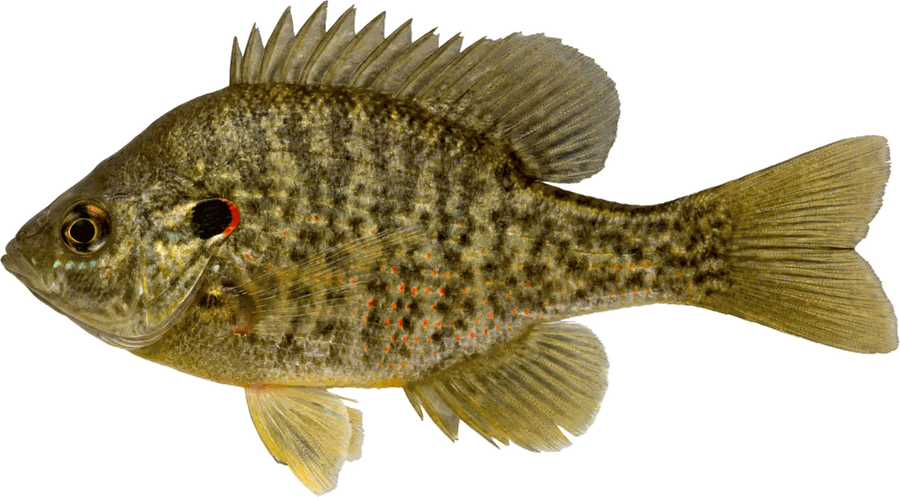
Bump Board's tactics library for Redear Sunfish — where to fish, what to tie on and how to fish it, season by season. In the app, these tips adapt live to the weather, the front and the light.
Redear Sunfish — Prespawn
Where to fish
- Redear build toward a single, once-yearly spawning aggregation — the event this whole fishery turns on. Ahead of it, fish the bottom-oriented feeding water near the bedding areas: this is a benthivore, working the bottom for hard prey, and its pre-spawn addresses are feeding addresses, not staging spectacles.
What to tie on
- Fish the measured diet: hard-shelled bottom prey — snails (rams-horn snails were strongly preferred in the preference trials), small mussels and clams, ostracods — WITH the correction the field work forces: chironomid larvae co-dominate the wild diet, so 'redear eat snails' is true but incomplete, and soft bottom offerings are as ledgered as shell-crackers. Juveniles are zooplankton-and-insect fish that shift to benthos with size — small fish want small, softer offerings.
How to fish it
- Bottom, slow, thorough. The functional morphology is a crushing mill built for hard prey — presentations that sit on the bottom in the feeding zone are fishing the anatomy the studies describe.
If it's still tough
- If the feeding flats are quiet, the aggregation hasn't formed — check the temperature. The spawn band below is temperature-gated, and prespawn fish follow it, not the calendar.
Redear Sunfish — Spawn
Where to fish
- The spawn is the redear year: a once-yearly aggregation on beds in shallow water at a main band of 21–24 °C (the low end is honestly flagged — two agency sources start spawning about 2 °C lower, and the monograph anchors onset near 20 °C rather than hiding the spread). The 'deeper than bluegill' nesting claim survived checking — three independent agency sources agree on the comparison, though absolute nest depths contradict between sources — so fish the beds a step deeper than the bluegill colonies nearby. And the guard-state rule, stated as the rating states it: strikes on nests are aggression, not feeding.
What to tie on
- Bottom offerings in and around the beds — the diet ledger (snails, clams, chironomids) is the menu here as everywhere for this fish. Nothing spawn-specific beyond the beds themselves is redear-measured.
How to fish it
- Fish the aggregation while it's formed — once-yearly means exactly that, and the rest of the year has no equivalent window. What this entry will not give you is a time-of-day rule: redear diel rhythm has never been measured, the secondary one-liners contradict each other, and the claim failed verification outright. Anyone's dawn-or-dusk redear rule is borrowed or invented; the rating's own diel term is carried neutral — redear's rhythm has never been measured — and the tactics stay silent where the fish is unmeasured.
If it's still tough
- If bed fish are striking short or swatting rather than eating, you're seeing the guard state, not a feeding mood — fish the colony edges, where feeding fish hold, instead of pestering the nests.
Redear Sunfish — Summer
Where to fish
- Summer redear are bottom fish on the mollusc-and-invertebrate fields. Vegetation has a measured shape: condition held average-or-better up to heavy-but-not-total cover (hydrilla to about 78% bottom coverage), and fell when the column filled completely (95% bottom / 80% surface) — full-column vegetation constrains their foraging. Fish the moderate-cover bottom and the open feeding lanes through it, not the choked mats.
What to tie on
- The diet ledger again, because it's this species' best science: snails (crushed — the trial fish crushed shells that a blue catfish in the same trial did not), fingernail clams, mussels, ostracods, and chironomid larvae sharing the lead. Bottom presentations sized to that menu are the whole supported tackle story; no lure is named in the redear literature, and none is invented here.
How to fish it
- Slow bottom work over the feeding fields. Warm water is their element — the one measured consumption ranking peaks near 26 °C — so summer is a genuine feeding season, fished thoroughly rather than at the day's edges. (No finer timing claim is made: diel is unmeasured in this species, full stop.)
If it's still tough
- If a feeding field is silent, check the cover density before the bait: a field that has grown into a full-column mat has left the measured comfort zone, and the open lanes beside it are the fix.
Redear Sunfish — Winter
Where to fish
- Winter redear are a persistence story, and the number is stark: at about 9 °C, fed fish still lost over 30% of body weight across the trial's thirteen weeks — feeding regime made no significant difference. They persist at negative energy balance; they are not on a winter feed. In their southern range, fish the warmest, stillest water on the sunniest stretches and expect little.
What to tie on
- If you fish them at all in the cold, the diet menu at its smallest and stillest — a winter redear's arithmetic, like the cutthroat's, punishes effort spent chasing.
How to fish it
- Treat winter as the off-season the physiology says it is. The redear year is the warm season and the spawn aggregation; winter effort is honestly better spent on the cold-water species.
If it's still tough
- A dead winter flat is the species working as measured, at negative balance even when fed. Wait for the warming toward the spawn band — that temperature climb is the entire redear spring pattern.
Redear Sunfish on the ice — Through the ice season
Where to fish
- Not applicable — and stated as a result, not an omission: redear is a subtropical, southern open-water species (native range roughly 26–40 °N), no under-ice study or ice fishery exists, and ICE mode for this species returns 'not applicable — southern open-water species.' Borrowed ice weights were refused in the research, and they're refused here.
What to tie on
- No ice presentation exists for redear sunfish.
How to fish it
- The cold-season redear guidance is the winter entry above: persistence at negative energy balance in open southern water. There is no ice chapter in this fish's science to summarise.
If it's still tough
- If you're standing on ice, redear are simply the wrong species for the water under you — the library's ice-covered panfish are perch, the crappies and bluegill (at its flagged confidence).
Where Redear Sunfish live
448 waters in the Bump Board dataset hold Redear Sunfish. A selection:
Alabama
- Aliceville Lake
- Gantt Lake
- Guntersville Lake
- Jordan Lake
- Lake Tuscaloosa
- Martin Lake
- Mitchell Lake
- Point A Lake
- R L Harris Reservoir
- Thurlow Reservoir
Arkansas
California
Colorado
Delaware
Florida
- Alligator Lake
- Blue Cypress Lake
- Crescent Lake
- Dead Lakes
- Deer Point Lake
- Hurricane Lake
- Lake George
- Lake Istokpoga
- Lake Jackson
- Lake Kissimmee
- Lake Monroe
- Lake Okeechobee
- Lake Panasoffkee
- Lake Parker
- Lake Rousseau
- Lake Rowell
- Lake Sampson
- Lake Talquin
- Lake Tarpon
- Lake Tohopekaliga
- Lake Trafford
- Lake Victor
- Lake Weir
- Lake Weohyakapka
Plus 7 more Florida waters — browse Florida lakes.
Georgia
- Allatoona Lake
- Hamburgh Millpond
- High Falls Lake
- J. Strom Thurmond Reservoir
- Jackson Lake
- Lake Blackshear
- Lake Oliver
- Lake Rabun
- Lake Seminole
- Lake Tobesofkee
- Randy Poynter Lake
Iowa
- Central Park Lake
- Cold Springs
- Diamond Lake
- Geode Lake
- Hannen Lake
- Lake Ahquabi
- Lake Anita
- Lake Belva Deer
- Lake Darling
- Lake Iowa
- Lake MacBride
- Lake Wapello
- Nine Eagles Lake
- Otter Creek Lake
- Pony Creek Lake
- Red Haw Lake
- Union Grove Lake
- Viking Lake
- West Lake
- Wilson Lake
Illinois
- Argyle Lake
- Baldwin Lake
- Braidwood Power Plant Cooling Pond
- Carlyle Lake
- Cedar Lake
- Coffeen Lake
- Devils Kitchen Lake
- Eureka Lake
- Kinkaid Lake
- Lake Jacksonville
- Lake Le-Aqua-Na
- Lake Murphysboro
- Lake of the Woods
- Lake Pittsfield
- Lake Sara
- Lake Springfield
- Lake Storey
- Mermet Lake
- Powerton Cooling Lake
- Sam Parr Lake
- Siloam Springs Lake
- Washington County Lake
Indiana
- Adams Lake
- Appleman Lake
- Atwood Lake
- Banning Lake
- Barr Lake
- Barton Lake
- Baugher Lake
- Bear Lake
- Beaver Dam Lake
- Bell Lake
- Big Chapman Lake
- Big Lake
- Big Long Lake
- Black Lake
- Brokesha Lake
- Buck Lake
- Cass Lake
- Cedar Lake
- Center Lake
- Cook Lake
- Crane Lake
- Crooked Lake
- Dewart Lake
- Diamond Lake
Plus 92 more Indiana waters — browse Indiana lakes.
Kansas
Kentucky
- Beaver Lake
- Boltz Lake
- Briggs Lake
- Bullock Pen Lake
- Cap Mauzy Lake
- Carpenters Lake
- Cave Run Lake
- Cedar Creek Lake
- Clear Creek Lake
- Corinth Lake
- Dewey Lake
- Elmer Davis Lake
- Fagan Branch Lake
- Fishtrap Lake
- Greenbo Lake
- Lake Barkley
- Lake Malone
- Lake Reba
- Marion County Lake
- Martins Fork Lake
- Pennyrile Lake
- Shanty Hollow Lake
- Wilgreen Lake
- Wood Creek Lake
Plus 1 more Kentucky waters — browse Kentucky lakes.
Louisiana
- Bayou D'Arbonne Lake
- Black Lake
- Caddo Lake
- Ivan Lake
- Lake Bistineau
- Lake Chicot
- Lake Maurepas
- Lake Saint Joseph
- Mill Creek Reservoir
Maryland
Michigan
- Clear Lake
- Coldwater Lake
- Cub Lake
- Devils Lake
- Devoe Lake
- Duck Lake
- Fourmile Lake
- Gilead Lake
- Gilletts Lake
- Grass Lake
- Kenyon Lake
- Lime Lake
- Long Lake
- Marble Lake
- Matteson Lake
- Portage Lake
- Pretty Lake
- Rainbow Lake
- Swains Lake
- Upper Brace Lake
Missouri
- Binder Lake
- Blind Pony Lake
- Crowder Lake
- Fellows Lake
- Hunnewell Lake
- Lake of the Ozarks
- Lake Taneycomo
- Little Dixie Lake
- Perry County Community Lake
- Sims Valley State Community Lake
- Sterling Price Community Lake
- Table Rock Lake
- Valley Water Mill Pond
- Watkins Mill Lake
Mississippi
- Aberdeen Lake
- Aliceville Lake
- Bailey Lake
- Bay Springs Lake
- Choctaw Lake
- Columbus Lake
- Enid Lake
- Geiger Lake
- Horseshoe Lake
- Jefferson Davis Lake
- Lake Bill Waller
- Lake Bogue Homo
- Lake Claude Bennett
- Lake Columbia
- Lake Lamar Bruce
- Lake Lowndes
- Lake Mary Crawford
- Lake Monroe
- Lake Tangipahoa
- Mayes Lake
- Moon Lake
- Neshoba County Lake
- Okatibbee Lake
- Okhissa Lake
Plus 6 more Mississippi waters — browse Mississippi lakes.
North Carolina
Nebraska
- Alexandria Reservoir
- East Hershey Lake
- Kea Lake
- Memphis Lake
- Olive Creek Lake
- Rock Creek Lake
- Walnut Creek Lake
- Wildwood Lake
Ohio
- Belmont Lake
- Burr Oak Reservoir
- Caldwell Lake
- Dow Lake
- Fox Lake
- Friendship Park Lake
- Hammertown Lake
- Hocking Hills Reservoir
- Lake Hope
- Lake Logan
- Lake Snowden
- Pike Lake
- Pine Lake
- Ross Lake
- Rush Creek Lake
- Rush Run Lake
- Tycoon Lake
- Veto Lake
Pennsylvania
South Carolina
- Ashwood Lake
- Jonesville Town Pond
- Lake Brown
- Lake Cherokee
- Lake George Warren
- Lake John D Long
- Lake Johnson
- Lake Wallace
- Lancaster Reservoir
- Star Fort Pond
- Sunrise Lake
- Thicketty Creek WCD Lake Number Twenty-six
Tennessee
- Boone Lake
- Calderwood Lake
- Center Hill Lake
- Cheatham Lake
- Cherokee Lake
- Chickamauga Lake
- Chilhowee Lake
- Cordell Hull Reservoir
- Dale Hollow Lake
- Douglas Lake
- Fort Loudoun Lake
- Fort Patrick Henry Lake
- Great Falls Lake
- J Percy Priest Reservoir
- John Sevier Detention Reservoir
- Kentucky Lake
- Lake Ocoee
- Melton Hill Lake
- Nickajack Lake
- Normandy Lake
- Norris Lake
- Old Hickory Lake
- Reelfoot Lake
- South Holston Lake
Plus 5 more Tennessee waters — browse Tennessee lakes.
Texas
Virginia
- Amelia Lake
- Banister Lake
- Bear Creek Lake
- Beaverdam Swamp Reservoir
- Burke Lake
- Chandlers Millpond
- Clifton Forge Reservoir
- Conner Lake
- Diascund Creek Reservoir
- Echo Lake
- Fluvanna Ruritan Lake
- Gardys Millpond
- Gatewood Reservoir
- Harrison Lake
- Harwoods Mill Reservoir
- Horsepen Lake
- Hunting Run Reservoir
- Lake Albemarle
- Lake Anna
- Lake Brittle
- Lake Chesdin
- Lake Cohoon
- Lake Frederick
- Lake Gordon
Plus 22 more Virginia waters — browse Virginia lakes.