
Fishing tips & tactics
How to catch Northern Pike
Esox lucius
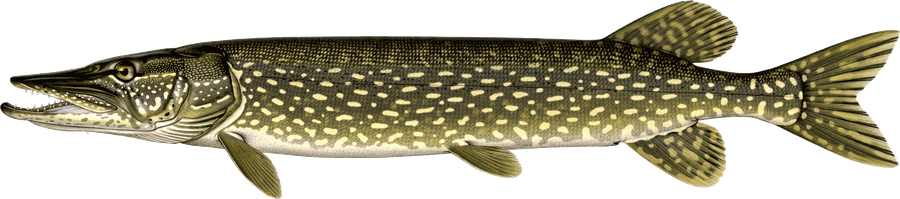
Bump Board's tactics library for Northern Pike — where to fish, what to tie on and how to fish it, season by season. In the app, these tips adapt live to the weather, the front and the light.
Northern Pike — Prespawn
Where to fish
- Before the spawn, pike gather where the food gathers: bays, connected sloughs and the funnel areas between them — channel edges, points, old weedlines and minor depth changes.
- Before the spawn, pike gather where the food gathers: tributary mouths, bays, connected sloughs and the funnel areas between them — channel edges and minor depth changes. Work current areas first: inflows, necked-down spots and snowmelt runoff all concentrate early fish.
What to tie on
- Early on, small and slender: a 3½-in soft swimbait on a light 1/8- to 1/4-oz jighead, a small slender spoon, or a 3¾-in minnow-profile crank. For a still presentation, the dead-bait float rig: a 25–30 cm smelt on a #6 treble with a short steel leader, set about 45 cm off the bottom in slack water.
How to fish it
- Anchor up, let the spot settle for ten minutes, then fan-cast it before you move — and move only far enough to overlap your last casts. Pike in cold water punish run-and-gun fishing; a big early bay can fish for hours fished properly.
- Cold water means a slow, steady retrieve — slow-roll a jig-and-swimbait just fast enough to keep the tail thumping, with the odd dart, and keep the reel turning the whole time.
If it's still tough
- When a pike takes a dead bait, it runs, then stops to turn it — freespool until the bobber stops for a few seconds, then set. Rushing that pause is how early-season fish are lost.
Northern Pike — Spawn
Where to fish
- Pike are spawning now — in the flooded vegetation and shallow bays — and spawning pike fast more than they feed. The honest pattern is the fish at the edges: pre- and post-spawn fish along the channel edges and the first depth changes outside the spawning bays, where the north ends warm fastest.
What to tie on
- Small, slow and close: the early-season swimbait on a light jighead, small slender spoons, or a dead bait under a float at the bay mouths. This is not the season for big aggressive baits over the beds themselves.
How to fish it
- Fish the edges and the travel lanes, not the beds. Expect a short window of feeding fish around the spawn rather than a day of them, and give spawning fish themselves a pass — the feeders at the edges are the catchable ones.
If it's still tough
- If the shallows are all spawners, move out to the first real depth change and dead-bait it slowly. Post-spawn fish recovering at the edge will take a still bait they wouldn't chase.
Northern Pike — Postspawn
Where to fish
- Right after the spawn, look in shallow mud-bottom bays full of cattails — the north end of the bay warms fastest and fishes first. Start in 1–4 ft. Channel edges with vegetation nearby hold the bigger recovering fish.
What to tie on
- For the biggest post-spawn fish, go big and slow: a 1-oz tandem spinnerbait with big Colorado blades, or a straight-wire spinnerbait dressed with a 6-in grub, on heavy braid and a 35 cm, 100-lb fluorocarbon leader. Colour rules follow the water: grey-white and brown-gold in clear water, black-chartreuse and green-chartreuse in dirty water.
How to fish it
- Slow-roll the big blades through the bay and along the channel edge — post-spawn pike are recovering, not chasing, and the big slow thump is what they answer. Cover the bay in a fan before you move, and overlap your casts.
If it's still tough
- Downshift to the dead-bait float rig in the slack corners of the bay. A recovering pike that ignores every moving bait will still pick up a still smelt sitting 45 cm off the bottom.
Northern Pike — Summer
Where to fish
- Three summer patterns, and the day tells you which: (A) open water — find the biggest bait schools; if bait is 15–30 ft down, troll it, if it's in the top 20 ft, cast it. (B) deep flats — packs of big pike hold on expansive flats 25–45 ft down by early summer (in young, deep, clear lakes, 25–60 ft), and the thermocline is a wall: the cold layer below it has no oxygen, so don't fish under it. (C) weedflats — on the deep weedline, active fish prowl the outside edge, neutral fish sit on cabbage points and inside turns, on the shaded side of the thickest clumps.
- The biggest pike — 30 in and up — visit 40 ft and deeper on warm days, down in the cool layers. Summer is when the giants live deepest.
What to tie on
- A big shad-profile crankbait is the core open-water trolling bait. On the weedline: big spinnerbaits, weedless spoons and jerkbaits; for pressured fish, a ½- to ¾-oz single-blade spinnerbait, or go subtle — a weightless 7-in soft jerkbait rigged weedless. On deep flats, a heavy jig with a 7–8 in softbait; a 1½-oz jig head is the right weight to work that depth.
- Leaders are not optional tackle, they're pike tackle: tieable wire around 20 lb covers most pike work (13 lb for the lightest presentations); heavy fluorocarbon for the big spinnerbaits.
How to fish it
- On deep flats, find the bait on sonar first — no bait, no pike — then snap-jig: rip the jig 6 ft up, drop the tip, and let it fall. Trolling depths matter: a big shad crank on 30-lb mono stays in the top 10 ft; on 40-lb braid the same bait runs 17 ft and deeper; in-line weights of ½–1 oz reach 12–25 ft — but never below the thermocline.
- One caution from the books: don't let a lure surprise a pike. If you spot one, set a jig 4–5 ft behind it and barely lift it — a bait that lands on top of a pike spooks it; one that creeps up behind it gets eaten.
If it's still tough
- When the pattern won't declare itself, fish the beaver lodges properly: work 75–100 ft out from them first, then move in. And when sucker spawn is on (around 10 °C), switch to wounded-sucker lures — a big slow wobbling bait or firetiger — around the spawning shallows.
Northern Pike — Fall
Where to fish
- Fall is the edges season — vegetation edges and rock edges are the most universal fall pike pattern there is. As it cools, pike also slide back toward the spring shallows, and the middle of the day, when the water is warmest, is when they're most aggressive.
What to tie on
- The summer baits still work — big spinnerbaits, jerkbaits, shad cranks — fished on the edges. Where bait is spawning (ciscoes and whitefish run the rock and reefs in fall), match it: pike intercept spawning baitfish on rock and reef edges, and that's a feed worth being on.
- The summer baits still work — big spinnerbaits, jerkbaits, shad cranks — fished on the edges. Where bait is spawning (ciscoes and whitefish run the rock in fall), match it: pike intercept spawning baitfish on rock edges, and that's a feed worth being on.
How to fish it
- Cover the edges with moving baits in the midday warmth. If the wind has blown the same direction for three days or more, fish where it's been pushing into shore — the food chain stacks up there.
If it's still tough
- Slow the edges down with a jig and big softbait, tight to the weedline's outside edge, and work the shaded sides of the thickest clumps — that's where the neutral fish sit.
Northern Pike — Midsummer
Where to fish
- The hottest water is a pike's worst season — above about 22 °C they feed best down in the cool layers, 25–65 ft, and in thermal extremes they will not chase fast prey at all. The deep flats and the cool side of the thermocline are the whole game now.
What to tie on
- Slowly reeled artificials or dead bait — the books are direct that in heat, those are the best odds. Troll the cool layer with a big shad crank (braid gets it to 17 ft+; in-line weights to 12–25 ft) and keep everything above the thermocline.
How to fish it
- Slow down and fish deep. Short windows at dawn and dusk, when big pike slide up to feed, are worth more than a midday grind in the heat.
If it's still tough
- If you must fish midday, dead-bait the deepest cool water you can find and be patient — a hot-weather pike eats a still meal because it costs nothing to catch.
Northern Pike — Coldfall
Where to fish
- Below about 10 °C the fall shallows empty out — pike drop to the deep edges and the first drop-offs near where they'll winter, and some fish eat only every few days. A small fish digests in a day or two in warm water; at near-freezing it lasts for weeks. Fewer meals means fewer chances, but each chance is a real one.
What to tie on
- Slow artificials and dead bait again — cold pike won't chase fast prey. The dead-bait float rig over the deep edge, or a jig-and-swimbait slow-rolled just off bottom, are the cold-water pair.
How to fish it
- Everything slows down: the retrieve, the hops, and your expectations between bites. Stay on the best deep edge you have and fish it thoroughly instead of sampling five spots quickly.
If it's still tough
- Dead-bait it and wait. In the coldest water, patience isn't a virtue, it's the whole technique — a still smelt on the deep edge outfishes every moving bait on the days they won't move.
Northern Pike on the ice — Early ice
Where to fish
- First ice carries the fall locations — don't rush shallow. Work the weedbeds that held fish in fall: broad beds of cabbage or coontail around 6–18 ft, bordered by deeper water, and set up on the deep edges. Some of the biggest fish are still deep at first ice.
What to tie on
- Dead bait on a quick-strike rig under a tip-up is the trophy method — every 25 lb pike in the old pro accounts came on it. Fresh dead ciscoes, suckers or smelt where they're legal. The rig: 14–18 in of 20–30 lb wire, two #4 trebles about 2½ in apart, hooks no more than 4 in apart even on the biggest bait, the front hook no farther forward than just above the bait's dorsal fin.
- For the jigging rod: a live bait of 6–8 in on a single hook, 20-lb fluorocarbon leader (a #6 Kahle for a 6-in bait, #4 for an 8-in).
How to fish it
- Set the tip-ups on the structure tops and jig the edges, 20–40 ft of water within reach of the set lines. When a flag flies on the quick-strike rig, sweep-set immediately — the fish took the bait headfirst and the rig is built for a fast hookup.
- An alternative to trebles: a barbless 5/0 circle hook (4/0 for smaller baits) on 18 in of 30-lb tieable wire — safer for the fish and the angler.
If it's still tough
- If the shallow weedbeds are quiet, believe the depth: the big fish may simply still be deep. Move a set line out to the deep edge of the bed before you move lakes.
- If the shallow weedbeds are quiet, believe the depth: the big fish may simply still be deep. Move a set line out to the deep edge of the bed before you move.
Northern Pike on the ice — Mid ice
Where to fish
- Mid-winter pike pattern like they stage for spring: from mid-February they follow the deep edges toward the spawning bays, shallower as the season runs — with the biggest fish in the bays at the season's edges and on main-lake structure in between.
- Mid-winter pike pattern like they stage for spring: from mid-February they follow the deep edges toward the spawning creeks and bays — around 18 ft outside creek mouths late in February, shallower as the season runs — with the biggest fish in the bays at the season's edges and on structure in between.
What to tie on
- Dead bait on quick-strike rigs stays the trophy play, jigging a live bait on the edges stays the active play — same rigs as first ice.
How to fish it
- Work the travel lane: set lines along the deep edge pointing at the bays, and jig the edge while they soak. Mark what produces — staging routes repeat every year.
- Work the travel lane: set lines along the deep edge pointing at the creek mouths and bays, and jig the edge while they soak. Mark what produces — staging routes repeat every year.
If it's still tough
- Slide shallower before you slide deeper. Late-season pike are moving one direction — toward the spawn — and the staging fish can be in 1–2 ft of water under the ice.
Northern Pike on the ice — Late ice
Where to fish
- Late ice is staging season: pike crowd the edges outside the spawning bays they'll enter at ice-out, shallower every week. Set up on those edges and in the mouths — this is the biggest-fish window of the ice season.
- Late ice is staging season: pike crowd the edges outside the spawning creeks they'll enter at ice-out, shallower every week. Set up on those edges and in the mouths — this is the biggest-fish window of the ice season.
What to tie on
- Big dead baits on quick-strike rigs for the trophies staging outside; jig the edges with live bait to find the active lane.
How to fish it
- Fish it like the spring pattern arriving early — the lanes into the bays, the first edges, and check shallower water than feels right. These fish are feeding up ahead of the spawn.
If it's still tough
- If the edges are quiet, the fish are all the way in — go shallow into the bay mouths themselves before you give up on the spot.
Manitoba Master Angler
A Northern Pike of 104 cm (41 in) or better qualifies for Manitoba's Master Angler Program.
Where Northern Pike live
12,540 waters in the Bump Board dataset hold Northern Pike. A selection:
Manitoba
- Adam Lake
- Aikens Lake
- Beaufort Lake
- Beautiful Lake
- Berens Lake
- Beresford Lake
- Betula Lake
- Big Sand Lake
- Big Whiteshell Lake
- Bird Lake
- Black Lake
- Boissevain Reservoir
- Bolton Lake
- Bower Lake
- Brereton Lake
- Burge Lake
- Burntwood Lake
- Caddy Lake
- Carroll Lake
- Childs Lake
- Clear Lake (Riding Mountain)
- Cormorant Lake
- Cranberry Lakes
- Cross Lake
Plus 121 more Manitoba waters — browse Manitoba lakes.
Ontario
- 16H-96, L.
- 17C-19, L.
- 20J-33, L.
- 21G-105, L.
- 21G-15, L.
- 21I-04, L.
- 5PB10-102, L.
- 5PB10-124, L.
- 5PB10-125, L.
- 5PB10-93, L.
- 5PB17-82, L.
- Aaron Lake
- Abamasagi Lake
- Abamategwia Lake
- Abazotikichuan Lake
- Abbott Lake
- Aberarder Creek
- Abie Lake
- Abimatinu Lake
- Abinette River
- Abitibi River
- Abram Lake
- Abram Lake
- Acheson Lake
Plus 6,287 more Ontario waters — browse Ontario lakes.
Alaska
Arizona
Colorado
- Banner Lakes
- Cheesman Lake
- Crawford Reservoir
- Elevenmile Canyon Reservoir
- Green Mountain Reservoir
- Lagerman Reservoir
- Martin Lake Reservoir
- Monument Lake
- Narraguinnep Reservoir
- Navajo Reservoir
- Puett Reservoir
- Quail Lake
- Rifle Gap Reservoir
- Sanchez Reservoir
- Spinney Mountain Reservoir
- Stabilization Reservoir
- Tarryall Reservoir
- Taylor Park Reservoir
- Totten Lake
- Vallecito Reservoir
- Williams Fork Reservoir
Connecticut
- Bantam Lake
- Batterson Park Pond
- Beseck Lake
- Chapman Pond
- Colebrook River Lake
- Hopeville Pond
- Lake Housatonic
- Lake Lillinonah
- Lake Winchester
- Lake Zoar
- Little Pond
- Pachaug Pond
- Park Pond
- Quaddick Reservoir
- Shaker Pond
Iowa
- Alligator Lake
- Badger Lake
- Blue Lake
- Browns Lake
- Bussey Lake
- Butler Lake
- Center Lake
- Clear Lake
- Coralville Lake
- Crystal Lake
- Diamond Lake
- East Okoboji Lake
- Elk Lake
- Fisher Lake
- Five Island Lake
- George Wyth Lake
- Gimmel Lake
- Half Moon Lake
- High Lake
- Ingham Lake
- Iowa Lake
- Lake Meyer
- Lake Red Rock
- Lost Island Lake
Plus 12 more Iowa waters — browse Iowa lakes.
Idaho
- Anderson Lake
- Black Lake
- Blue Lake
- Cave Lake
- Coeur d'Alene Lake
- Fernan Lake
- Freeman Lake
- Killarney Lake
- Lake Cascade
- Lake Hayden
- Lake Pend Oreille
- Medicine Lake
- Rose Lake
- Swan Lake
- Thompson Lake
- Twin Lakes
- Upper Priest Lake
Illinois
Indiana
- Adams Lake
- Atwood Lake
- Barton Lake
- Big Chapman Lake
- Big Long Lake
- Big Otter Lake
- Bixler Lake
- Bower Lake
- Cass Lake
- Center Lake
- Dewart Lake
- Diamond Lake
- Eagle Lake
- Emma Lake
- Gordy Lake
- Hackenburg Lake
- Hamilton Lake
- Houghton Lake
- Hunter Lake
- Irish Lake
- James Lake
- Jimmerson Lake
- Jones Lake
- Lake Gage
Plus 27 more Indiana waters — browse Indiana lakes.
Massachusetts
- Cheshire Reservoir
- Holland Pond
- Indian Lake
- Lake Buel
- Onota Lake
- Pontoosuc Lake
- Quaboag Pond
- Quacumquasit Pond
Maryland
Maine
Michigan
- Adams Lake
- Albino Lake
- Alderman Lake
- Algoe Lake
- Algonquin Lake
- Allen Lake
- Alma Lake
- Anderson Lake
- Andrus Lake
- Appleton Lake
- Archer Lake
- Arnold Lake
- Au Sable Lake
- Au Train Lake
- Austin Lake
- Avalon Lake
- Avery Lake
- Backus Lake
- Badger Lake
- Bailey Lake
- Bald Eagle Lake
- Baldwin Lake
- Baldy Lake
- Baptist Lake
Plus 865 more Michigan waters — browse Michigan lakes.
Minnesota
- Achman Lake
- Adams Lake
- Adams Lake
- Adney Lake
- Agnes Lake
- Ahsub Lake
- Airport Lake
- Aitkin Lake
- Albert Lake
- Albert Lea Lake
- Alden Lake
- Alder Lake
- Alger Lake
- Alice Lake
- Allen Lake
- Alpine Lake
- Alton Lake
- Amber Lake
- Amelia Lake
- Anderson Lake
- Andrew Lake
- Andrusia Lake
- Ann Lake
- Ann Lake
Plus 1,985 more Minnesota waters — browse Minnesota lakes.
Montana
- Big McNeil Slough
- Blanchard Lake
- Blue Lake
- Boxelder Lake
- Bull Lake
- Canyon Ferry Lake
- Castle Rock Lake
- Church Slough
- Cow Creek Reservoir
- Dickey Lake
- East Fork Reservoir
- Ester Lake
- Eyraud Lakes
- Fennon Slough
- Flathead Lake
- Fort Peck Lake
- Fort Peck Trout Pond
- Frenchman Reservoir
- Fresno Reservoir
- Gartside Reservoir
- Hauser Lake
- Hidden Lake
- Holter Lake
- Homestead Reservoir
Plus 45 more Montana waters — browse Montana lakes.
North Dakota
- Alkali Lake
- Alkaline Lake
- Armourdale Lake
- Arnegard Dam
- Arnies Lake
- Audubon Lake
- Barnes Lake
- Battle Lake
- Baumgartner Lake
- Beaver Lake
- Belcourt Lake
- Bisek Lake
- Blacktail Lake
- Bowman-Haley Lake
- Braddock Dam
- Brush Lake
- Buffalo Lodge Lake
- Cain Lake
- Camp Lake
- Carpenter Lake
- Cavanaugh Lake
- Cedar Lake
- Cherry Lake
- Cherry Lake
Plus 101 more North Dakota waters — browse North Dakota lakes.
Nebraska
- Atkinson Lake
- Big Alkali Lake
- Blue Lake
- Box Butte Reservoir
- Calamus Reservoir
- Clear Lake
- Cottonmill Reservoir
- Cottonwood Lake
- Crescent Lake
- Dewey Lake
- Elwood Reservoir
- Enders Reservoir
- Goose Lake
- Grove Lake
- Harlan County Lake
- Hershey Lake
- Hugh Butler Lake
- Lake McConaughy
- Lake Minatare
- Lake Wanahoo
- Maskenthine Reservoir
- Merritt Reservoir
- Pelican Lake
- Peterson Lake
Plus 8 more Nebraska waters — browse Nebraska lakes.
New Hampshire
- Dodge Pond
- Jericho Lake
- Lower Baker Pond
- Martin Meadow Pond
- Massabesic Lake
- Ogontz Lake
- Partridge Lake
- Perch Pond
- Round Pond
- Skatutakee Lake
- Spofford Lake
- Upper Baker Pond
New Mexico
New York
- Ballston Lake
- Basic Creek Reservoir
- Bear Lake
- Black Lake
- Blake Falls Reservoir
- Buck Pond
- Burden Lake
- Butterfield Lake
- Carry Falls Reservoir
- Cassadaga Lakes
- Cayuga Lake
- Chazy Lake
- Church Pond
- Collins Lake
- Conesus Lake
- Copake Lake
- Copperas Pond
- Cossayuna Lake
- Cranberry Lake
- Cranberry Pond
- Cross Lake
- Cuba Lake
- Deep Pond
- Deer River Flow
Plus 96 more New York waters — browse New York lakes.
Ohio
- Aldrich Pond
- Amann Reservoir
- Atwood Lake
- Belmont Lake
- Charles Mill Lake
- Clark Lake
- Decker Lake
- East Branch Reservoir
- Evergreen Lake
- Findley Lake
- Forked Run Lake
- Fox Lake
- Fulton Pond
- Grand Lake
- Greenfield Lake
- Greenwich Reservoir
- Guilford Lake
- Harrison Lake
- Hinckley Lake
- Indian Lake
- Jackson Lake
- Lake Alma
- Lake Logan
- Lake Rupert
Plus 22 more Ohio waters — browse Ohio lakes.
Pennsylvania
- Allegheny Reservoir
- Black Moshannon Lake
- Clear Lake
- Conemaugh River Lake
- Conneaut Lake
- Cranberry Glade Lake
- East Branch Clarion River Lake
- Glendale Lake
- High Point Lake
- Hopewell Lake
- Howard Eaton Reservoir
- Kyle Lake
- Lake Arthur
- Lake Canadohta
- Lake Pleasant
- Lake Wallenpaupack
- Lake Wilhelm
- Laurel Hill Lake
- LeBoeuf Lake
- Lily Lake
- Long Pine Run Reservoir
- Ontelaunee Lake
- Quemahoning Reservoir
- Shawnee Lake
Plus 6 more Pennsylvania waters — browse Pennsylvania lakes.
South Dakota
- Amsden Lake
- Antelope Lake
- Bear Butte Lake
- Blue Dog Lake
- Brakke Dam
- Brush Lake
- Bullhead Lake
- Bullhead Lake
- Byre Lake
- Chapelle Lake
- Clear Lake
- Clear Lake
- Clear Lake
- Corsica Lake
- Cottonwood Lake
- Cottonwood Lake
- Cottonwood Lake
- Cottonwood Lake
- Dog Ear Lake
- Dry Lake
- Durkee Lake
- Elm Lake
- Enemy Swim Lake
- Ethan Lake
Plus 84 more South Dakota waters — browse South Dakota lakes.
Utah
Virginia
Vermont
- Arrowhead Mountain Lake
- Breese Pond
- Bristol Pond
- Burr Pond
- Cedar Lake
- Colchester Pond
- Emerald Lake
- Fairfield Pond
- Fern Lake
- Glen Lake
- Green River Reservoir
- Joes Pond
- Lake Bomoseen
- Lake Carmi
- Lake Champlain
- Lake Dunmore
- Lake Elmore
- Lake Hortonia
- Lake Iroquois
- Lake Memphremagog
- Lake Morey
- Lake Paran
- Lake Saint Catherine
- Long Pond
Plus 10 more Vermont waters — browse Vermont lakes.
Washington
Wisconsin
- 13 Reservoir
- 2780 Reservoir
- 6 Reservoir
- Aabajijiwang Flowage
- Ackerman Lake
- Adventure Lake
- Alabama Lake
- Albany Lake
- Alder Lake
- Alder Lake
- Alderley Millpond
- Alderwood Lake
- Aldridge Lake
- Alex Pond
- Alexander Lake
- Alexander Lake
- Allequash Lake
- Allis Lake
- Amacoy Lake
- Amber Lake
- American Lake
- Amey Pond
- Amherst Millpond 90
- Amik Lake
Plus 2,410 more Wisconsin waters — browse Wisconsin lakes.