Fishing tips & tactics
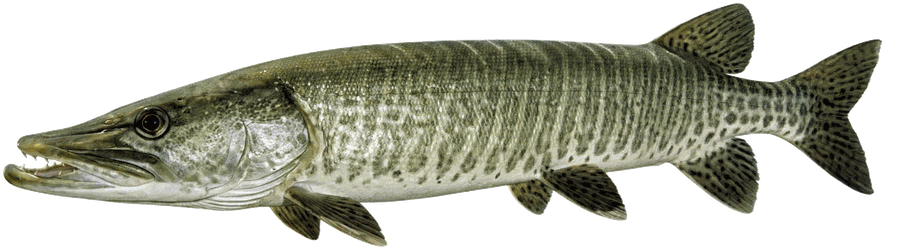
How to catch Muskellunge
Esox masquinongy
Bump Board's tactics library for Muskellunge — where to fish, what to tie on and how to fish it, season by season. In the app, these tips adapt live to the weather, the front and the light.
Muskellunge — Prespawn
Where to fish
- Ahead of the spawn, muskies are on the move toward the shallow spawning bays — movement peaks ride the cold transitions of spring (the 4–12 °C band in the telemetry). Fish the routes: the edges and funnels between winter water and the bays, a step behind the pike, whose spawn runs first.
What to tie on
- This is a searching-season fish in the making (the post-spawn mode below is the measured extreme of it). The monograph is movement and catch science, not a lure book — it names no baits, and these entries follow it: present forage-sized offerings along the travel lanes and let location do the work.
How to fish it
- Keep the day's clock in view even now: dawn is this species' measured minimum, dusk its maximum, in every method that has timed it. A prespawn evening on a travel lane is worth two dawns.
If it's still tough
- If the lanes are quiet, the move hasn't reached your bay — work back toward the deep edges. Spring muskies are distributed along a route, and the route is longer than one spot.
Muskellunge — Spawn
Where to fish
- Spawning runs at 9–15 °C, peaking near 12.8 °C, after the pike are done, in the shallow bays. One honesty rule the rating also follows: whether spawning muskies stop feeding has never been measured — no other fish's spawning fast is borrowed as a number — so the spawn renders here as a location note, not a predicted shutdown. The fish are in the bays; fish the edges and the fish travelling in and out, and leave the beds themselves alone.
What to tie on
- Nothing spawn-specific is sourced. Edge presentations at the dusk window are the season's honest play.
How to fish it
- Fish the bay mouths and first edges at dusk, when the species' clock peaks, rather than over the spawning shallows at midday — that advice is location plus diel, both measured, and it's as far as the evidence honestly goes in this window.
If it's still tough
- If the bays are all spawners and no feeders, work the prespawn lanes again — late movers and early post-spawn fish travel them while the spawn peaks.
Muskellunge — Postspawn
Where to fish
- Post-spawn into midsummer is the searching mode: muskies range, covering water, before the late-summer shift to ambush. Fish like it — cover the edges, points and weedlines, and expect encounters anywhere along a route rather than on one pinned spot. Two-of-three stomachs in the big diet study were empty (34.3% fullness, the lowest feeding frequency among the programme's predators): this is a low-base-rate fish, and a quiet day is its normal, not your failure.
What to tie on
- Forage-profile offerings fished on the move. One measured lever on size of encounter: hunger doubles catchability with no change in activity (fasted fish were caught over twice as often) — you can't set the lake's hunger, but it explains why the same water fishes dead one week and alive the next on identical weather.
How to fish it
- Build the day toward dusk — dawn minimum, day intermediate, dusk maximum is consistent across creel, telemetry and burst-activity data, with June sharpening the crepuscular peaks. Save your best water for the last shift.
If it's still tough
- When a searching-season fish won't show, resist downsizing the water: stay on routes and edges, and let the dusk window come to you on the best lane you have. Also note the vulnerability finding, because it tempers expectations honestly: the muskies that get caught were the larger but LESS explorative, less aggressive fish in the pond work — the bold fish you raise may be exactly the ones that don't eat.
Muskellunge — Summer
Where to fish
- Late summer flips the mode to ambush: fish hold on weed edges, points and structure and wait. And the temperature story is this species' own, opposite to pike's — the plateau is warm, 19–24 °C, with the realised niche near 22 °C; but above about 24–26 °C the fish crowd into refuges (over 90% refuge occupancy at a 26 °C daily average in the river work), and warm-water catch-and-release mortality climbs toward 30% while it runs near zero below 25 °C. Fish the ambush edges near cool refuges in heat — and in real heat, weigh whether to fish at all, and handle any fish you catch for a fast, wet release.
What to tie on
- Ambush-season presentations tight to the edge — the fish are holding, not roaming, so the bait has to arrive at the lie. Followers are this species' famous tease; the pond science says the caught fish are the shy ones, so a follow is information about location, and a slower, smaller second presentation to a known lie is the evidence-consistent next cast.
How to fish it
- Dusk is still the peak; in June-style long days the crepuscular sharpening flattens by late summer, so spread effort through the day more evenly than in June — but never start with dawn, the measured minimum, on your best water.
If it's still tough
- In a heat wave, the toughest and most honest advice in this entry: the fish are in refuges and stressed, catch-and-release itself kills a share of them, and the season will give you better, safer chances when the water drops back under the mid-20s.
Muskellunge — Fall
Where to fish
- Fall is a maximum season — stomach fullness runs fall > summer > spring in the diet data, and movement peaks again on the cooling transitions. Fish the edges, points and weedlines as a feeding fish again, with the searching and ambush water both in play.
What to tie on
- Full-size forage profiles on the structure routes. Fall muskies are feeding up; the base rate that haunts summer improves, and standard presentations on good edges are the play the season's data supports.
How to fish it
- Dusk maximum still rules the day. Cooling fronts that would be a pike story are not one here: pressure was a measured null for muskellunge (both success and catch rate), and precipitation likewise — fish the temperature transitions themselves, which are the measured fall trigger.
If it's still tough
- If fall water is quiet, check the warm side of the day — this species' activity rises with warmth through the teens and 20s, so a cold fall snap slows muskies more than it slows the pike beside them.
Muskellunge on the ice — Through the ice season
Where to fish
- Muskellunge under ice is a NOT COVERED state in this app, by decision: the entire under-ice evidence is one 1979 agency telemetry study — fish deeper (2.5–4.5 m) in moderately vegetated overwintering habitat, moving minimally, with one relocation away from low-oxygen water. No under-ice diel, light response or catchability data exists. A numeric ice rating would be invention, so there isn't one.
What to tie on
- No ice presentation is sourced for muskellunge — and no other species' ice set was borrowed wholesale to fill this space, because a borrowed rating would look like knowledge it isn't.
How to fish it
- Muskies are present and catchable under ice — the fishery exists; the science doesn't. If you fish them, you're ahead of the literature, and the app says so instead of pretending otherwise.
If it's still tough
- The sourced muskie seasons are the spring routes, the searching early summer, the ambush late summer and the fall maximum. Through the ice, target the species this library's ice science actually covers.
Manitoba Master Angler
A Muskellunge of 79 cm (31 in) or better qualifies for Manitoba's Master Angler Program.
Where Muskellunge live
1,453 waters in the Bump Board dataset hold Muskellunge. A selection:
Manitoba
- Barren Lake
- Beautiful Lake
- Hadashville Pond
- Kingfisher Lake
- Lac Du Bonnet
- Lake of the Prairies
- Lake of the Woods
- Lake Wahtopanah
- Line Lake
- Nora Lake
- Nutimik Lake
- Perch Lake
- Singush Lake
- Tees Lake
- Twin Lakes
- Wahtopanah Lake
- West Watjask Lake
Ontario
- Allumette Lake
- Amaleen Lake
- Apsley Lake
- Armstrong Lake
- Balsam Lake
- Baptiste Lake
- Barnston Lake
- Barron River
- Bass Lake
- Beach Lake
- Bear Lake
- Beaver Lake
- Beaver River
- Beaverdam Lake
- Beech Lake
- Belmont Lake
- Benoir Lake
- Big Bald Lake
- Big Canoe River
- Big Canon Lake
- Big Cedar Lake
- Big Fox Lake
- Big Grassy River
- Big Gull Lake
Plus 394 more Ontario waters — browse Ontario lakes.
Iowa
- Big Creek Lake
- Black Hawk Lake
- Brushy Creek Lake
- Clear Lake
- East Okoboji Lake
- Hawthorn Lake
- Lake Cornelia
- Lake MacBride
- North Twin Lake
- Spirit Lake
- West Lake
- West Okoboji Lake
Illinois
- Argyle Lake
- Canton Lake
- Evergreen Lake
- Heidecke Lake
- Kinkaid Lake
- Lake of the Woods
- Lake Pittsfield
- Lake Shelbyville
- Lake Storey
- Pierce Lake
- Shabbona Lake
Indiana
Kentucky
Maine
Michigan
- Bankson Lake
- Bass Lake
- Big Bear Lake
- Big Island Lake
- Black Lake
- Brule Lake
- Budd Lake
- Burt Lake
- Campau Lake
- Caribou Lake
- Center Lake
- Chicagon Lake
- Chief Edwards Lake
- Clam Lake
- Craig Lake
- Crooked Lake
- Crooked Lake
- Dean Lake
- East Bay Lake
- East Paint Lake
- Elk Lake
- Gun Lake
- Hanley Lake
- Haven Hill Lake
Plus 28 more Michigan waters — browse Michigan lakes.
Minnesota
- Andrusia Lake
- Baby Lake
- Bald Eagle Lake
- Bde Maka Ska
- Beers Lake
- Benedict Lake
- Big Lake
- Big Sand Lake
- Blueberry Lake
- Borden Lake
- Bouder Lake
- Boy Lake
- Budd Lake
- Cass Lake
- Cedar Island Lake
- Cedar Lake
- Charley Lake
- Child Lake
- Comfort Lake
- Crane Lake
- Crescent Lake
- Cross Lake
- Cut Foot Sioux Lake
- Deep Lake
Plus 84 more Minnesota waters — browse Minnesota lakes.
Missouri
Nebraska
- Blue Lake
- Calamus Reservoir
- Crescent Lake
- Elwood Reservoir
- Enders Reservoir
- Glenn Cunningham Lake
- Merritt Reservoir
- Timber Point Lake
- Wagon Train Lake
- Zorinsky Lake
New York
Ohio
- Acton Lake
- Alum Creek Lake
- Berlin Lake
- Buckeye Lake
- Burr Oak Reservoir
- Caesar Creek Lake
- Charles Mill Lake
- Clarence J Brown Reservoir
- Clear Fork Reservoir
- Clendening Lake
- Cowan Lake
- Deer Creek Lake
- Delaware Lake
- Dillon Lake
- Findlay Upground Reservoir Number Two
- Guilford Lake
- Hargus Lake
- Hoover Reservoir
- Indian Lake
- Jackson Lake
- Knox Lake
- Lake Logan
- Lake Milton
- Lake White
Plus 13 more Ohio waters — browse Ohio lakes.
Pennsylvania
- Allegheny Reservoir
- Beltzville Lake
- Blue Marsh Lake
- Canoe Creek Lake
- Conneaut Lake
- Cowanesque Lake
- Edinboro Lake
- Frances Slocum Lake
- Glendale Lake
- Hills Creek Lake
- Keystone Lake
- Lake Arthur
- Lake Canadohta
- Lake Marburg
- Lake Nockamixon
- Lake Wilhelm
- LeBoeuf Lake
- Loyalhanna Lake
- Marsh Creek Reservoir
- Prompton Lake
- Pymatuning Reservoir
- Raystown Lake
- Shenango River Lake
- Sugar Lake
Plus 6 more Pennsylvania waters — browse Pennsylvania lakes.
South Dakota
Tennessee
- Calderwood Lake
- Center Hill Lake
- Dale Hollow Lake
- Douglas Lake
- Great Falls Lake
- Lake Ocoee
- Melton Hill Lake
- Norris Lake
- Watts Bar Lake
Virginia
Vermont
Wisconsin
- 2780 Reservoir
- Alder Lake
- Alexander Lake
- Allequash Lake
- Alma Lake
- Altoona Lake
- Alva Lake
- Amacoy Lake
- Amber Lake
- American Lake
- Amik Lake
- Amnicon Lake
- Anderson Lake
- Annabelle Lake
- Apeekwa Lake
- Apple Falls Flowage
- Apple River Flowage 134
- Archibald Lake
- Armour Lake
- Arrowhead Lake
- Ashegon Lake
- Audie Lake
- Augustine Lake
- Averill Lake
Plus 691 more Wisconsin waters — browse Wisconsin lakes.