
Fishing tips & tactics
How to catch Mountain Whitefish
Prosopium williamsoni
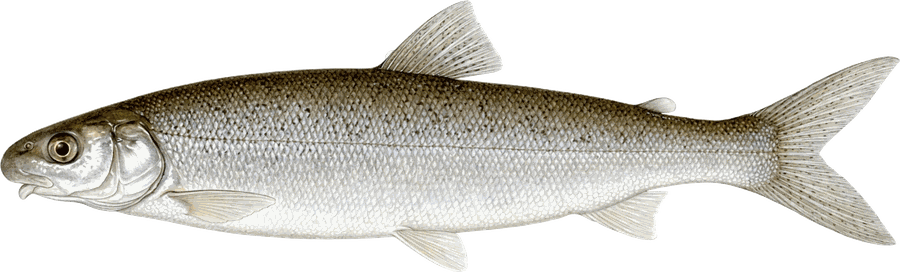
Bump Board's tactics library for Mountain Whitefish — where to fish, what to tie on and how to fish it, season by season. In the app, these tips adapt live to the weather, the front and the light.
Mountain Whitefish — Summer
Where to fish
- Summer is the growth-season peak on the model's compromise plateau: season values run 0.95 in June, 1.0 in July and 0.95 in August, and the temperature curve is at its top across 10–14 °C — the band that brackets the growth optimum of 13.8 °C between the post-spawning (11.9 °C) and spring (16.3 °C) preferenda. Fish water in that band on benthic structure first; it is a preference-and-growth construction, not a measured feeding-rate curve, and the entry fishes it at exactly that strength.
- Summer river fish hold the classic swift-water feeding address on the habitat accounts: runs and the broken water over gravel and cobble, working benthic insects where the bottom food is produced. That habitat statement is expert-consensus grade, carried here as the river address the diet studies sampled — the Logan and Smith River diet work was collected from exactly this kind of feeding water.
- Respect the warm edge without inventing a lethal: sustained water above about 20 °C is the documented stress zone — the August 2016 Yellowstone River kill followed peak temperatures above 20 °C for 18 straight days at near-record low flow, with a temperature-linked disease in the causal mix, so it corroborates stress without being a lethal temperature. No adult lethal has ever been measured for this species; every lethal-looking number in its record is a fry or embryo number (fry tolerance 22.6–23.6 °C over 7 days; embryo mortality at 9 °C and above), and none of them is applied to adults anywhere in this entry.
What to tie on
- The benthic menu at full size: mayfly and caddisfly immatures and chironomids off the bottom, matching the diet studies' year-round composition — in the Smith River spring sampling at peak discharge, population staples were Ephemeroptera and Trichoptera, and diet composition barely changed between mainstem and tributary. Bottom presentations that stay in contact with gravel and cobble are fishing the measured feeding mode of a fish with a small, downward mouth that stirs substrate to expose invertebrates.
How to fish it
- Carry the record's one open tension honestly rather than averaging it away: juvenile scope for activity peaked at 9–12 °C and had collapsed by 15 °C (Rajagopal 1975), while adult pre-spawning fish chose 17.7 °C in a gradient. The model sides with the adult and growth evidence for its plateau and lets the warm limb fall through the upper growth optimum of 18.8 °C — so in practice, fish the low teens confidently, treat the high teens as a shoulder, and do not expect a juvenile physiology number to tell you where adult summer fish feed.
- Keep the clock near-flat and dusk-leaning, at synthesis strength: dusk 1.0 and night 0.85 rest on expert accounts and on observed nocturnal spawning, not on any adult stomach study — none exists. A summer day fished thoroughly on the bottom in plateau-temperature water is a defensible full pattern for this species; the light changes are an emphasis, not a gate.
If it's still tough
- If summer fish refuse in warm water, check the band before the bait: by 18 °C the curve is at 0.65, by 20 °C at 0.40. Move toward the coolest benthic water available rather than changing presentations in the stress zone. And on clarity this entry offers no rule at all, deliberately: the turbidity direction for this species is conflicted in its own literature — clear-water accounts on one side, a 1940 suggestion of better silt tolerance than trout on the other — no dose–response exists, and the rating carries turbidity at zero rather than inventing a direction.
Mountain Whitefish — Fall
Where to fish
- Fall is the great redistribution before the spawn, and movement is its measured signature: McLeod River fish travelled from 9 km upstream to 89 km downstream between September tagging and winter, with most movement in September–November, and the season values step down through it (0.85 in September, 0.65 in October). Fish the staging water along the routes between summer feeding water and the spawning reaches — addresses change week to week in this season because the fish are travelling, not because they have stopped feeding.
- The pre-spawning river move has a temperature marker: Blackfoot River prespawning migrations, from under a kilometre to 79 km with most fish moving only a few kilometres, began in early September as daily average temperatures declined to about 12 °C. On river water, the early-fall cooling through the low teens is the staging signal — fish the holding water below the spawning reaches as it passes.
What to tie on
- Nothing fall-specific is measured in this species' diet — no autumn diet shift appears in the diet corpus — so the supported offering is the year-round benthic menu, worked along the staging routes and the holding water off the spawning ground. No staging lure or egg presentation is named for mountain whitefish, and none is invented here.
How to fish it
- Fish the calendar more than the thermometer in this season, because that is what the spawn-timing evidence supports: in both the Madison and the Green River systems, spawning happened on similar dates across years despite wide variation in water temperature and discharge, pointing to photoperiod-like cueing rather than a thermal trigger. Expect the staging pattern to advance on schedule through October whether the fall runs warm or cold, and plan coverage of the staging water accordingly.
- Note the pre-spawning temperature choice for what it is: the 17.7 °C pre-spawning preferendum is the warmest value in the seasonal family — autumn fish in a gradient chose water their own embryos cannot survive in. It is a laboratory choice measurement, not a fall fishing address; the fall pattern in the field is movement and staging in cooling water, and that is what the sections above fish.
If it's still tough
- If a staging spot goes dead overnight in fall, the redistribution is the first explanation, not an emptied reach: a population measured moving tens of kilometres between September and November will vacate good water on its own schedule. Move along the route toward the spawning reaches before changing presentations — in this season, following the fish beats refining the bait.
Mountain Whitefish — Winter
Where to fish
- Winter is a real season for this fish, not an edge case — it spawns into it and feeds through it at a reduced rate: season values hold a moderate floor of 0.55 through the cold months, supported by a winter river fishery documented since 1954 and by under-ice telemetry showing fish settled and present all winter. The winter temperature preference is the family's cold member at 9.9 °C — a choice measurement that tells you these fish remain oriented and active in cold water, at about half the open-water pace. In open winter water, fish deep holding water on the bottom and expect that half rate.
- The winter river fishery is the oldest direct evidence: Montana's most intensive mountain whitefish fishery was the winter fishery as early as 1952–54, prosecuted while trout seasons were closed, on fish concentrated near bottom in winter holding water. Winter river fish are catchable and feeding at fishery scale — that establishes the pattern's existence, though no study measures a winter feeding rate, and the entry claims no rate for it.
What to tie on
- The winter river fishery's own baits are on the record: live stonefly nymphs and maggots were the documented winter offerings (Gaffney 1954), fished near bottom in the holding water. That is a fishery record, graded as one — it names what winter anglers used on this fish, which is more than most seasons offer.
- Everywhere, the supported shape is the benthic menu at its smallest and slowest: chironomid larvae and small invertebrate presentations delivered to the bottom where winter fish are settled, because a settled fish at half rate is found by position, not provoked by pace.
How to fish it
- Fish slowly and stay on a spot: the under-ice telemetry pattern — a big September–November redistribution, then movement slowing from November to March as fish settle into overwintering habitat — is the winter behaviour this entry transfers to open cold water. A settled winter population rewards thorough bottom coverage of one holding area over a searching day, and the dusk-leaning clock carries into winter only at its synthesis strength, as in every other season here.
- Watch a hard cold snap for a short movement window rather than a shutdown: in the Chehalis radio work, winter fish were more likely to move when the temperature fell below about 6.5 °C, and temperature was the only significant movement covariate in that programme. A mid-winter drop can reshuffle holding water for a day — worth one check of the neighbouring holding areas, at a season when fish otherwise barely move at all.
If it's still tough
- A quiet winter holding area is the species at its measured rate before it is a wrong spot: half pace across a whole season means half the encounters. Make one move to deeper or more sheltered holding water before changing presentations — and in a hard winter on river water, remember the Wapiti programme's finding that overwintering fish were sensitive to water withdrawals at low winter flows: the lowest-flow holding water is the most fragile address of the season.
Mountain Whitefish — Spring
Where to fish
- Start with what kind of entry this is, because two honest limits govern everything below: mountain whitefish's rating is a DERIVED set, confidence capped at Low, built from this species' own physiology and movement record — and almost all of that record is river evidence, while the waters this entry rates are lakes. That river-to-lake transfer is stated here once and applies to every season that follows. In spring the annual cycle is climbing: season values rise from 0.60 in March through 0.70 in April to 0.85 in May, on the way to the early-summer peak.
- The spring river pattern is an upstream feeding move: in the Smith River system, fish moved upstream into tributaries outside the spawning period in movements the authors hypothesised were feeding moves toward seasonally available prey, and Methow PIT-tagged fish likewise moved upstream in spring after autumn downstream overwintering migrations. Fish the tributary water and the first holding water above the winter reaches as the move develops.
- Lake fish in the record are bottom fish in deeper water: the Lake Tahoe account has them feeding just above the bottom in deeper water on snails, insect larvae, crayfish and amphipods. Spring effort on a lake population belongs on that deep bottom menu, worked slowly — the lake evidence is a habitat and diet description, not a movement study, and the entry claims no more for it than that.
What to tie on
- Fish the measured diet, because composition is the best-sampled feeding axis this species has: benthic aquatic insects dominate across five diet studies, with chironomid larvae the single largest item (52% of all food items in the Teton River stomachs; 85% by number in age-0 fish) alongside mayfly and caddisfly immatures. Small bottom presentations sized to that benthic menu are the supported tackle story; the studies name the food in detail and name no lure for this fish.
How to fish it
- Fish the temperature family, not a single preference number, because this species' preference moves: measured adult final preferenda ran 17.7 °C before spawning, 11.9 °C after it, 9.9 °C in winter and 16.3 °C in spring (Ihnat & Bulkley 1984) — a roughly 8 °C seasonal swing. The model's plateau is therefore a compromise at 10–14 °C, centred on the measured growth optimum of 13.8 °C. Spring presentations belong in water climbing through that plateau, not in a hunt for the spring preferendum point itself.
- Time the day by a synthesis, labelled as one: the clock is dusk-led and near-flat (dusk 1.0, night 0.85, dawn 0.75, day 0.70) because expert accounts describe dusk and after-dark feeding — but adult feeding periodicity has never been measured for this species, and the only primary diel datum, for age-0 fish, is daylight and evening feeding. Position on the benthic food comes first; the dusk lean is a lean, not a proven feeding hour.
If it's still tough
- If cold spring water is quiet, it is not yet a shutdown verdict: winter river fish remained active and feeding at temperatures near freezing on the telemetry record, and the curve's cold limb still holds 0.75 at 4 °C. Slow down on the bottom in the deepest spring holding water before concluding the season has not started.
Mountain Whitefish — Fallspawn
Where to fish
- This is the spawn itself, the best-documented event in this species' year: across the Madison, Green, Blackfoot and Duncan systems, spawning concentrates in the last two weeks of October into early November, inside a full range that runs from late September in high northern water to mid-February in warm regulated regimes. It is a broadcast spawn over gravel and cobble, typically below 10 °C with peak behaviour below 6 °C — no redd, no nest, no guarding — and the honest framing comes first: feeding across the window has never been measured, so this is an aggregation entry, not a feeding entry.
- River spawning fish use shallow gravel and cobble runs, in water at least about 75 cm deep on the range-wide account, in groups at night. The Madison record is the precise one: spawning ran 19 October to 10 November in 2013 and 16 October to 4 November in 2014, with males moving first from early October and water temperatures across the spawning periods spanning 13.3 °C down to 0 °C.
- Lake populations spawn on shorelines and at the mouths of incoming streams, on the same fall schedule. The staging fish hold on the bottom off that shallow hard ground — fish the deep edge of the shoreline spawning areas while the window builds, which is where the feeders among a spawning population are defensibly sought.
What to tie on
- Nothing spawn-specific is named in the mountain whitefish literature — no egg presentation, no spawning lure — and none is invented here. On the edges of the spawning ground, the supported offering remains the benthic invertebrate menu the diet studies measure, presented on the bottom to the fish that are staging and travelling rather than spawning.
How to fish it
- Fish the aggregation's own timing, which is measured even though its feeding is not: the window is short and synchronous — a core of roughly three weeks — movement peaks during the spawning period itself, and the event happens at night. Within the season model, the October–November dip (0.65, then 0.55) encodes reproductive reallocation by analogy to other fall spawners, and the study flags its magnitude as the softest number in the whole set; fish the window for concentrated, findable fish, and do not read the dip as a measured fast.
- Be in position at the light changes on the edges of the ground: the spawning itself is a night event, and the travelling fish around it move most in the same period, so dawn and dusk sessions on the holding water beside the spawning areas cover both the arrivals and the fish already done. That is a movement pattern being fished, stated as one — it is not a claim that spawning fish feed at those hours, which nobody has measured.
If it's still tough
- A spawning reach full of visible fish that will not respond is consistent with everything the research can and cannot say: an aggregation whose feeding has never been measured. Move to the first holding water off the spawning ground and fish the benthic menu there — the travellers and the fish already off the spawn are the defensible target, and pestering broadcast spawners on shallow gravel is not a tactic this library teaches.
Mountain Whitefish on the ice — Through the ice season
Where to fish
- PROVISIONAL — and this ice entry carries its transfer in the open, as the study requires: every under-ice datum for mountain whitefish is river telemetry, and no under-ice study of a lake population exists at all, so this entry transfers measured river winter behaviour to lake ice fishing and says so in its first line. What transfers is real: two full-winter telemetry programmes (McLeod and Wapiti Rivers, Alberta), a winter fishery documented since 1954, and a measured winter preferendum of 9.9 °C. Fish winter lake structure as settled, bottom-oriented fish on that transferred pattern, at the set's Low confidence cap, which the whole DERIVED rating carries.
- The McLeod under-ice record is specific, and it corrects the standard shorthand: across a full winter, radio-tagged fish settled from November to March and selected shallower water with larger cobble substrate — mean used depth was only about 0.41 m, over cobble, at low column velocities — not the deep pools of the usual winter story. Dissolved oxygen at used sites ran 6.7–9.4 mg/L, essentially identical to what was available, so no low-oxygen behaviour was observable in that system and none is claimed here.
- The one direct bridge to lake ice is a movement record: after spawning in 2013, about 40% of the Madison River fish moved into Ennis and Earthquake lakes to overwinter. That documents lake overwintering as this species' own behaviour — what those fish did under lake ice was not studied, and the entry does not pretend the river habitat numbers describe it.
What to tie on
- The benthic menu through the ice, at its smallest: chironomid larvae and small invertebrate presentations on the bottom in the settled winter areas, matching both the year-round diet record and the winter fishery's small-bait tradition. No ice-specific lure is measured for this species, and none is invented here.
- The documented winter river offerings — live stonefly nymphs and maggots, from the winter fishery record (Gaffney 1954) — are the one bait statement in this species' winter file, carried at fishery-record grade for river ice water.
How to fish it
- Fish the settled pattern patiently: winter movement slows sharply after the fall redistribution, the fish hold in chosen overwintering habitat for months, and winter feeding is attested at fishery scale across seventy years — so a through-ice session is position work on bottom, giving a located area real time at a half-rate season. The ice clock is the open-water dusk-leaning shape carried under ice slightly flattened (dusk 0.95, night 0.85, dawn 0.75, day 0.70) as a labelled within-species transfer — under-ice timing has never been measured in any habitat for this fish, and the entry holds the lean loosely for exactly that reason.
- Keep oxygen in its measured place, which is a small one: the winter river fish lived all season at 6.7–9.4 mg/L because that is what the water offered, the rating's ice oxygen anchors are near-flat with a low-end penalty whose position comes from the embryo curve transferred to adults — a labelled life-stage transfer, since adult oxygen behaviour is unmeasured — and no winterkill dataset for this species exists. Do not abandon deep winter structure on a borrowed trout threshold; this species' own record gives you no such threshold to fish by.
If it's still tough
- If the transferred pattern is silent on your lake, that outcome is inside the evidence, not outside it: the river-to-lake transfer is this ice set's largest single assumption, and a lake population is allowed to winter differently from two Alberta rivers. Work a second depth band — the record itself holds both shallow cobble selections and populations that wintered deep after moving into lakes — before changing presentations, and treat a blank as information about the transfer, not about your tackle.
- On river ice, hold the two telemetry programmes' disagreement open rather than picking one: the McLeod model selected on substrate and depth with velocity weak, while the Wapiti programme found overwintering fish sensitive to low winter flows and withdrawals. In a low-flow winter, the flow-sensitive reading deserves the benefit of the doubt — fish the holding water least exposed to drawdown first.
Where Mountain Whitefish live
124 waters in the Bump Board dataset hold Mountain Whitefish. A selection:
California
Colorado
Idaho
- Alturas Lake
- Arrowrock Reservoir
- Ben Ross Reservoir
- Black Canyon Reservoir
- Blackfoot Reservoir
- C J Strike Reservoir
- Deadwood Reservoir
- Island Park Reservoir
- Lake Cascade
- Lake Pend Oreille
- Little Payette Lake
- Loon Lake
- Lucky Peak Lake
- Mackay Reservoir
- Murtaugh Lake
- Palisades Reservoir
- Payette Lake
- Priest Lake
- Spirit Lake
- Upper Payette Lake
- Upper Priest Lake
- Yellow Belly Lake
Montana
- Ackley Lake
- Anita Reservoir
- Bighorn Lake
- Bowman Lake
- Bull Lake
- Bynum Reservoir
- Canyon Ferry Lake
- Church Slough
- Clark Canyon Reservoir
- Cyclone Lake
- Deadmans Basin Reservoir
- Deep Lake
- Dickey Lake
- East Rosebud Lake
- Emerald Lake
- Ennis Lake
- Fennon Slough
- Flathead Lake
- Glen Lake
- Hauser Lake
- Hebgen Lake
- Holland Lake
- Holter Lake
- Horseshoe Lake
Plus 36 more Montana waters — browse Montana lakes.
Utah
Washington
- Baker Lake
- Boundary Lake
- Bumping Lake
- Cle Elum Lake
- Clear Lake
- Franklin D Roosevelt Lake
- Lake Easton
- Lake Wallula
- Lake Wenatchee
- Palmer Lake
- Rimrock Lake
- Sullivan Lake
Wyoming
- Big Sandy Reservoir
- Bradley Lake
- Buffalo Bill Reservoir
- Elk Ranch Reservoir
- Flaming Gorge Reservoir
- Fontenelle Reservoir
- Green River Lakes
- Half Moon Lake
- High Savery Reservoir
- Jackson Lake
- Jenny Lake
- Kemmerer Reservoir
- Lake Viva Naughton
- Leigh Lake
- Little Half Moon Lake
- Lower Slide Lake
- Lower Sunshine Reservoir
- Meeks Cabin Reservoir
- New Fork Lakes
- Phelps Lake
- Pilot Butte Reservoir
- Ring Lake
- Sunshine Reservoir
- Taggart Lake