Fishing tips & tactics
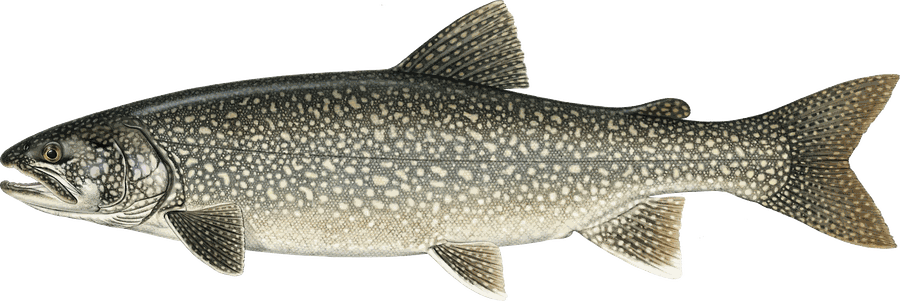
How to catch Lake Trout
Salvelinus namaycush
Bump Board's tactics library for Lake Trout — where to fish, what to tie on and how to fish it, season by season. In the app, these tips adapt live to the weather, the front and the light.
Lake Trout — Summer
Where to fish
- Summer lake trout live in the thermocline band — the cold layer that still holds oxygen. That's the whole location rule: find the cold, oxygenated water and you're in their world. Where the bottom reaches that layer, the Great Lakes canon fishes them right on or near bottom.
What to tie on
- The trolling spread: a Spin-N-Glo behind a herring dodger, a rotating flasher, or a Fish Flash — attractors in use since the early 1950s. Dodger colours: chartreuse and brushed stainless ('trash can'). The No. 2 Spin-N-Glo is the most popular size; Nos. 4, 2 and 0 produce most of the fish. Attractor size follows depth and clarity: 4–6 in attractors in shallow or very clear water, 6–8 in deeper or off-colour.
- Vertical jigging works all summer too: the white tube through the column, and jigging spoons of ½–1 oz.
How to fish it
- Leader length is the mood dial. Behind a herring dodger: 12–24 in of 20-lb fluorocarbon — 12–18 in gives a violent snap for active fish, toward 24 in a soft, slow target for lethargic ones. Behind a Fish Flash, leaders run 36–72 in. Speeds are specific: the herring dodger fishes at 1.6–2.0 mph and is very speed-sensitive; a rotating flasher at 2.0–2.8; a Fish Flash at 1.6–2.8.
- 'Skipping bottom' — ball and dodger ticking bottom every few feet — works over silt, sand and gravel; over chunk rock, hold a few feet off. When you change the spread, change spoon colour and pattern first, then brand and size; and treat glow and UV as separate colours in the rotation, not finishes.
If it's still tough
- In the afternoon the canon flips: spoons outproduce flashers and flies — except for bottom-oriented lake trout, which stay a dodger fish. If the flashers stop producing by midday, pull them and run clean spoons or plugs.
Lake Trout — Spring
Where to fish
- Spring is the shallow season — before the surface warms, lake trout can be caught shallow, and right after turnover the water is one temperature top to bottom (around 39 °F at turnover), so the fish may be anywhere. Enjoy it: by mid-to-late June on classic trout water they're already 70–140 ft down.
What to tie on
- The Shield standard is a white or silver tube jig, 3–4 in — it matches their forage: ciscoes, whitefish and suckers, all streamlined, thin, soft-scaled and silvery-white. Scented tubes are the same profile. Where the forage is tiny shiners instead, small flutter spoons match better — lure size follows the forage, always.
- Vertical jigging spoons and lead-heads of ½–1 oz in white or chartreuse are the other standard.
How to fish it
- Work the tube through the whole column — hopping it, popping it, swimming it, on a ¼- to ⅜-oz head and 8–10 lb line. And learn the chase trigger: when a trout appears on the sonar below your bait, reel rapidly. A fleeing bait makes a lake trout commit.
- Snap-jigging works the same nerve: snap hard, pause, let it fall — the hits come on the drop. With a heavy 1-oz head you can pound bottom on humps — dig a hole in it, in the old phrase.
If it's still tough
- If shallow spring fish won't go, they may already be deeper than you think. Drop down the first big break and jig the column there — the spring window closes from the top down.
Lake Trout — Fallspawn
Where to fish
- Fall is the spawn: rocky reefs and shoals less than 40 ft deep — sometimes a foot deep — the same reefs every year (lake trout build no redd; they broadcast over the rock). And in canoe country, the autumn feeding frenzy around those shoals is famous: a simple jig and twister tail is the premier lure of the season there.
What to tie on
- Keep it simple on the shoals: a jig with a twister tail, the white tube, and spoons. The forage-matching rule still holds — silvery-white profiles over the rock.
How to fish it
- Work the shoals and their edges through the column. Spawn-season trout are concentrated and findable — the year's best chance to fish them shallow without electronics doing the finding.
If it's still tough
- If the shoals are quiet, the fish are staging off them — drop to the first deep edge beside the spawning rock and jig there. They use the deep edge as a hallway to the shoal.
Lake Trout on the ice — Early ice
Where to fish
- Follow the food, not a depth — that's the ice rule from the best lake-trout ice angler of his generation, whose best hour ever came over 19 ft of water, and who took a giant over 28 ft. Bottom where the gobies are; mid-column where smelt and ciscoes cruise. Trout hunt in packs of three or four — the fish are where their food is, in groups.
What to tie on
- A white tube jig, 3½–5 in, on a ¼- to ⅜-oz head — corkscrew-plummeted down, or rigged swimbait-style with the head outside. Rod: 34–36 in inside a shelter, 36–42 in in the open; 10–12 lb braid with about a metre of 10–12 lb mono.
How to fish it
- Work the tube through the column and use the chase trigger — a trout on the sonar gets a rapidly reeled, fleeing bait. And when your partner hooks one, drop down a nearby hole (or the same one) immediately: the pack is there and feeding.
- A spoon trick with real scent: run the treble through the head of a freshly snipped sucker minnow. Rattling lipless cranks (Rippin' Rap class) call trout in when they're in a chasing mood.
If it's still tough
- The western system is the backup plan: humps topping out at 30–50 ft are the pattern from around Christmas — if the food-following hasn't produced, set up on a deep hump and jig the column there.
Lake Trout on the ice — Mid ice
Where to fish
- By mid-January the western pattern shifts from humps to flats and saddles — still in the 30–50 ft band. Food is still the rule; the structure type changes, not the depth.
What to tie on
- The white tube still leads — but past 50 ft, the tube gives way to the deep spoon: a Williams Ice Spoon, 2.25 or 3.25 in, half-gold/half-silver, is the proven deep-water bait.
How to fish it
- Jig the whole column over the flats and saddles, drop to the spoon when the fish are deeper than 50 ft, and drop a second line the moment anyone hooks up — packs of three or four are still the rule.
If it's still tough
- Colour note, honestly regional: the Shield school fishes white, silver and clear-flake; the western school fishes drab green, brown and olive over kokanee forage. Use the school your water belongs to — the books disagree because their lakes do.
Lake Trout on the ice — Late ice
Where to fish
- Late ice moves trout shallow — but stay near deep water: a flat of 10–15 ft right beside a 50 ft-plus drop is the classic late-ice setup.
What to tie on
- White tube on a ¼- to ⅜-oz head, the deep spoon if they're holding over the drop. Same tackle as mid-winter.
How to fish it
- Fish the shallow flat for cruisers and the edge for the pack. Late-ice trout roam more — check the flat first, then the drop, then back.
If it's still tough
- Slide shallower before you slide deeper — late-ice trout are travelling toward the shallows, and the flat next to the drop is the last stop.
Manitoba Master Angler
A Lake Trout of 89 cm (35 in) or better qualifies for Manitoba's Master Angler Program.
Where Lake Trout live
2,841 waters in the Bump Board dataset hold Lake Trout. A selection:
Manitoba
- Aikens Lake
- Big Sand Lake
- Bolton Lake
- Brereton Lake
- Cedar Lake
- Childs Lake
- Clearwater Lake
- Cormorant Lake
- Cranberry Lakes
- Cross Lake
- Crowduck Lake
- Davidson Lake
- East Blue Lake
- Edmund Lake
- Falcon Lake
- Fishing Lake
- Garner Lake
- Glad Lake
- Gods Lake
- Gunisao Lake
- High Lake
- Hunt Lake
- Kississing Lake
- Lake Athapapuskow
Plus 28 more Manitoba waters — browse Manitoba lakes.
Ontario
- 5PB10-125, L.
- 5PB10-93, L.
- 5PB17-82, L.
- Aaron Lake
- Abamasagi Lake
- Abamategwia Lake
- Abbess Lake
- Abbott Lake
- Abigogami Lake
- Acheson Lake
- Achigan Lake
- Acid Lake
- Adelaide Lake
- Adele Lake
- Aerobus Lake
- Affleck Lake
- Agnes Lake
- Aiabewatik Lake
- Aikens Lake
- Aileen Lake
- Airport Lake
- Ajax Lake
- Al's L.
- Alces Lake
Plus 2,353 more Ontario waters — browse Ontario lakes.
Nova Scotia
Alaska
- Birch Lake
- Blueberry Lake
- Chet Lake
- Coal Mine Number 5 Lake
- Craig Lake
- Dicks Pond
- Donnelly Lake
- Four Mile Lake
- Ghost Lake
- Harding Lake
- Kenna Lake
- Kens Pond
- Lake Clunie
- Long Lake
- Lost Lake
- Matanuska Lake
- Moose Lake
- Nickel Lake
- North Twin Lake
- Pauls Pond
- Rangeview Lake
- Rapids Lake
- Sand Lake
California
Colorado
- Big Creek Lakes
- Blue Mesa Reservoir
- Carter Lake Reservoir
- Chambers Lake
- Clear Lake
- Crystal Creek Reservoir
- Crystal Reservoir
- Deep Lake
- Grand Lake
- Green Mountain Reservoir
- Gross Reservoir
- Ivanhoe Lake
- Jefferson Lake
- Lake Granby
- Lake San Cristobal
- Lincoln Lake
- Loch Lomond
- Morrow Point Reservoir
- Rampart Reservoir
- Ruedi Reservoir
- Shadow Mountain Lake
- Taylor Park Reservoir
- Turquoise Lake
- Twin Lakes
Plus 2 more Colorado waters — browse Colorado lakes.
Connecticut
Idaho
- Palisades Reservoir
- Payette Lake
- Priest Lake
- Ririe Reservoir
- Stanley Lake
- Thirtythree Lake
- Upper Priest Lake
- Warm Lake
Massachusetts
Maine
- Beau Lake
- Big Bennett Pond
- Big Benson Pond
- Big Greenwood Pond
- Big Indian Pond
- Churchill Lake
- Cliff Lake
- Crawford Pond
- Crescent Pond
- Crystal Lake
- Eagle Lake
- Echo Lake
- First Buttermilk Pond
- First Debsconeag Lake
- Flying Pond
- Foss Pond
- Fourth Debsconeag Lake
- Glazier Lake
- Halfmile Pond
- Hancock Pond
- Heart Pond
- Hopkins Pond
- Hurd Pond
- Indian Pond
Plus 17 more Maine waters — browse Maine lakes.
Michigan
- Beatons Lake
- Big Blue Lake
- Cass Lake
- Chicagon Lake
- Clark Lake
- Crystal Lake
- Dawson Lake
- Derby Lake
- East Bay Lake
- Elk Lake
- Glen Lake
- Golden Lake
- Grand Sable Lake
- Higgins Lake
- Hulbert Lake
- Imp Lake
- Lac La Belle
- Lake Arfelin
- Lake Bellaire
- Lake Charlevoix
- Lake Macatawa
- Lake Skegemog
- Mullett Lake
- North Blue Lake
Plus 7 more Michigan waters — browse Michigan lakes.
Minnesota
- Alder Lake
- Alpine Lake
- Amoeber Lake
- Bear Lake
- Bearskin Lake
- Big Trout Lake
- Birch Lake
- Bluewater Lake
- Burntside Lake
- Caribou Lake
- Cherokee Lake
- Cherry Lake
- Clearwater Lake
- Crooked Lake
- Cruiser Lake
- Crystal Lake
- Daniels Lake
- Duncan Lake
- Dunn Lake
- East Bearskin Lake
- Ester Lake
- Explorer Lake
- Fat Lake
- Fay Lake
Plus 40 more Minnesota waters — browse Minnesota lakes.
Montana
- Bighorn Lake
- Bowman Lake
- Church Slough
- Elk Lake
- Fennon Slough
- Flathead Lake
- Georgetown Lake
- Holland Lake
- Kersey Lake
- Kintla Lake
- Lake Blaine
- Lake Koocanusa
- Lindbergh Lake
- Lower Stillwater Lake
- McGregor Lake
- Mystic Lake
- Spar Lake
- Swan Lake
- Tally Lake
- Twin Lakes
- Upper Stillwater Lake
- Whitefish Lake
New Hampshire
- Dan Hole Pond
- Diamond Pond
- First Connecticut Lake
- Granite Lake
- Greenough Pond
- Lake Francis
- Lake Tarleton
- Lake Winnipesaukee
- Lake Winnisquam
- Little Squam Lake
- Merrymeeting Lake
- Newfound Lake
- Nubanusit Lake
- Ossipee Lake
- Second Connecticut Lake
- Silver Lake
- Silver Lake
- Spoonwood Pond
- Squam Lake
- Stinson Lake
- Sunapee Lake
- Third Connecticut Lake
New Jersey
New Mexico
New York
- Big Moose Lake
- Blue Mountain Lake
- Canada Lake
- Canadice Lake
- Canandaigua Lake
- Cayuga Lake
- Chazy Lake
- Crane Pond
- Eighth Lake
- Green Lake
- Hemlock Lake
- Hoel Pond
- Indian Lake
- Kensico Reservoir
- Keuka Lake
- Lake Bonaparte
- Lake Eaton
- Lake George
- Lake Gilead
- Lake Gleneida
- Lake Kushaqua
- Lake Lila
- Lake of the Woods
- Lake Placid
Plus 27 more New York waters — browse New York lakes.
Ohio
Oregon
South Dakota
Tennessee
Utah
Vermont
- Amherst Lake
- Caspian Lake
- Center Pond
- Crystal Lake
- East Long Pond
- Echo Lake
- Echo Lake
- Great Averill Pond
- Harriman Reservoir
- Harvey Lake
- Lake Champlain
- Lake Dunmore
- Lake Elligo
- Lake Memphremagog
- Lake Rescue
- Lake Willoughby
- Little Averill Pond
- Long Pond
- Maidstone Lake
- Mirror Lake
- Nelson Pond
- Nichols Pond
- Seymour Lake
- Shadow Lake
Plus 2 more Vermont waters — browse Vermont lakes.
Washington
Wyoming
- 1000 Island Lake
- Beartooth Lake
- Beaver Lakes
- Boulder Lake
- Boysen Reservoir
- Buffalo Bill Reservoir
- Burnt Lake
- Cathedral Lake
- Christina Lake
- Cook Lakes
- Crater Lake
- Cross Lake
- Crystal Lake Reservoir
- Dome Lake Number 1
- Don Lake
- Fayette Lake
- Firehole Lakes
- Flaming Gorge Reservoir
- Fontenelle Reservoir
- Fremont Lake
- Grassy Lake Reservoir
- Grave Lake
- Green River Lakes
- Gustave Lake
Plus 39 more Wyoming waters — browse Wyoming lakes.