Fishing tips & tactics
How to catch Kokanee
Oncorhynchus nerka
Bump Board's tactics library for Kokanee — where to fish, what to tie on and how to fish it, season by season. In the app, these tips adapt live to the weather, the front and the light.
Kokanee — Spawn
Where to fish
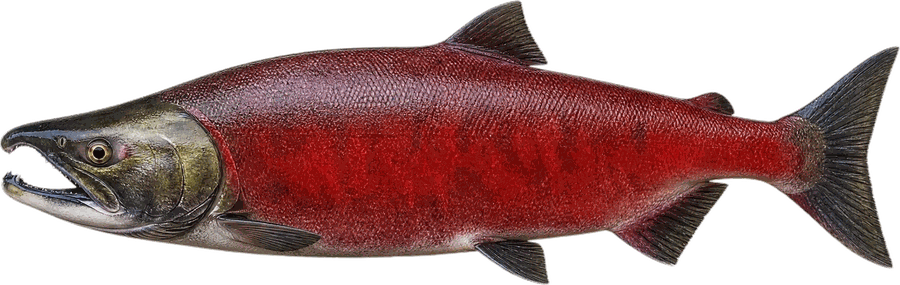
- From August staging into the autumn spawn (centre: October), the mature fish gather at the spawning shores — shore spawning around 11.4–13.4 °C. Know this before you fish it: in the spawn window the mature cohort has stopped feeding — strikes now are reaction strikes, not feeding. The entry says it plainly because the rating does too.
- From August staging into the autumn spawn (centre: October), the mature fish gather at the stream mouths — stream spawning across a wider, cooler spread; the monograph flags that spread rather than merging it. Know this before you fish it: in the spawn window the mature cohort has stopped feeding — strikes now are reaction strikes, not feeding. The entry says it plainly because the rating does too.
What to tie on
- If you fish the spawn window at all, you are fishing a reaction, not an appetite — presentations that provoke are the honest description of the tactic, and the library offers no feeding pattern for spawning fish because there isn't one in the evidence.
How to fish it
- The better spawn-season play is the immature fish still on the feeding pattern — the spring/summer layer game, in deep water away from the spawning concentrations. Leave the spawners to their work where your regulations and conscience point that way; many kokanee fisheries close or discourage exactly this window.
If it's still tough
- If everything shallow is red and unreceptive, that's the season working as measured — feeding has ceased for those fish. Go deep and fish the feeders, or call it the kokanee year and wait for the unstratified seasons.
Kokanee — Summer
Where to fish
- Summer stratification is this species' bottleneck — measured, not supposed: in the Lake Sammamish work the squeeze cut habitat by as much as 90% and condition dropped significantly with it. The fish are compressed into the oxythermal band — cooler than about 17 °C, oxygen above the ~4 mg/L criterion — and the feeding layer lives inside that band. In a drawdown reservoir, low water makes the band thinner still.
What to tie on
- Depth precision is the whole summer game: offerings run through the band, at the band, catch; the same offerings ten feet high or low are over or under the fish's world. Dusk is when the band's fish rise and disperse to feed — be fishing the ascent, not setting up during it.
How to fish it
- Fish the layer's day like the fish's: deep and tight by day (a hard target — work it slowly or wait), rising at dusk, feeding dispersed at night, descending at dawn. Brighter days push the feeding layer deeper — the light geometry is measured — so a sunny midday depth is not the depth to carry into the evening.
If it's still tough
- If summer fish won't go, shrink the search to the band's arithmetic: below the too-warm surface, above the oxygen floor, at the low-light depth. Kokanee summer fishing fails by fishing a lake; it works by fishing a layer.
Kokanee — Winter
Where to fish
- Winter kokanee science is distribution only: at Dworshak Reservoir all age classes congregated near the dam in winter. That's a location fact without a feeding study behind it — the entry passes it on at exactly that strength.
What to tie on
- The open-water layer logic is the only sourced guidance: cold, oxygenated water is everywhere in winter, so the constraint that replaces the squeeze is light and prey. Small offerings at a found layer, in low light, are consistent with the evidence — no winter-specific presentation is measured.
How to fish it
- Fish found concentrations slowly. Winter is the season this library knows least about for kokanee, and the honest entry fishes it as a search problem, not a pattern.
If it's still tough
- If winter kokanee won't go, the gap may be the science's, not yours: no under-ice or winter feeding study exists to be wrong against. The proven kokanee seasons are the unstratified spring and fall and the summer band, fished precisely.
Kokanee — Spring
Where to fish
- Unstratified spring is favourable water: no squeeze yet, and the fish work the Daphnia layer wherever it forms. Kokanee location is a depth before it's a place — deep and schooled by day, rising toward dusk into the dispersed feeding layer, back down at dawn. That daily vertical migration is the strongest shape in this species' science; fish the layer's schedule, not a fixed depth.
What to tie on
- Small offerings at the layer's exact depth — this is a zooplankton feeder, and the canon's one consistent insistence is depth precision. The studies measure feeding against light at the fish (maximal at crepuscular levels, about 15–30 lux; feeding demonstrated down to 0.1 lux), so 'at the layer, in low light' is the presentation in one line.
How to fish it
- Time the ends of the day: the dusk ascent and the night feeding layer are the catchable configuration; midday fish are deep, schooled and at their most wary. If the migration seems missing, believe the exceptions the research documents — predator pressure and low food can flatten it almost to nothing on some lakes and years.
If it's still tough
- When the layer won't declare itself, fish the temperature: about 15 °C at full ration is the growth centre, and water above 17–18 °C is avoided. The band where temperature, oxygen (above ~4 mg/L) and low light overlap is the fish's address in any season.
Kokanee on the ice — Through the ice season
Where to fish
- No kokanee ice set is issued, following the programme's whitefish precedent: no under-ice feeding, diel or telemetry study exists, despite a real ice fishery. The ice canon that does exist (Grade C) describes schooled fish suspended over deep water tracking shallower winter zooplankton — passed on as labelled canon, never as a pattern with science behind it.
What to tie on
- No ice presentation is study-backed for kokanee. Small offerings at a suspended layer are the canon's shape and the open-water evidence's shape — that agreement is all the support there is, and it's stated, not inflated.
How to fish it
- First principles, labelled as inference: under ice the summer squeeze is absent — cold, oxygenated water is abundant — so winter limits plausibly run through light and prey instead. Plausible is the grade. Fish found schools over deep water and keep expectations at experiment level.
If it's still tough
- If ice kokanee won't go, there is no monograph to consult — this is the programme's emptiest ice file. The sourced kokanee fishing is open water, fished by layer and light.
Where Kokanee live
239 waters in the Bump Board dataset hold Kokanee. A selection:
Manitoba
- Beautiful Lake
- Big Whiteshell Lake
- Brereton Lake
- Caddy Lake
- Childs Lake
- Clearwater Lake
- Falcon Lake
- Gass Lake
- Gull Lake
- Gull Lake
- Jessica Lake
- Lake Winnipeg
- Laurie Lake
- Red Rock Lake
- West Hawk Lake
- White Lake
Colorado
- Beaver Creek Reservoir
- Blue Mesa Reservoir
- Chambers Lake
- Cheesman Lake
- Clear Creek Reservoir
- Crystal Reservoir
- Dillon Reservoir
- Elevenmile Canyon Reservoir
- Grand Lake
- Gross Reservoir
- Lake Granby
- Lake Isabel
- Lake San Cristobal
- Lemon Reservoir
- McPhee Reservoir
- Monument Lake
- Morrow Point Reservoir
- Navajo Reservoir
- North Lake
- Platoro Reservoir
- Ridgway Reservoir
- Ruedi Reservoir
- Shadow Mountain Lake
- Sweetwater Lake
Plus 4 more Colorado waters — browse Colorado lakes.
Connecticut
Idaho
- Alturas Lake
- Arrowrock Reservoir
- Black Canyon Reservoir
- Black Lake
- Blackwell Lake
- Bull Trout Lake
- C J Strike Reservoir
- Coeur d'Alene Lake
- Deadwood Reservoir
- Devil Creek Reservoir
- Dworshak Reservoir
- Hauser Lake
- Henrys Lake
- Horsethief Reservoir
- Island Park Reservoir
- Killarney Lake
- Lake Cascade
- Lake Hayden
- Lake Lowell
- Lake Pend Oreille
- Lake Waha
- Lake Walcott
- Little Payette Lake
- Lucky Peak Lake
Plus 14 more Idaho waters — browse Idaho lakes.
Montana
- Ackley Lake
- Ashley Lake
- Beaver Lake
- Bull Lake
- Bull Lake
- Bynum Reservoir
- Canyon Ferry Lake
- Crystal Lake
- Dailey Lake
- Deadmans Basin Reservoir
- Dickey Lake
- Fennon Slough
- Flathead Lake
- Fresno Reservoir
- Georgetown Lake
- Glen Lake
- Halfmoon Lake
- Hauser Lake
- Helena Valley Regulating Reservoir
- Holland Lake
- Holter Lake
- Horseshoe Lake
- Hubbart Reservoir
- Kilbrennan Lake
Plus 25 more Montana waters — browse Montana lakes.
New Mexico
Oregon
Utah
- Causey Reservoir
- East Canyon Reservoir
- Electric Lake
- Fish Lake
- Jordanelle Reservoir
- Lost Creek Reservoir
- Moon Lake
- Porcupine Reservoir
- Rockport Lake
- Smith and Morehouse Reservoir
- Stateline Reservoir
- Strawberry Reservoir
Washington
- Alder Lake
- Alta Lake
- American Lake
- Angle Lake
- Badger Lake
- Baker Lake
- Banks Lake
- Bead Lake
- Billy Clapp Lake
- Bonnie Lake
- Bumping Lake
- Cascade Lake
- Chapman Lake
- Clear Lake
- Clear Lake
- Coffin Lake
- Conconully Lake
- Conconully Reservoir
- Cooper Lake
- Curlew Lake
- Davis Lake
- Deep Lake
- Deep Lake
- Deep Lake
Plus 43 more Washington waters — browse Washington lakes.