Fishing tips & tactics
How to catch Green Sunfish
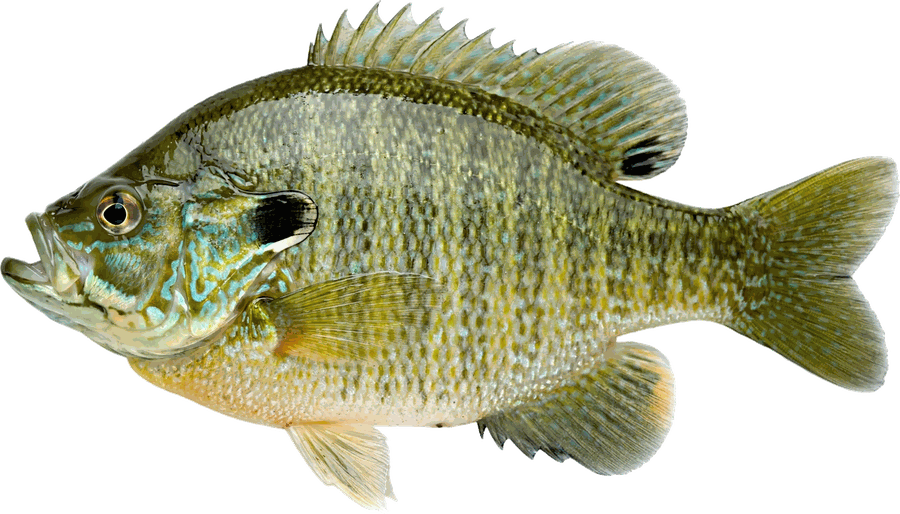
Lepomis cyanellus
Bump Board's tactics library for Green Sunfish — where to fish, what to tie on and how to fish it, season by season. In the app, these tips adapt live to the weather, the front and the light.
Green Sunfish — Prespawn
Where to fish
- As the water climbs through the teens toward the first spawning at about 20–22 °C, green sunfish set up where they live all year: tight to cover — rocks, logs, vegetation and undercut banks — in shallow, low-velocity water. This species stages at its ambush posts, not in open water; growth and food conversion were still rising from 13.2 °C toward 28 °C in the growth work, so each warming step through the teens is a real step up in feeding.
- In still water the same cover rule points to the warmest shallow bays and coves with rock, wood or vegetation at casting range — the fish hold beside the structure, at short range, and wait. Fish the cover itself, not the open flat between pieces of it.
- In streams the measured velocity preference does the locating: adults prefer about 10 cm/s and tolerate about 25 cm/s, in water that is at least half pool, on gentle gradients. Fish the slow pools and the still water beside banks and boulders, and leave the fast water alone — the burst limit measured for this fish is only about 46 cm/s.
What to tie on
- Small, natural offerings matched to the measured prespawn menu: aquatic and terrestrial insects first, with crayfish and small fish growing in importance as fish get larger — adults are the most fish-eating member of their genus on the measured record. No lure is named in the green sunfish literature, and none is invented here; small and presented close to cover is the supported tackle story for a short-range ambush feeder.
- Size down for the smaller fish in a pocket: juveniles start on zooplankton and shift early to insects and fish, so the smallest residents of a cover pocket want the smallest insect-sized offerings you have.
How to fish it
- Fish the daylight: every diel line for this species points the same way — a laboratory locomotor rhythm, field daylight feeding, and food consumption rising directly with light exposure. Dawn scores close to the day peak in the model (0.90 against 1.0), so be on the cover at first light and fish the full day, not just its edges.
- Use the season's own accelerator: at constant temperature, consumption tracked daylength — increasing days stimulated feeding and growth, decreasing days inhibited them. A warming spring day is therefore worth more than the same temperature in fall; fish prespawn green sunfish as if the lengthening day itself is part of the pattern, because in the experiment it was.
- Work one piece of cover thoroughly before moving: a sit-and-wait fish with a large mouth takes prey at short range, including fish approaching half its own length, so a slow pass tight to the structure reaches fish that a fast retrieve past it never shows.
If it's still tough
- If the cover is empty, check the temperature before the tackle: below the mid-teens this fish is still on the cold, interpolated limb of its curve — no cold feeding threshold has ever been measured for it — and the fix is the warmest covered shallows you can find, fished slowly.
Green Sunfish — Spawn
Where to fish
- Spawning runs in repeated bouts from May into August: noted at 19–31 °C, usually beginning at 20–22 °C, with the embryo optimum at 20–27 °C. Males clear nests about 30 cm across on firm gravel or sand in only about 4–35 cm of water, near rocks, logs and vegetation, in colonies or alone. Fish the shallow nesting ground and the cover right beside it — with the repeated bouts, a fresh wave of nesting fish is building somewhere through most of the summer window.
- In streams the nests sit in the same low-velocity world as the feeding posts — slow pool margins and still bank water over firm bottom, at the velocities this species prefers (about 10 cm/s) rather than in fast water. Look for the cleared saucers in the shallows where the water nearly stops.
What to tie on
- Offerings sized to the small food of the nesting shallows — insect larvae and the other small invertebrates around the beds — worked tight to the nest cover. No spawn-specific lure is named in the green sunfish literature, and none is invented here.
How to fish it
- Carry the guard state openly: no study has measured how much guarding green sunfish males feed — the rating's guard window is annotation, not a measurement. A male that charges a bait on the nest is defending, not feeding — parental males guard and fan for about 5–7 days after a 2–3-day hatch — so strikes on nests are aggression, and the entry says so rather than calling them a bite pattern.
- Fish the feeding fish at the colony edges and in the daylight hours: the species feeds principally during daylight, and the non-guarding fish around a colony are the ones actually eating the insect, crayfish and fish menu. Dawn is a strong second window (model dawn 0.90); night, at 0.20, is the low.
If it's still tough
- Between bouts a nesting flat can look finished when it is only resting — the cycle repeats on a short rhythm through a long season. Check the neighbouring cover and the next shallow flat before you conclude the spawn is over; from May to August, it pulses rather than ends.
Green Sunfish — Summer
Where to fish
- Summer is this fish's measured peak, and it is hot by sunfish standards: three independent preference experiments put the final preference at 27.3–30.6 °C, adults avoided water below about 26 °C and above about 31 °C when they could choose, and the model plateau sits at 26–31 °C. Fish the warm, covered shallows and shorelines without apology — and in a heat wave, remember the other end: the upper incipient lethal estimate sits near 35.4 °C and warm-acclimated fish tolerated far higher in the laboratory, so hot water alone rarely explains a blank.
- In still water, turbidity is not the excuse it is for its cousins: ventilation was unaffected below roughly 900–2,125 FTU depending on temperature and oxygen consumption was unaffected to 3,500 FTU — far murkier than ordinary water gets — and field abundance was positively associated with moderate turbidity (about 25–100 JTU). Fish the stained, covered shallows on the same cover pattern as the clear ones.
- In streams, summer fish hold the pool pattern: adults most abundant where at least half the reach is pool, on gradients of about 2 m/km or less, at preferred velocities near 10 cm/s. Fish the deep, slow pools and the cover in them; this is also the pioneer fish of intermittent water, among the first to repopulate after drought and able to persist in isolated, stagnant pools.
What to tie on
- Fish the full generalist menu, because no single prey gates this fish: terrestrial and aquatic insects are the most important foods overall, with crayfish and fish alongside — and even 45–55 mm juveniles readily took young fish in enclosure trials. Insect-sized offerings for numbers, crayfish and small-fish profiles for the largest, most fish-eating adults beside heavy cover. No lure is named in the green sunfish literature, and none is invented here.
- In stained water keep the offering close and unhurried: the turbidity record is physiological tolerance, not a measured feeding distance — no reaction-distance experiment exists for this species at any turbidity — so proximity is the honest compensation, not a bigger or louder bait.
How to fish it
- Daylight carries the day, plainly: the model's shape is dawn 0.90, day 1.0, dusk 0.75, night 0.20 — a cover-ambush predator's daylight curve, deliberately unlike a plankton-chaser's evening build. Fish the middle of the day as a real shift on the cover, and treat dusk as a taper, not a second peak.
- Do not abandon the still, warm corners other panfish leave: this species reaches its greatest abundance in habitats that do not support other sunfishes, persists in stagnant isolated pools, and survives winterkills and low-oxygen events that remove less tolerant fish. Its absolute feeding-versus-oxygen curve has never been measured — the textbook lethal figure in its habitat profile is a 1982 assumption taken from another species, refused here as a measurement — but the direction is its own: low-oxygen cover water is still green sunfish water.
If it's still tough
- If warm covered shallows look but won't take, shrink and slow in place, tight to the structure — a short-range visual ambush fish refusing a bait it can see is giving a size-and-speed verdict. If the water has pushed well past the low 30s, you are off the plateau and down the warm limb; find the cooler covered edge before you change a single bait.
Green Sunfish — Fall
Where to fish
- Fall green sunfish keep feeding on the cover pattern as the water cools off the plateau — but the season has a measured twist: at identical temperatures, fish on decreasing daylength ate and grew less than fish on increasing days, and the experimenters attributed the autumn stall of warmwater fish largely to that shrinking light. Expect a fall fish at a spring temperature to fish slower than the spring fish did, and work the warmest covered shallows first.
- In streams the cooling fish slide toward the deepest, slowest pools and the still water among rocks and boulders — the same interstitial cover the winter field record describes them occupying, inactive, where there is no measurable velocity. Start the fall search there, not in the summer runs.
What to tie on
- The summer menu a step smaller and slower — insects and small crayfish around the cover, with small fish still on the table for the largest adults. Cooling shortens the effective feeding day for a daylight fish, so put the best presentations into the bright middle hours rather than saving them for a dusk that scores lower for this species.
How to fish it
- Fish the daylight while you have it: the twin facts of fall are a day-led clock and less of it. The warmest part of the day on the warmest covered water is the fall pattern; give located pockets real time, because cooling fish at a cover post are not travelling to a bait.
- Watch the temperature limb honestly: growth was measured rising from 13.2 °C, but no cold feeding threshold exists below that — the model's cold anchors under the mid-teens are interpolation. A cooling fall is a slide down an unmeasured slope, so let your own results, logged against the thermometer, teach you your water's fall pace.
If it's still tough
- If the fall cover is silent, it is usually the photoperiod-and-temperature slide, not the bait — this species was measured stalling in autumn at temperatures that fed it well in spring. Move toward warmth and cover before you move waters.
Green Sunfish — Winter
Where to fish
- Winter is this fish's honest weak chapter: in the laboratory cold record, swimming activity fell to near-dormant at cold temperatures — the opposite winter posture from its cousin that feeds all winter — and no winter feeding threshold was ever measured. Fish that do show will be in the still, covered water that still carries oxygen; expect a reduced, survival-first fish, not a winter feed.
- The closest field winter observation — a desert stream, not ice cover, and flagged as such — found most winter fish relatively inactive, tucked into the spaces between rocks and boulders where there was no measurable velocity, a posture credited with holding them in place through a winter flood. In cold moving water, that interstitial rock cover in dead-still pockets is the winter address the record supports.
What to tie on
- Small and slow, delivered to the fish in its cover pocket: winter consumption, where it happens at all in the record, is a mild-climate open-water fact (a North Carolina stream study found winter feeding, with terrestrial prey gaining share) — it proves the species can feed in cold months where water stays open, not that it feeds everywhere in winter. No winter-specific lure is named in the green sunfish literature, and none is invented here.
How to fish it
- Give each located pocket real time and fish the brightest, warmest part of the short day first, per the year-round daylight shape. A near-dormant fish is a located-fish game: finding the still, oxygenated cover is most of the catch.
- Treat oxygen as a survival address, not a feeding promise: green sunfish were among the survivors of a severe oxygen-driven winterkill, and they turn up in the low-oxygen fish assemblages that mark regularly depleted water. That record bounds where winter fish can still be alive — it does not measure them feeding there, and the entry keeps the two apart.
If it's still tough
- If a winter pocket is dead, move toward better-oxygenated, stiller cover before you change baits — and know the limit honestly: no under-ice feeding study exists for this species, so a silent winter is the evidence behaving as documented, not a tactics failure.
Green Sunfish on the ice — Through the ice season
Where to fish
- PROVISIONAL — and the flag is part of the entry: the green sunfish ice set is provisional, capped at Moderate confidence. Winter survival and low-oxygen tolerance are documented for this species, but winter feeding under ice has never been measured — laboratory fish become near-dormant in the cold — so under-ice ratings carry low confidence until a winter dataset exists. Fish the still, covered shallows and deep edges that still hold oxygen, and hold your confidence at the cap.
- Expect the fish tight to cover rather than roaming: the winter field posture on record is inactivity in the spaces between rocks and boulders in water with no measurable flow, and the laboratory posture is near-dormancy. A green sunfish under ice is a pocket fish — locate the still, structured pockets first.
What to tie on
- Small, natural offerings fished close and still in the located pockets — the open-water menu (insects and other small invertebrates) at its smallest. No ice-specific presentation is measured for this species; small and slow is the provisional evidence applied honestly, not an ice finding.
How to fish it
- Work the daylight shape carried under ice, slightly dampened — dawn 0.85, day 0.95, dusk 0.70, night 0.20 in the model — labelled in the research as a within-species transfer, because the under-ice clock has never been measured. The bright middle of the short day is the main shift.
- Treat oxygen as the address with this species' own direction: it survived an oxygen-driven winterkill that removed less tolerant fish and belongs to low-oxygen assemblages, so as a basin depletes it may persist in pockets other panfish have left. The absolute under-ice oxygen curve is unmeasured — persistence is the documented fact, feeding there is not.
If it's still tough
- Mid-winter silence fits this species' evidence, not just your tactics: the laboratory record is near-dormancy, and angler guidance describes green sunfish as not a common ice catch compared with its better-known cousins. Move toward better-oxygenated, still cover once — then accept that the provisional set may simply be describing a fish that is barely fishing this season.
- If you do connect, log the conditions carefully — any real under-ice feeding record for this species is exactly the dataset the research says would reopen this set's confidence.
Where Green Sunfish live
1,380 waters in the Bump Board dataset hold Green Sunfish. A selection:
Ontario
- Amable du Fond River
- Another Lake
- Ausable River
- Avon River
- Baby Creek
- Ballard Lake
- Battlefield Creek
- Bear Creek
- Bell Lake
- Bells Lake
- Black Creek
- Black Creek
- Blair Creek
- Boyd L.
- Bronte Creek
- Burt Lake
- Canagagigue Creek
- Cedar Creek
- Cirrus Lake
- Clarke's Lake
- Clay Creek
- Como Lake
- Conmee Lake
- Connell's Lake
Plus 102 more Ontario waters — browse Ontario lakes.
Arizona
California
- Diamond Valley Lake
- Grizzly Forebay
- Grizzly Lake
- Rucker Lake
- Salt Springs Reservoir
- Silverwood Lake
- Willow Lake
Colorado
- Banner Lakes
- Beckwith Reservoir
- Berkeley Lake
- Blackrock Lake
- Brush Hollow Reservoir
- Bufflehead Lake
- Carter Lake Reservoir
- Cottonwood Lake
- Crown Hill Lake
- Eaglewatch Lake
- Echo Canyon Reservoir
- Harper Lake
- Heinricy Lake
- Highline Lake
- Juniata Reservoir
- Karval Lake
- Kenney Reservoir
- Ketring Lake
- Kinney Lake
- Ladybug Lake
- Lake Arbor
- Lon Hagler Reservoir
- Main Reservoir
- McCall Lake
Plus 20 more Colorado waters — browse Colorado lakes.
Connecticut
- Aspinook Pond
- Freshwater Pond
- Halls Pond
- Highland Lake
- Lake Candlewood
- Lake Lillinonah
- Lake Quassapaug
- Lake Zoar
- Mashapaug Pond
- Merimere Reservoir
- Mono Pond
- Nepaug Reservoir
- South Norwalk Reservoir
- Spaulding Pond
Iowa
- Alice Wyth Lake
- Cedar Lake
- Clear Lake
- Cold Springs
- Coralville Lake
- Diamond Lake
- East Lake
- Grade Lake
- Green Valley Lake
- Greenfield Lake
- Lake Anita
- Lake Binder
- Lake Cornelia
- Lake MacBride
- Lake McKinley
- Lake of Three Fires
- Mormon Trail Lake
- Nine Eagles Lake
- Nodaway Lake
- Prairie Rose Lake
- Slip Bluff Lake
- Spirit Lake
- Summit Lake
- Swan Lake
Plus 7 more Iowa waters — browse Iowa lakes.
Idaho
- Alexander Reservoir
- Anderson Lake
- C J Strike Reservoir
- Coeur d'Alene Lake
- Dierkes Lake
- Dog Creek Reservoir
- Emerald Lake
- Fernan Lake
- Kelso Lake
- Murtaugh Lake
- Oneida Narrows Reservoir
- Strongarm Reservoir Number One
- Twin Lakes
- Wilson Lake Reservoir
Illinois
- Canton Lake
- Lake Jacksonville
- Lake Pittsfield
- Lake Springfield
- Lake Storey
- Lake Taylorville
- Powerton Cooling Lake
- Sangchris Lake
- Washington County Lake
Indiana
- Brokesha Lake
- Cedar Lake
- Cedar Lake
- Emma Lake
- Gordy Lake
- Houghton Lake
- Jimmerson Lake
- Lake Wawasee
- Lindsey Lake
- Loomis Lake
- Lower Long Lake
- Lukens Lake
- Marsh Lake
- McClish Lake
- Meteer Lake
- Olin Lake
- Otter Lake
- Pretty Lake
- Round Lake
- Royer Lake
- Rupel Lake
- Sellers Lake
- Shipshewana Lake
- South Twin Lake
Plus 3 more Indiana waters — browse Indiana lakes.
Kansas
- Clinton Lake
- Douglas Lake
- El Dorado Lake
- Fall River Lake
- Kirwin Reservoir
- Milford Lake
- Perry Lake
- Toronto Lake
- Tuttle Creek Lake
- Webster Reservoir
Maryland
Maine
Michigan
- Archer Lake
- Arnold Lake
- Austin Lake
- Baptist Lake
- Barlow Lake
- Barton Lake
- Bass Lake
- Bass Lake
- Bass Lake
- Bass Lake
- Bassett Lake
- Bat Lake
- Beadle Lake
- Beaver Lake
- Beebe Lake
- Belleville Lake
- Bertha Lake
- Big Cedar Lake
- Big Crooked Lake
- Big Pine Island Lake
- Bills Lake
- Birch Lake
- Blanchard Millpond
- Blue Lake
Plus 189 more Michigan waters — browse Michigan lakes.
Minnesota
- Adney Lake
- Albert Lea Lake
- Alder Lake
- Allen Lake
- Amber Lake
- Andrew Lake
- Andrusia Lake
- Annie Battle Lake
- Arrowhead Lake
- Arrowhead Lake
- Bald Eagle Lake
- Ballantyne Lake
- Barrett Lake
- Bass Lake
- Bass Lake
- Bass Lake
- Bass Lake
- Bass Lake
- Bass Lake
- Bass Lake
- Bass Lake
- Bass Lake
- Bass Lake
- Battle Creek Lake
Plus 756 more Minnesota waters — browse Minnesota lakes.
Mississippi
Montana
- Arapooish Pond
- Bighorn Lake
- Castle Rock Lake
- Fort Peck Lake
- Hollecker Lake
- Hump Reservoir
- Lake Elmo
- Lake Josephine
- South Sandstone Reservoir
- Spotted Eagle Lake
- Tongue River Reservoir
Nebraska
Nevada
Pennsylvania
- Blue Marsh Lake
- Dutch Fork Lake
- Kyle Lake
- Loyalhanna Lake
- Mauch Chunk Lake
- Pymatuning Reservoir
- Tamarack Lake
- Tuscarora Lake
South Dakota
- Beaver Lake
- Byre Lake
- Cottonwood Lake
- Dog Ear Lake
- Eureka Lake
- Hamak Lake
- Herman Slough
- Horseshoe Lake
- Jones Lake
- Lake Alice
- Lake Dimock
- Lake Faulkton
- Lake Geddes
- Lake Menno
- Lehrman Slough
- Marindahl Lake
- Mud Lake
- Reausaw Lake
- Reliance Lake
- Swan Lake
- Tisdale Lake
- Tripp Lake
- Twin Lakes
- Waggoner Lake
Plus 1 more South Dakota waters — browse South Dakota lakes.
Utah
- Baker Reservoir
- Burriston Ponds
- Deer Creek Reservoir
- Gunlock Reservoir
- Huntington Lake
- Kens Lake
- Lake Powell
- Lloyds Lake
- Mantua Reservoir
- Newcastle Reservoir
- Pineview Reservoir
- Quail Creek Reservoir
- Recapture Reservoir
- Sand Hollow Reservoir
- Twenty First Street Pond
- Utah Lake
- Wide Hollow Reservoir
- Willard Bay Reservoir
Virginia
Washington
- Bear Lake
- Clear Lake
- Deer Lake
- Diamond Lake
- Lake Ellen
- Lake Washington
- Loon Lake
- Pass Lake
- Pierre Lake
- Sacheen Lake
Wyoming
- Bighorn Lake
- Black Hills Power and Light Reservoir
- Boysen Reservoir
- Cook Lake
- Deaver Reservoir
- Driskill Reservoir
- Gillette Fishing Lake
- Goshen Hole Reservoir
- Grayrocks Reservoir
- Guernsey Fish Pond
- Hawk Springs Reservoir
- Hume Ponds
- Keyhole Reservoir
- Lake Absarraca
- Lovell Lakes
- Midwest Number 23 Reservoir
- Packer Lake