
Fishing tips & tactics
How to catch Flathead Catfish
Pylodictis olivaris
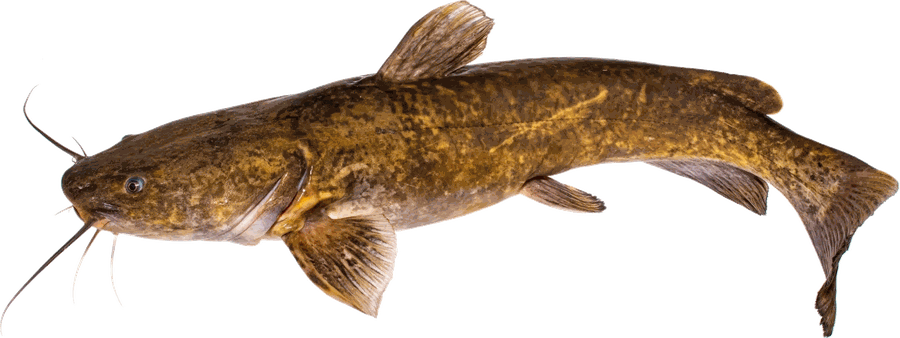
Bump Board's tactics library for Flathead Catfish — where to fish, what to tie on and how to fish it, season by season. In the app, these tips adapt live to the weather, the front and the light.
Flathead Catfish — Prespawn
Where to fish
- Spring is a transition season with the year's largest movements — fish leaving the overwintering pools for the feeding and spawning water. Distances are honestly contested in the research (one programme's ~5.4 km against another's ~1.0 km), so don't bank on a long migration: fish the water between the deep pools and the spawning banks, at whatever scale your river offers.
What to tie on
- Live fish is this species' diet — the strict piscivore of the catfish family. Presentations that imitate a live, struggling fish are fishing the stomach contents (the research's own finding is diet stability, ~half of stomachs empty — this is a fish that waits for real food). Canon inside the family books documents cutbait taking flatheads too, which refutes the 'live bait only' absolute; the study-grade claim is the live-fish diet, and both are labelled here at their grades.
How to fish it
- Start fishing the hours the telemetry owns: dusk, night and dawn. Even in the spring transition, the day fish are stationary — 23.33 hours a day of it, on average — and the movers move at night.
If it's still tough
- If the routes are quiet, sit on the overwintering pools' exits at dusk. Transition fish pass those doors on their way out, and night is when they pass.
Flathead Catfish — Spawn
Where to fish
- Flatheads spawn in cavity nests with a guarding male, like their cousins — and the research refuses to give you a tidy temperature band: across six sources the spawn spread runs 19–29 °C, the widest disagreement in the monograph series, carried as a spread and not averaged into a rule. In plain terms: sometime in the low-to-upper 20s on your water, fish are on nests. Whether guarding suppresses feeding has zero evidence in this species — no coefficient exists — so fish the banks' edges and the feeding water between nest areas.
What to tie on
- Live-fish presentations along the nesting banks and the first deep water off them — the piscivore's menu, fished at night, when this species does everything.
How to fish it
- Night, always night: the spawn doesn't change the diel law (day movement median 0 m/h against 40–51 m/h across dusk, night and dawn). A daytime spawn trip is fishing the one shift this fish measurably doesn't work.
If it's still tough
- If the banks are dead at night, move to the deep pools between spawning stretches — non-nesting fish hold and feed there through the window.
Flathead Catfish — Summer
Where to fish
- Summer flatheads are a night shift with an address: motionless by day in a small core area (typical home range well under a kilometre — one study's mean was about 758 m), then genuinely mobile at dusk, night and dawn, working 6% of the habitat by day against 22–40% across the dark periods in the habitat-use data. Find the day core — deep pool, cover, the lie — and fish its edges when the light goes.
What to tie on
- Live fish, presented near the lie at dark. This is the family's pure piscivore: the diet evidence is fish, stably, across systems — match a living fish's size and struggle, in the size your water's forage runs.
How to fish it
- Fish the telemetry's own numbers: be set before dusk, work the first dark hours hardest, and know the hidden wrinkle the canon misses — a short early-afternoon activity period (about 12:00–14:00, moves under 100 m) exists in the continuous tracking. It's repositioning, not a feeding run, but a bait already soaking near a lie at midday is fishing a real, measured movement. Mostly, though: night is the season, and patience at one good lie beats running five spots — neighbours share core areas in space but almost never at the same time, so a quiet hour at a lie is not an empty one.
If it's still tough
- If a night produces nothing, change lies, not baits: a flathead that isn't home isn't catchable at any presentation, and the cores are small enough that the next pool can be a different fish's whole world. Warm stable nights on known lies are the percentage play; weather tricks for this species do not exist in any study (next section).
Flathead Catfish — Winter
Where to fish
- Winter flatheads are in the overwintering water — deep pools, deeper than about 4 m in the northern telemetry — and the observed winter movement was zero. This isn't a slow season; at and below 7 °C the feeding experiments record a full stop, with most fish done by 11 °C.
What to tie on
- Nothing honest to tie on: a species that does not feed at winter temperatures has no winter presentation, and this entry won't borrow one from the other catfish (the '<40 °F and they shut down' line that circulates for flatheads is, for once, roughly the measured story — for THIS species).
How to fish it
- The winter play is scouting, not fishing: mark the deep overwintering pools. They are the first water to check when spring transitions — the season's largest movements — carry fish out of them.
If it's still tough
- If flatheads are the goal in mid-winter, the evidence-based answer is to wait for water above the low teens. Channel and blue catfish in the same system keep feeding windows open far colder; flatheads, measurably, do not.
Flathead Catfish on the ice — Through the ice season
Where to fish
- The ice model does not apply to flathead catfish: the species stops feeding at and below 7 °C, no winter movement was observed in northern telemetry, and no ice fishery or under-ice study exists. Ice mode for this species returns 'not applicable — no ice season,' and that is a finding, not a missing feature.
What to tie on
- No ice presentation exists for a fish that is not feeding under the ice.
How to fish it
- If flatheads are your fish, the cold season's work is the winter entry above: mark the deep overwintering pools now, on the map, for the spring transitions.
If it's still tough
- Through the ice, fish the catfish that stay on the feed in cold water — channel catfish aggregate and feed in winter on real (if unstudied-through-ice) evidence. Flatheads under ice are a closed book because the fish themselves are closed down.
Where Flathead Catfish live
200 waters in the Bump Board dataset hold Flathead Catfish. A selection:
Ontario
Alabama
- Coffeeville Lake
- Jordan Lake
- Martin Lake
- Mitchell Lake
- Point A Lake
- R E 'Bob' Woodruff Reservoir
- Walter F George Reservoir
- Wilson Lake
- Yates Reservoir
Arkansas
Arizona
- Bear Canyon Lake
- Becker Lake
- Black Canyon Lake
- C.C. Cragin Reservoir
- Chevelon Canyon Lake
- Horseshoe Reservoir
- Knoll Lake
- Lake Pleasant
- Patagonia Lake
- Willow Springs Lake
- Woods Canyon Lake
California
Colorado
Florida
Georgia
- Allatoona Lake
- Blue Ridge Lake
- Carters Lake
- High Falls Lake
- J. Strom Thurmond Reservoir
- Jackson Lake
- Lake Blackshear
- Lake Sidney Lanier
- Lake Sinclair
- Nottely Lake
- West Point Lake
Iowa
- Big Lake
- Big Pond
- Butler Lake
- Clear Lake
- Coralville Lake
- Gimmel Lake
- Half Moon Lake
- Lake Cornelia
- Lake MacBride
- Lake Manawa
- Lake Red Rock
- Little Wall Lake
- Loch Ayr
- Rathbun Lake
- Saylorville Lake
- Three Mile Lake
- Wood Duck Slough
Illinois
- Baldwin Lake
- Braidwood Power Plant Cooling Pond
- Canton Lake
- Carlyle Lake
- Cedar Lake
- Coffeen Lake
- Governor Bond Lake
- Kinkaid Lake
- Lake Decatur
- Lake Mattoon
- Lake Murphysboro
- Lake Pittsfield
- Lake Shelbyville
- Lake Springfield
- Rend Lake
- Sangchris Lake
Indiana
Kansas
- Cedar Bluff Reservoir
- Cheney Reservoir
- Clinton Lake
- Douglas Lake
- El Dorado Lake
- Fall River Lake
- Hillsdale Lake
- Kanopolis Lake
- Keith Sebelius Lake
- Kirwin Reservoir
- Lovewell Reservoir
- Marion Reservoir
- Milford Lake
- Perry Lake
- Toronto Lake
- Tuttle Creek Lake
- Waconda Lake
- Webster Reservoir
- Wilson Lake
Kentucky
- Barren River Lake
- Buckhorn Lake
- Bullock Pen Lake
- Cave Run Lake
- Dewey Lake
- Fishtrap Lake
- Grayson Lake
- Guist Creek Lake
- Herrington Lake
- Nolin Lake
- Rough River Lake
- Taylorsville Lake
- Yatesville Lake
Louisiana
- Anacoco Lake
- Bayou D'Arbonne Lake
- Caddo Lake
- Kepler Creek Lake
- Lake Maurepas
- Lake Rodemacher
- Mill Creek Reservoir
Minnesota
Missouri
- Blue Springs Lake
- Clearwater Lake
- Edwin A Pape Lake
- Fellows Lake
- Harry S Truman Reservoir
- Higginsville Reservoir
- Lake Jacomo
- Lake of the Ozarks
- Long Branch Lake
- Longview Lake
- Pomme de Terre Lake
- Smithville Lake
- Stockton Lake
- Table Rock Lake
- Thomas Hill Reservoir
Mississippi
North Carolina
Nebraska
- Bluestem Lake
- Branched Oak Lake
- Elwood Reservoir
- Enders Reservoir
- Farwell South Reservoir
- Harlan County Lake
- Harry Strunk Lake
- Hershey Lake
- Hugh Butler Lake
- Jeffrey Reservoir
- Johnson Lake
- Lake Babcock
- Lake Maloney
- Pawnee Lake
- Rockford Lake
- Sherman Reservoir
- Swanson Lake
Ohio
- Charles Mill Lake
- Clendening Lake
- Forked Run Lake
- Grand Lake
- Jackson Lake
- Lake Logan
- Lake Loramie
- Michael J Kirwan Reservoir
- Piedmont Lake
- Pleasant Hill Lake
- Rocky Fork Lake
- Ross Lake
- Salt Fork Lake
- Tappan Lake
- Veto Lake
Oklahoma
- Eufaula Lake
- Fort Cobb Reservoir
- Fort Gibson Lake
- Greenleaf Lake
- Lake Arcadia
- Lake Eucha
- Lake Thunderbird
- Oologah Lake
- Robert S Kerr Reservoir
- Tenkiller Ferry Lake
- Tom Steed Reservoir
- Webbers Falls Reservoir