Fishing tips & tactics
How to catch Coho Salmon
Oncorhynchus kisutch
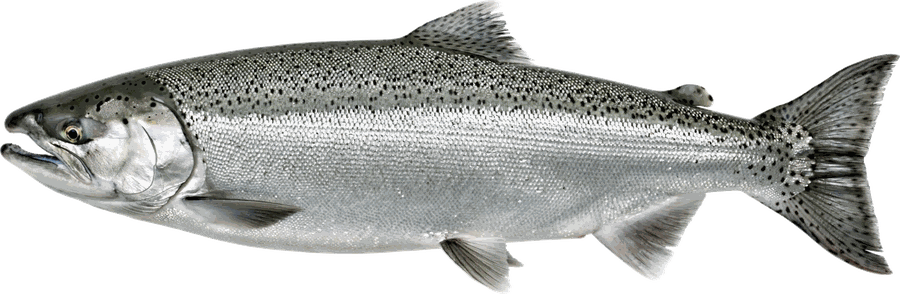
Bump Board's tactics library for Coho Salmon — where to fish, what to tie on and how to fish it, season by season. In the app, these tips adapt live to the weather, the front and the light.
Coho Salmon — Summer
Where to fish
- Summer coho ride the same cold heart as chinook — an 11–14 °C preferred band — but sit higher in it, and they quit the warm side sooner: growth was already reduced at 18 °C in the feeding studies and stops above about 20 °C. Fish the upper cold band over the baitfish, and expect coho shallower than the kings below them.
- Summer position follows the prey: alewife in the lower lakes, smelt and insects on Superior — find the baitfish layer in cold water and the coho are on it, because this species has one summer to grow in and spends it feeding.
What to tie on
- Spoons and dodger-and-fly rigs at the upper cold band — the established summer coho troll pattern, carried as canon over a measured depth-and-temperature core.
How to fish it
- Keep the dawn/dusk stomach-study peaks as the day's frame, with a higher night floor than chinook carries — telemetry found coho active and moving inshore at night — so an evening that runs past dark is still fishing the pattern, not leaving it.
If it's still tough
- Warm water is this fish's hard edge: once the upper band pushes past the high teens, coho go down or go quiet a full step before chinook do. If kings are biting and coho are not, you are probably fishing water that has already warmed past them.
Coho Salmon — Fall
Where to fish
- Fall coho keep feeding later than chinook — the run comes later, mid-October to mid-November — so September and early October still hold a feeding lake fishery on the cooling upper band while the kings are already staging. That extra month is a real, sourced difference between the two species, and it is the fall coho's whole story.
- As October advances the maturing fish gather toward the smaller tributaries; the staging pattern replaces the feeding one on the same countdown as every Pacific salmon — feeding winds down into the run.
What to tie on
- The summer rigs, fished on the rising cold band as the lake cools — turnover pulls the coho's water upward, and the fall pattern is the summer pattern at steadily shallower depth.
How to fish it
- Fish the fall as a closing window with a known date: feeding fish through September, staging fish from October, spawners in the tributaries by mid-October. The entry will not pretend the last group is feeding.
If it's still tough
- Late-October fish at a creek mouth that ignore everything are running, not refusing. The feeding coho are the ones still over open water — fewer every week, and honestly so.
Coho Salmon — Winter
Where to fish
- Winter coho are the young lake cohort, feeding at the season's floor in cold open water — a real but modest pattern, the quiet middle of the species' single feeding year.
What to tie on
- The spring menu at winter depth and pace: small spoons high in cold water when the season and the ice allow open-water fishing at all.
How to fish it
- No winter rhythm is measured for coho; the entry keeps the dawn/dusk frame from the lake stomach study as a shape to test, labelled as carried-over, and sets expectations at the model's winter floor.
If it's still tough
- Winter silence is the floor working as modelled. The species repays patience in spring, when it is the first salmon back inshore.
Coho Salmon — Spring
Where to fish
- Coho own the earliest spring of the lake salmon: the Lake Michigan simulations start coho on April 1, a month ahead of chinook, and the spring fishery is a nearshore, surface-oriented one — on Superior the spring fish feed heavily on emerging insects and smelt at the surface (MDNR). Fish high and close early; this is the salmon that comes to you.
- That earliness is the species' shape: with only some eighteen months of lake feeding in its whole life, a spring coho is a fish in its one great growth season, feeding hard whenever the water is in its 11–14 °C centre.
What to tie on
- Small spoons and dodger-and-fly rigs trolled high in the nearshore water — the spring coho canon of the Great Lakes, and labelled canon: the research supports the place, the depth band and the prey; the rigs are the fishery's own tradition.
How to fish it
- Dawn and dusk lead: the one lake feeding-rhythm study for this species — stomach fullness sampled around the clock in a rearing lake — peaked near 06:00 and 21:00. Fish the nearshore surface at those hours first, and treat midday as a deeper, slower search.
If it's still tough
- If the surface is quiet, drop a few metres before moving: spring coho slide down the warming column through the day, and the same school that dimpled at dawn is often catchable at ten metres by noon.
Coho Salmon — Fallspawn
Where to fish
- Coho spawn mid-October to mid-November in the tributaries, including very small creeks the other salmon pass by. On the gravel and on the way to it they do not feed — this entry is the guide saying so in the right season, as it does for every Pacific salmon in this library.
- The lake through the spawn holds next year's fish — the new lake cohort, feeding on into the cold season on the winter pattern.
What to tie on
- Nothing spawn-specific is named in the coho literature for the lake, and none is invented here.
How to fish it
- Fish the young lake fish on the winter pattern; treat the creek-mouth aggregations as the migration they are.
If it's still tough
- A November creek full of dark coho is the end of the species' story, not a technique problem. The lake fishery reopens with the spring — earliest of all the salmon.
Coho Salmon on the ice — Through the ice season
Where to fish
- No ice parameter set exists for this species, deliberately: coho are genuinely caught through the ice in Lake Superior's bays, but a catch record is not an under-ice feeding study, and no ice rating is issued from catchability alone.
What to tie on
- No ice presentation is sourced for coho salmon from any study. The Superior bay fishery's own tackle tradition exists, but it is not research this library can cite, and it is not dressed up as such.
How to fish it
- If your water is ice-covered, the honest guidance is the winter open-water pattern in this guide, labelled as exactly that — not as ice science.
If it's still tough
- The ice season is a measured-presence, unmeasured-pattern gap for coho — the entry says so rather than inventing a set.
Where Coho Salmon live
646 waters in the Bump Board dataset hold Coho Salmon. A selection:
Ontario
- Achigan Creek
- Batchawana River
- Belgrave Creek
- Bennett Creek
- Big Creek
- Black Creek
- Black River
- Bowmanville Creek
- Bronte Creek
- Brougham Creek
- Carolyn Creek
- Carp River
- Catfish Creek
- Chippewa River
- Colborne Creek
- Coldwater Creek
- Coldwater River
- Cranberry Creek
- Credit River
- Driving Creek
- Duffins Creek
- Frenchman's Bay
- Ganaraska River
- Garden River
Plus 49 more Ontario waters — browse Ontario lakes.
Alaska
- Abercrombie Lake
- Afognak Lake
- Afonasi Lake
- Aka Lake
- Akalura Lake
- Alder Pond
- Alecks Lake
- Alexander Lake
- Amanka Lake
- Amber Lake
- Anan Lagoon
- Anan Lake
- Anderson Lake
- Andrew Lake
- Angel Lake
- Aniak Lake
- Ankau Saltchucks
- Arc Lake
- Auke Lake
- Aurora Lake
- Badger Lake
- Bakewell Lake
- Baldy Lake
- Barbel Lake
Plus 514 more Alaska waters — browse Alaska lakes.
Idaho
Michigan
- Au Train Lake
- Burt Lake
- Crystal Lake
- Glen Lake
- Green Lake
- Hemlock Lake
- Lake Charlevoix
- Mullett Lake
- Platte Lake