
Fishing tips & tactics
How to catch Chinook Salmon
Oncorhynchus tshawytscha
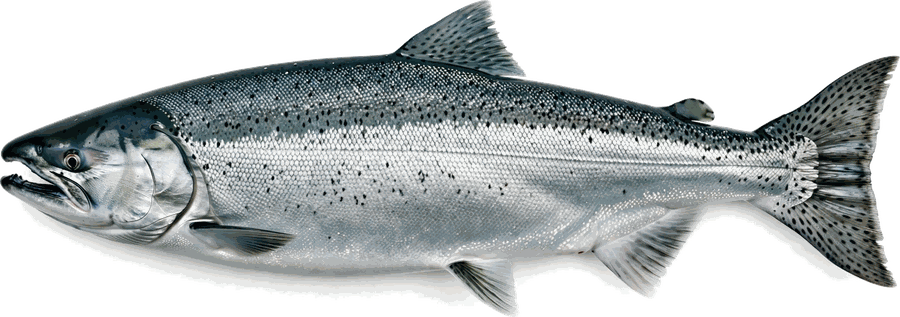
Bump Board's tactics library for Chinook Salmon — where to fish, what to tie on and how to fish it, season by season. In the app, these tips adapt live to the weather, the front and the light.
Chinook Salmon — Summer
Where to fish
- Summer chinook live in the cold band of the stratified lake: the tagged fish's core niche was 10–16 °C with a mean occupied temperature of 13.2 °C, sitting in and below the thermocline at roughly 10–30 m — and the thermocline itself heaves 10–20 m a day on internal waves, carrying the fish's address with it. Fish the band where it is today, over open water, on the baitfish schools.
- Bottom-check the band for oxygen before trusting it: these fish need the cold layer to stay breathable — the thresholds in the rating put avoidance below about 4–5 mg/L — and in a lake whose deep water has gone low, the cold band that remains fishable is the one that still carries oxygen, higher and narrower than the temperature map alone suggests.
What to tie on
- Spoons and flasher-and-fly rigs trolled at the depth of the cold band, over the bait — the Great Lakes summer pattern and the fishery's canon. The research names the depth and the prey (alewife first, smelt on Superior); presentation colour and speed are canon, and are labelled as such.
How to fish it
- Dawn and dusk are the measured peaks — activity highest near sunrise and sunset in the tag record — with a real night fishery underneath: the growth modelling runs higher at night than at midday, so a dark-hours troll over the band is a supported pattern, not a desperation move.
- Re-find the band every trip: with the thermocline moving metres a day, yesterday's exact depth is a starting guess, and the first pass of the day is a sounding pass. Fish that follow baitfish down a heaving layer reward the boat that keeps measuring.
If it's still tough
- A silent summer band is usually the squeeze or a moved band, not a refused lure: warm water above, low oxygen below, and the fish compressed into what is left. Search the oxygenated cold layer systematically across depths before concluding anything about tackle.
Chinook Salmon — Fall
Where to fish
- Fall splits the population in two, and the entry keeps them separate on purpose: the maturing fish gather off the tributary mouths from late August through September, staging for the run — while the immature fish stay offshore on the summer pattern and keep feeding. Only the second group is a feeding target, and it is the honest one.
- The staging fish are a countdown, not a pattern: feeding winds down as the run approaches, and a chinook in spawning colour at a river mouth is living on stored fat. Fish them early in the staging window if you fish them at all, and expect the response to die as September wears on.
What to tie on
- For the offshore immatures, the summer spoons at the cold band, unchanged. At the mouths, the staging fishery's canon is spoons and plugs trolled across the staging water early in the window — carried as canon, and it ends when the fish stop feeding, which the research dates to the run itself.
How to fish it
- Fish the calendar honestly: spawning runs September to mid-November, peaking September to mid-October (NYSDEC; DFO), and no presentation makes a running fish feed. The fall entries in this library that promise a bite on spawning fish are aggregation entries; this one is too, for the staging group — the feeding fish are the immatures, offshore.
If it's still tough
- If the mouths are full of fish that will not move, you are watching the run, not failing at it. Move offshore to the immature fish on the cold band, or wait for next year's spring — a coloured chinook's refusal is physiology, and the entry will not dress it up as a technique problem.
Chinook Salmon — Winter
Where to fish
- Winter lake chinook are the immature fish, feeding at the year's floor rate in deep cold water — the growth scenarios run the full year, and winter is their low end, not a shutdown. Expect a slow, deep, unspectacular fishery in open water where the season allows it.
What to tie on
- Spoons at the cold band's winter depth, trolled slowly — the summer menu at winter pace, carried as the only supported shape; no winter-specific chinook presentation is measured anywhere.
How to fish it
- No winter clock pattern is measured for this fish, so the entry invents none: find the deep cold water, present at its depth, and give located fish time. Winter chinook fishing is a location exercise repeated accurately.
If it's still tough
- Hold winter expectations at the model's floor (the season curve sits at 0.35): a quiet day is the season working as measured, and the fish that are there are the spring's nearshore fish, months early.
Chinook Salmon — Spring
Where to fish
- Spring is the nearshore season: lake chinook leave their deep winter water and work the surface layers and the shorelines through April and May, ahead of and on the alewife moving inshore — the spring window the Lake Michigan simulations open on April 1, with the fish in the top layers again. Tagged Lake Ontario fish ran cool, selecting water near 14 °C whatever the season, so the spring address is wherever that cool water meets the shore.
- In Pacific lakes the spring fish are different animals — young chinook rearing briefly before the sea and, later in the year, adults passing through to the tributaries — and this entry's lake-feeding pattern is the lake-resident one. Know which chinook your lake holds before fishing a spring pattern at them.
What to tie on
- The Great Lakes spring pattern is spoons trolled high and slow in the warming shallows — the fishery's standard nearshore presentation, carried as guide canon; no controlled study names a spring chinook lure, and none is invented here.
How to fish it
- Fish the light changes: the one activity measurement this species has — pop-off tags on Lake Ontario fish — puts vertical activity highest near sunrise and sunset, which is when a cool-water fish in warming shallows is moving and meeting prey. Midday spring fish rest deeper; the dawn and dusk windows are the measured pattern, not a custom.
- Set depth by temperature, not by last spring's mark: a fish whose core niche is 10–16 °C will be exactly as deep as that water is on the day, and in a spring of cold runoff that can be the top few metres while in a warm spring it is already sliding down.
If it's still tough
- If the shallows are empty, the fish have not left — they have gone down early. Follow the 10–16 °C water offshore and down before changing a single lure; a spring chinook problem is almost always a depth problem.
Chinook Salmon — Fallspawn
Where to fish
- The spawn itself happens in the tributaries, September to mid-November — the fish leave the lake to do it, and they do not feed on the way or on the gravel. This entry exists so the guide says that plainly in the season where an angler will look for it: there is no lake spawning pattern for chinook, and the migration is the migration model's subject, not a feeding pattern.
- What remains in the lake through the spawn is the immature stock, still on cold water offshore — the only chinook a fall lake angler is actually fishing for.
What to tie on
- Nothing spawn-specific is named in the chinook literature for the lake — no spawning lure exists to recommend, and none is invented here. The immatures take the summer presentation at the cold band.
How to fish it
- Fish the spawners' absence, not their presence: with the mature cohort gone to the rivers, the chinook remaining in the lake are the feeding immatures, and fall success is the summer pattern executed in cooling water as the band rises toward turnover.
If it's still tough
- A river mouth crowded with rolling fish in October is the run at its peak — magnificent, and not a fishing pattern this entry will sell. The feeding fish of the lake are offshore; go to them.
Chinook Salmon on the ice — Through the ice season
Where to fish
- No ice parameter set exists for this species, deliberately: the lake chinook fishery the rating describes is an open-water troll fishery, and the only under-ice record anywhere is catch presence from stocked small lakes (ADF&G) — presence, not a measured under-ice feeding pattern. No ice rating is issued rather than an invented one.
What to tie on
- No ice presentation is sourced for chinook salmon. Nothing here is borrowed from the open-water troll fishery and relabelled as ice science.
How to fish it
- If your water is ice-covered, the honest guidance is the winter open-water pattern in this guide — immature fish, deep cold water, slow pace — labelled as exactly that, not as an ice pattern.
If it's still tough
- The ice season is, on present evidence, a gap for this species — the entry says so rather than papering over it.
Where Chinook Salmon live
248 waters in the Bump Board dataset hold Chinook Salmon. A selection:
Ontario
- Achigan Creek
- Batchawana River
- Beaver River
- Belgrave Creek
- Big Creek
- Bighead River
- Black River
- Bothwell's Creek
- Bowmanville Creek
- Boyne River
- Boyne River
- Bronte Creek
- Brougham Creek
- Carolyn Creek
- Carp River
- Chippewa River
- Colborne Creek
- Coldwater Creek
- Coldwater River
- Cranberry Creek
- Credit River
- Dam Creek
- Driving Creek
- Duffins Creek
Plus 68 more Ontario waters — browse Ontario lakes.
Alaska
- Alexander Lake
- Amanka Lake
- Anan Lagoon
- Aniak Lake
- Bathing Beauty Pond
- Beach Lake
- Bear Lake
- Beaver Lake
- Becharof Lake
- Beluga Lake
- Big Lake
- Birch Lake
- Bolio Lake
- Bunco Lake
- Byers Lake
- Campbell Lake
- Canyon Lake
- Caswell Number 3 Lake
- Chandalar Lake
- Chena Lake
- Cheney Lake
- Chignik Lake
- Coal Mine Number 5 Lake
- Coghill Lake
Plus 99 more Alaska waters — browse Alaska lakes.
Idaho
- Anderson Lake
- Arrowrock Reservoir
- Black Canyon Reservoir
- Coeur d'Alene Lake
- Deadwood Reservoir
- Lucky Peak Lake
- Spirit Lake