Fishing tips & tactics
How to catch Brook Trout
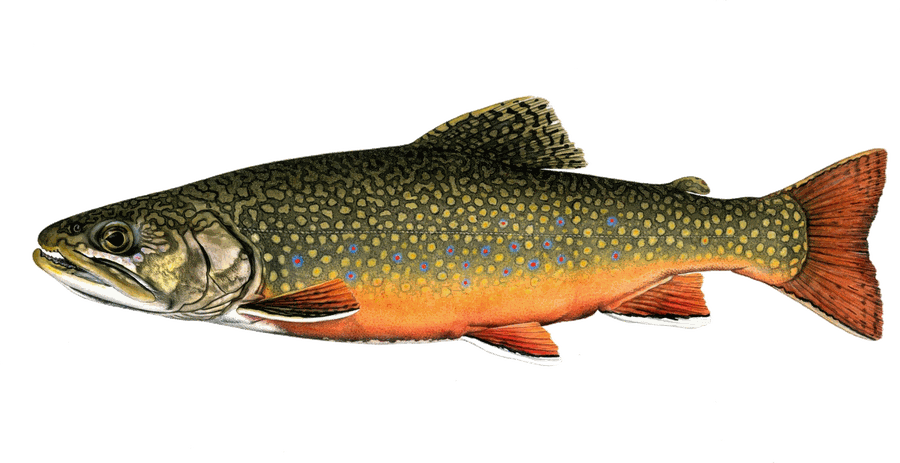
Salvelinus fontinalis
Bump Board's tactics library for Brook Trout — where to fish, what to tie on and how to fish it, season by season. In the app, these tips adapt live to the weather, the front and the light.
Brook Trout — Fall
Where to fish
- Autumn is the spawning movement: in the great Quebec lake country the pattern is famous — through summer the giants stay in the cool spring-fed depths, then in late August they descend into the outlet river.
- Autumn is the spawning movement: from September into November the fish move up nearly to the sources of the spring brooks, preferring fast water over gravel. In late August they descend into the outlet river, and through late August and all of September big fish rise freely to ordinary trout flies there. Note the old teaching: in the spawning season the fish take no food at all — fish the feeders at the edges of the movement, and the pools they rest in.
- On the Nipigon pattern: the best fishing of the year runs mid-July through August and September, at the foot of the falls and chutes — excellent fishing at the foot of all of them.
What to tie on
- Streamers for the lake fish: Gray Ghost, Supervisor, Black Ghost, and the Colonel Bates — Stevens's pattern recorded as successful particularly in stained water.
- Ordinary trout flies, fished in the river, take the big autumn fish — the standard cast of the classics.
- Trolling with the spoon, the phantom minnow or a dead-fish bait is very successful on the big lake fish in fall — they'll take a very large pike spoon.
- On off days on the river, the phantom minnow usually does the work.
How to fish it
- Fish the foot-of-falls pools and the outlet rivers with the full stealth rules — shadow and concussion discipline matters more with these fish the bigger they get. Dusk is coming into its own: feeding peaks as the dark gathers.
If it's still tough
- On the days they won't rise in the river, the phantom minnow is the classic's own fallback. And remember the season's oddity — spawning fish fast; if a pool full of fish ignores everything, they may be spawners, and the feeders are in the next pool down.
Brook Trout — Cool
Where to fish
- Brook trout are strictly cold water — native below 60 °F, ideal 35–55 °F — and the name says the address: fontinalis, 'living in springs.' In lakes, the spring-fed water and the mouths of cold tributaries. In warm weather the fishing moves to the mouths of streams.
- Brook trout are strictly cold water — native below 60 °F, ideal 35–55 °F — and the name says the address: fontinalis, 'living in springs.' In streams, the deep pools and eddies where they can lie concealed under grassy banks or logs and see without being seen. In warm weather the fishing moves to the mouths of streams and the swift, aerated water.
- On the big lakes the seasonal round runs: shallows and points as the water warms in June, the cool depths in the heat of summer, the pools again in September. Big lake fish live deep and feed under the surface — they are not surface feeders.
What to tie on
- Match what is on the water — the books' first rule: study the insects along the stream and make up your cast accordingly. Small and plain beats large and gaudy on most streams; for educated fish, the smallest flies on No. 12–18 hooks, on gossamer leaders. The old standard cast: Professor, Queen of the Water, Grizzly King, the Drakes, Montreal, Silver Doctor, Coachman — and hackles.
- For big lake fish, think smelt: the great Rangeley streamers — Carrie Stevens's Gray Ghost first, the Supervisor (tied to mimic the finger smelt), the Black Ghost — and Don Gapen's Muddler Minnow, invented in 1936 to imitate the slimy sculpin for the giant brook trout of the Nipigon River.
- If they won't rise: 'fear not to use bait' — minnows, red worms, white grubs, grasshoppers. A dead bait must be fresh and sweet; brook trout will not eat carrion.
How to fish it
- Stealth is the whole technique with this fish. No other fish is so affected by shadows: the shadow of your body, your raised rod, or your line across a quiet pool is instant alarm. Crawl to the pool noiselessly on all fours. Slide rather than step when you wade. It's concussion they hear — a voice doesn't disturb them, but a toe scratched on the boat bottom or a careless tread on the bank empties the pool.
- Most trout are taken within 30 ft — long casts are seldom needed. Working a rise: cast a little short of it first, then a little further. Let flies fall lightly, and let a dry fly drift down into a foamy pool with the current now and then — that drift took one classic author's largest fish.
- For big lake fish: cast a straight line, let the fly sink a foot or two, then draw it toward you with short pauses. From a boat at a brook mouth, cast toward the mouth and draw the flies slowly across the ripples — and where big fish are known, use one fly only.
- Strike with the wrist alone, swiftly but delicately — swift because a trout ejects a fly in a fraction of a second (in rapids, instantaneously; in a quiet pool, the slow striker wins), delicate because the arm is never needed. And don't land a hooked fish hastily: most escapes are lost through undue haste.
If it's still tough
- Clear, low water under bright skies is the books' hardest condition — the answer is more stealth and finer presentation, not a different lure. And fish unlikely water thoroughly: 'Never think that you know a brook until you have fished it thoroughly — the best trout are sometimes taken in the most unlikely spots.'
Brook Trout — Warm
Where to fish
- The water is past what this fish calls home — above the mid-teens Celsius it's a relocation problem, not a tactics problem. Go where the cold is: the mouths of cold tributary streams and the spring-fed depths of the lake. Brook trout gather about springs in the bottoms of lakes and ponds in warm weather.
- The water is past what this fish calls home — above the mid-teens Celsius it's a relocation problem, not a tactics problem. Go where the cold is: the mouths of cold tributary streams and the swift, aerated water.
What to tie on
- At a cold tributary mouth, a fresh minnow is the classic bait; in the spring-fed lake shallows in spring, big char chase minnow shoals and a live minnow takes fish daily.
- In swift water they tolerate more warmth than in sluggish water — fish the runs and riffles with streamers (the Gray Ghost, the Muddler) and small plain flies. At a cold tributary mouth, a fresh minnow is the classic bait.
How to fish it
- All the stealth rules double in warm, clear, low water: crawl, slide, keep your shadow off the pool, cast short of the fish first. Warm water holds the wariest fish in the coldest corners — fish those corners like they're made of glass.
If it's still tough
- If the home water is warm everywhere, the honest book answer is to travel to the cold: spring holes — brook trout gather about springs in the bottoms of lakes and ponds in warm weather. There is no presentation that fixes warm water for a brook trout.
- If the home water is warm everywhere, the honest book answer is to travel to the cold: tributary mouths and high-gradient runs. There is no presentation that fixes warm water for a brook trout.
Brook Trout on the ice — Through the ice season
Where to fish
- We have to be honest with you here: none of the brook trout books behind this app — and we read the classics cover to cover — covers fishing for them through the ice. There's no book-taught ice pattern for this species to pass on.
What to tie on
- No ice lure for brook trout is book canon. Anything you read elsewhere about tip-ups and spoons for brookies is modern magazine material, not the books this app is built on — and the app won't dress it up as book teaching.
How to fish it
- What the books do give you is the season around the ice: after ice-out, the fish aren't commonly taken until the water and the morning air are nearly the same temperature — and the early-spring trolling streamers earn their keep then, on fish hungry after a winter under the ice. If brook trout are the goal, that's the sourced season to plan for.
If it's still tough
- For hard-water fishing, the honest move is to target the species the ice books actually cover — walleye, pike, perch, lake trout, burbot — and save the brook trout for the cold open water they're made for.
Manitoba Master Angler
A Brook Trout of 51 cm (20 in) or better qualifies for Manitoba's Master Angler Program.
Where Brook Trout live
7,391 waters in the Bump Board dataset hold Brook Trout. A selection:
Manitoba
- Aikens Lake
- Amphipod Lake
- Antons Lake
- Bagguley Lake
- Barbe Lake
- Black Beaver Lake
- Blueberry Pond
- Boissevain Reservoir
- Bolton Lake
- Camp Lake
- Cedar Pond
- Childs Lake
- Clear Creek
- Clearwater Lake
- Crater Lake
- Crowduck Lake
- Deloraine Reservoir
- Digney Lake
- Ditch Lake
- Dorothy Pond
- East Blue Lake
- Falcon Creek
- Foot Print Lake
- Gass Lake
Plus 63 more Manitoba waters — browse Manitoba lakes.
Ontario
- 24 Mile Lake
- A.Y. Jackson Lake
- Aaron Creek
- Abbotsford Creek
- Abbotsford Lake
- Aberfoyle Creek
- Abimatinu River
- Abitibi River
- Achigan Creek
- Achigan Lake
- Acorn Lake
- Adams Lake
- Adelaide Lake
- Adrian Lake
- Affleck Lake
- Aguasabon Lake
- Aguasabon River
- Aide Creek
- Aide Lake
- Airstrip Lake
- Alaska's Lake
- Albany River
- Alberta Lake
- Alces Lake
Plus 3,747 more Ontario waters — browse Ontario lakes.
Nova Scotia
- # 20 DAM
- ABRAHAMS
- AINSLIE
- ALBRO
- ALLEN
- ALMA
- ALVIN
- AMEROS
- ANDERSON
- ANNIS
- ANTIDAM
- ARCHIBALD
- ARMSTRONG
- ARNOLD
- ASH
- AYLESFORD
- BAPTIZING
- BAR
- BARNIE
- BARREN HILL
- BAYER
- BEAR
- BEAVERBANK
- BEAVERDAM
Plus 474 more Nova Scotia waters — browse Nova Scotia lakes.
Arizona
California
- Abbott Lake
- Adams Lake
- Agnew Lake
- Albert Lake
- Alpine Lake
- Alpine Lake
- Alta Morris Lake
- American Lake
- Angel Lake
- Antelope Lake
- Arrowhead Lake
- Arrowhead Lake
- Aspen Lake
- Azalea Lake
- Azure Lake
- Babs Lake
- Baby Lake
- Baltimore Lake
- Bare Island Lake
- Barney Lake
- Barney Lake
- Barrett Lake
- Barrett Lake
- Bathtub Lake
Plus 596 more California waters — browse California lakes.
Colorado
- Alberta Park Reservoir
- Alexander Lake
- Andrews Lake
- Antero Reservoir
- Balman Reservoir
- Bear Lake
- Beaver Creek Reservoir
- Beaver Lake
- Big Meadows Reservoir
- Blue Lakes
- Brainard Lake
- Butts Lake
- Carson Lake
- Cedar Mesa Reservoir
- Cheesman Lake
- Chinns Lake
- Clear Lake
- Columbia Reservoir
- Cooper Lake
- Crater Lakes
- Creedmore Lakes
- Crystal Creek Reservoir
- Crystal Lakes
- Curtain Ponds
Plus 72 more Colorado waters — browse Colorado lakes.
Connecticut
- Aspetuck Reservoir
- Ball Pond
- Beach Pond
- Beachdale Pond
- Bigelow Pond
- Billings Lake
- Birge Pond
- Black Pond
- Black Pond
- Black Rock Pond
- Broad Brook Millpond
- Bunnells Pond
- Cedar Lake
- Colebrook River Lake
- Colony Pond
- Compensating Reservoir
- Gardner Lake
- Highland Lake
- Keney Park Pond
- Lake Candlewood
- Lake Chamberlain
- Lake Housatonic
- Lake Saltonstall
- Lake Wintergreen
Plus 21 more Connecticut waters — browse Connecticut lakes.
Iowa
Idaho
- Baron Lakes
- Beaver Lake
- Big Hazard Lake
- Black Lake
- Blackmare Lake
- Blue Lake
- Box Lake
- Bull Trout Lake
- Cape Horn Lakes
- Cocolalla Lake
- Deep Lake
- Elizabeth Lake
- Elk Creek Reservoir
- Elsie Lake
- Farley Lake
- Fish Creek Reservoir
- Gamlin Lake
- Goose Lake
- Granite Lake
- Hauser Lake
- Hawkins Reservoir
- Hazard Lake
- Hell Roaring Lake
- Henrys Lake
Plus 33 more Idaho waters — browse Idaho lakes.
Massachusetts
Maine
- Adams Pond
- Adams Pond
- Alder Brook Pond
- Allen Pond
- Arnold Brook Lake
- Aziscohos Lake
- B Lake
- B Pond
- Barker Pond
- Bartlett Pond
- Bartlett Pond
- Basin Pond
- Basin Pond
- Beau Lake
- Beaver Tail Pond
- Beddington Lake
- Bell Pond
- Ben Lake
- Bennett Lake
- Bennett Pond
- Berry Pond
- Big Bennett Pond
- Big Benson Pond
- Big Caribou Pond
Plus 442 more Maine waters — browse Maine lakes.
Michigan
- Ashford Lake
- Avery Lake
- Badger Lake
- Baldwin Kiln Lake
- Barnes Lake
- Bear Den Lake
- Beatons Lake
- Beaver Lake
- Beaverhouse Lake
- Bed Spring Lake
- Bela Lake
- Benny Lake
- Big Trout Lake
- Black Lake
- Blanchard Millpond
- Boardman Lake
- Bob Lake
- Bridge Lake
- Brockies Pond
- Brocky Lake
- Brown Bridge Pond
- Brule Lake
- Brush Lake
- Burke Lake
Plus 163 more Michigan waters — browse Michigan lakes.
Minnesota
- Alruss Lake
- Bath Lake
- Beetle Lake
- Bench Lake
- Bingshick Lake
- Blesener Lake
- Boys Lake
- Chant Lake
- Cramer Lake
- Crosscut Lake
- Dislocation Lake
- Dragon Lake
- Dyers Lake
- Eikala Lake
- Fay Lake
- Feather Lake
- Finn Pond
- Forbay Lake
- Found Lake
- Gogebic Lake
- Goldeneye Lake
- Greenwood Lake
- Grindstone Lake
- Gypsy Lake
Plus 43 more Minnesota waters — browse Minnesota lakes.
Montana
- Abandoned Lake
- Ackley Lake
- Alp Lake
- Alvord Lake
- Astral Lake
- Bair Reservoir
- Basin Creek Lake
- Bearpaw Lake
- Beaver Lake
- Blue Lake
- Bob Lake
- Bonanza Reservoir
- Broadview Pond
- Broadwater Lake
- Browns Lake
- Bull Lake
- Burnt Lake
- Cairn Lake
- Canyon Ferry Lake
- Canyon Lake
- Carpenter Lake
- Castle Lake
- Clark Canyon Reservoir
- Clear Lake
Plus 188 more Montana waters — browse Montana lakes.
New Hampshire
- Atwood Pond
- Back Lake
- Barbadoes Pond
- Bean Pond
- Bear Brook Pond
- Beaver Lake
- Beaver Pond
- Big Brook Bog
- Bixby Pond
- Black Mountain Pond
- Black Pond
- Blue Pond
- Bog Pond
- Bragg Pond
- Bryant Pond
- Butterfield Pond
- Caldwell Pond
- Campton Pond
- Canobie Lake
- Carr Pond
- Catamount Pond
- Center Pond
- Chandler Pond
- Chapin Pond
Plus 150 more New Hampshire waters — browse New Hampshire lakes.
New Mexico
Nevada
New York
- Bass Lake
- Blue Mountain Lake
- Bug Lake
- Bullhead Pond
- Cheney Pond
- Cranberry Lake
- Crystal Lake
- Dead Lake
- Goose Pond
- Horseshoe Pond
- Huggins Lake
- Little Trout Pond
- Long Pond
- Lower Cascade Lake
- Munson Pond
- North Lake
- Pharoah Lake
- Pine Pond
- Raquette Lake
- South Lake
- Stillwater Reservoir
- Streeter Lake
- Swan Lake
- Thirteenth Lake
Plus 5 more New York waters — browse New York lakes.
Oregon
- Abernethy Lake
- Aerial Lake
- Alforja Lake
- Andy Lake
- Aneroid Lake
- Anthony Lake
- Aspen Lake
- Averill Lake
- Babyfoot Lake
- Badger Lake
- Baldy Lake
- Bays Lake
- Beal Lake
- Bear Lake
- Benson Lake
- Bert Lake
- Big Finger Lake
- Big Lake
- Billy Jones Lake
- Bingo Lake
- Birthday Lake
- Black Lake
- Blair Lake
- Blow Lake
Plus 345 more Oregon waters — browse Oregon lakes.
Pennsylvania
Rhode Island
- Alton Pond
- Barber Pond
- Browning Mill Pond
- Carbuncle Pond
- Carolina Trout Pond
- Meadow Brook Pond
- Olney Pond
- Shippee Sawmill Pond
- Silver Spring Lake
- Simmons Pond
- Spring Grove Pond
- Stafford Pond
- Tarkiln Pond
- Tucker Pond
- Watchaug Pond
- Willett Pond
South Carolina
South Dakota
Utah
- Academy Mill Reservoir
- Big East Reservoir
- Blue Lake
- Box Lake
- Browne Lake
- Burriston Ponds
- Deep Lake
- East Park Reservoir
- Ferron Reservoir
- Fish Lake
- Foy Lake
- Kolob Reservoir
- Koosharem Reservoir
- Lake Catherine
- Lake Florence
- Lake Mary
- Little Dell Reservoir
- Long Park Reservoir
- Maple Lake
- McClellan Lake
- Mill Hollow Reservoir
- Miller Flat Reservoir
- Moon Lake
- Oowah Lake
Plus 13 more Utah waters — browse Utah lakes.
Virginia
Vermont
- Ansel Pond
- Baker Pond
- Bean Pond
- Buck Lake
- Bullhead Pond
- Caspian Lake
- Center Pond
- Colby Pond
- Colton Pond
- Crystal Lake
- Dufresne Pond
- Echo Lake
- Ewell Pond
- Glen Lake
- Great Averill Pond
- Greenwood Lake
- Harriman Reservoir
- Harvey Lake
- Holland Pond
- Island Pond
- Jobs Pond
- Joes Pond
- Kent Pond
- Kettle Pond
Plus 44 more Vermont waters — browse Vermont lakes.
Washington
- Antilon Lake
- Aspen Lake
- Bayley Lake
- Blue Lake
- Blue Lake
- Boundary Lake
- Bumping Lake
- Caldwell Lake
- Cherry Lake
- Cle Elum Lake
- Clear Lake
- Coffin Lake
- Conconully Reservoir
- Conners Lake
- Cooper Lake
- Deep Lake
- Deer Lake
- Echo Lake
- Elbow Lake
- Fan Lake
- Fanchers Dam Reservoir
- Fish Lake
- Forde Lake
- Franklin D Roosevelt Lake
Plus 45 more Washington waters — browse Washington lakes.
Wyoming
- 1000 Island Lake
- Adelaide Lake
- Alice Lake
- Allen Lake
- Archie Pond
- Arrastre Lake
- Arrowhead Lake
- Atlantic Lake
- Baby Lake
- Bailey Lake
- Baldy Lakes
- Basin Lakes
- Bear Lake
- Beartooth Lake
- Beauty Lake
- Beaver Lakes
- Becker Lake
- Belford Lake
- Bellamy Lake
- Bertha Lake
- Beulah Belle Lake
- Big Sandy Lake
- Big Sandy Reservoir
- Black Lake
Plus 377 more Wyoming waters — browse Wyoming lakes.
Alberta
- Acadia Valley
- Acadia Valley Reservoir
- Allstones Lake
- Athabasca
- Bashaw Pond
- Birch Lake
- Butcher'S Lake
- Camrose
- Captain Eyre Lake (Capt
- Cardston
- Chrystina Lake
- Dunn Lake
- Edith Lake
- Edson
- Elk Point Pond
- Emerald Lake
- Fairview
- Grande Cache
- Hanna
- Heritage Lake
- High Prairie
- Hinton
- Horseshoe Lake
- Innisfree Trout
Plus 59 more Alberta waters — browse Alberta lakes.
Saskatchewan
- Armit River 10 km S of Armit
- Atchison Lake S of Keeley Lake, N of Meadow Lake
- Belanger Creek 12 km SE of Cypress Hill Prov. Park
- Broad Creek S of Keeley Lake, N of Meadow Lake
- Camp 10 Lake Km 2, Hwy #916
- Greenbush River 20 km W of Hudson Bay (town)
- Jackfish Creek SW of Glaslyn
- Poplar Ridge Lake 19 km N of Chitek Lake (town)
- Sandy Creek 8 km E of Mortlach
- Saskatoon Trout Pond 5 km N of Saskatoon
- Scissors Creek 7 km S of Tantallon
- Sedge Lake Hwy #916, km 16 Rock Lake Rd
- South Sask River Tailwater @ Gardiner Dam
- Steep Creek 30 km E of Prince Albert
- Suffern Lake 27 km S of Marsden
- Swan River 48 km SE of Hudson Bay (town)
- Tisdale Park Pond 1 Km E of Tisdale
- Vimy Creek 25 km N of Leoville, Hwy #946