
Fishing tips & tactics
How to catch Atlantic Salmon
Salmo salar
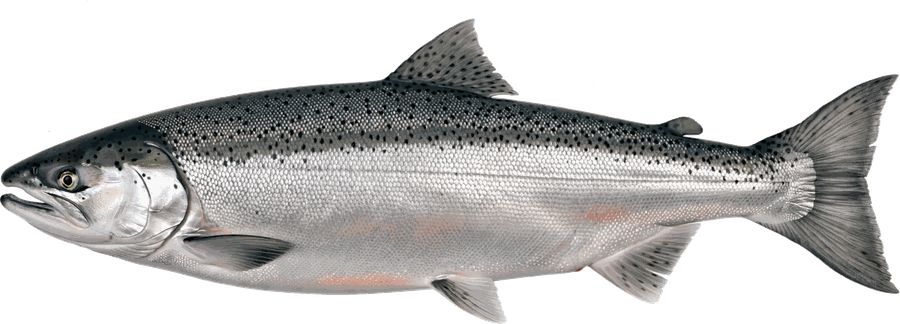
Bump Board's tactics library for Atlantic Salmon — where to fish, what to tie on and how to fish it, season by season. In the app, these tips adapt live to the weather, the front and the light.
Atlantic Salmon — Summer
Where to fish
- Summer sends this fish deep with its prey: down to the cold band — the agency profile puts summer fish 30 to 60 feet down, near the smelt schools — in water at or below the preferred 12–16 °C range. The surface salmon of May is a memory; the summer fish is a depth fish, and the entry fishes it that way.
- Oxygen rides with temperature in that band: feed intake holds until roughly 6 mg/L at summer temperatures and falls below it, so the fishable summer band is cold AND oxygenated water over the smelt — the same squeeze logic as every cold-water fish in this library.
What to tie on
- Spoons and streamers trolled at the depth of the cold band — trolling is this fishery's primary method and spoons and streamers its standard offerings (MDIFW), carried as agency-stated canon over a measured depth pattern.
How to fish it
- Set the depth by the temperature band and verify it against the bait: 14 °C water with smelt in it is the address; either one alone is half an address. Dawn and dusk still edge the day, but the summer pattern is depth discipline first, clock second.
If it's still tough
- A silent summer set is usually a band problem — too warm, too low in oxygen, or simply above the smelt. Move with the cold oxygenated layer across depths before changing a single lure.
Atlantic Salmon — Fall
Where to fish
- Fall cools the surface back into this fish's range and the salmon rise with it, returning toward the shores and the tributary mouths through September — feeding as they come, because unlike the Pacific salmon this fish spawns and lives: a repeat spawner does not shut down feeding the way a semelparous fish does.
- By October the gatherings at the mouths are pre-spawn staging; the feeding continues at the staging edges even as the run assembles, in a way no Pacific salmon in this library matches.
What to tie on
- The smelt-pattern spoons and streamers, fished progressively shallower as the surface cools — the summer rig on the fall's rising band.
How to fish it
- Fish the cooling as a rising escalator: each cold week lifts the fishable band, and the fall pattern is the summer pattern at steadily shallower depth, ending at the tributary mouths in October.
If it's still tough
- If fall fish at a mouth seem locked on the gathering rather than the feed, work the edges and the first deep water off the mouth — the staging fish that are still feeding hold there, not in the middle of the assembly.
Atlantic Salmon — Winter
Where to fish
- Winter is a real, low season for this fish — not a shutdown: landlocked salmon feed through the cold months at the year's floor, in deep cold water in open lakes and, where the ice allows the fishery, in the first metres under it (the ice entry carries that pattern). The winter values are the lowest of its year and they are honestly above zero, which for a salmon is a distinction.
What to tie on
- In open water, the smelt menu at the cold band's winter depth, slow — the summer presentation at winter pace.
How to fish it
- No winter clock is measured in open water; the under-ice day-led pattern in the ice entry is the species' only sourced winter rhythm. Fish location over timing, and give the deep schools time.
If it's still tough
- Hold winter at its floor and fish it anyway if you fish it: this is the one salmon in the library whose winter feeding is a fishery, and a slow day is the season's rate, not its absence.
Atlantic Salmon — Spring
Where to fish
- Spring is the landlocked salmon's great season, and it is built on smelt: at ice-out the smelt run to spawn in the tributaries and along the shores, and the salmon follow them into the shallows and the surface layer — the one time of year this fish is a shoreline, top-water target (MDIFW). Fish the tributary mouths, the smelt shores and the first open leads while the run lasts.
- The spring fish are hungry in a way the rest of the year is not: a winter of maintenance feeding behind them and the smelt feast in front, with the water still in their preferred low-teens band everywhere. It is the year's highest-confidence salmon pattern in this library.
What to tie on
- Streamers and spoons that read as smelt, trolled or cast in the surface layer along the spawning shores — the Maine pattern and the fishery's canon, over a measured behaviour: this is when and where the fish demonstrably feed at the surface.
How to fish it
- Fish early and shallow while the smelt are in: the window is set by the smelt run and the warming surface, and it closes as the salmon follow the smelt down. Dawn and dusk are the peaks of the model's day; the spring surface fish will also take through the day while the run is on.
If it's still tough
- If the shores go quiet mid-spring, the salmon have started down with the smelt — lengthen the leads and fish the first drop into cold water off the spawning shores before leaving the pattern.
Atlantic Salmon — Fallspawn
Where to fish
- The spawn runs mid-October to late November, in tributary gravel and at lake outlets with upwelling flow — the fish leave the open water of the lake to do it, and feeding drops around the redds. But hold the Pacific contrast firmly: these fish survive it, return to the lake, and feed again — the spawn is a season in their lives, not the end of them.
- The feeding fish of the lake through the spawn are the non-spawning adults and the young — on the late-fall pattern at the mouths' edges and the first cold drop-offs.
What to tie on
- Nothing spawn-specific is recommended for the redds. At the staging edges, the fall smelt-pattern offerings remain the supported menu for fish that are still feeding.
How to fish it
- Fish the edges and the calendar's far side: as November ends the spawners drop back to the lake and resume feeding into the winter — a post-spawn lake pattern no Pacific salmon offers, and one of this species' quiet distinctions.
If it's still tough
- Fish locked over redds in November are spawning, not refusing. The feeders of the lake are at the edges and, within weeks, everywhere again.
Atlantic Salmon on the ice — Through the ice season
Where to fish
- This is the one salmon ice set in the library that is a fishery rather than a gap, because the fishery is agency-documented: landlocked salmon are a recognised through-ice target, worked within the first 15 feet below the ice over the smelt (MDIFW) — counter-intuitive for a fish that summers at sixty feet, and sourced, so the entry states it plainly. The salmon winter high in the column, over deep water, near the bait.
- Early ice and late ice are the strong ends of the season in the fishery's record, with the midwinter weeks the slowest — the phase values in the issued set carry that shape, and the oxygen term carries the late-season caution for fertile basins.
What to tie on
- Smelt imitations — small spoons and jigs that read as a smelt, and live smelt where the law allows — fished high in the column on tip-ups and jig rods over deep water: the documented Maine pattern, carried as agency canon.
How to fish it
- Fish the day: the under-ice rhythm here is day-led, with dawn and dusk softer — the tip-up fishery's own shape — so a midday set over a located school is a first-choice pattern, not a compromise. Set high first (the first 15 feet), and only search deeper when the high column is genuinely empty.
- Carry the oxygen caution into late ice in shallow, fertile basins: the set's oxygen term is its largest single ice weight for a reason — a salmon's cold-water oxygen needs do not shrink under ice, and better-oxygenated deep water is the late-season move when a basin is depleting.
If it's still tough
- If a high set over deep water is silent, move along the basin edge at the same high depth before dropping down: winter salmon travel the smelt layer, and the layer moves. Depth discipline — high — is this entry's core claim; abandon it last, not first.
Where Atlantic Salmon live
138 waters in the Bump Board dataset hold Atlantic Salmon. A selection:
Ontario
- Aura Lee Lake
- Bass Lake
- Bowmanville Creek
- Bronte Creek
- Cauchon Lake
- Cedar Lake
- Credit River
- Ganaraska River
- Ganatsekiagon Creek
- Grindstone Creek
- Lake Huron
- Lake Ontario
- Lake Superior
- Limestone Creek
- Little Rouge Creek
- Mary Lake
- McConnell Lake
- McCullough Lake
- Shelter Valley Creek
- Soper Creek
- St. Marys River
- Stouffville Creek
- Trout Lake
- Wanapitei Lake
Plus 2 more Ontario waters — browse Ontario lakes.
Nova Scotia
- BEAR
- BEAVERBANK
- BOWER
- CANOE
- CHARLES
- DOUCETTE
- EDEN
- FANCY
- GILBERT
- INDIAN
- LOWER CORNING
- LOWER WRIGHTS
- MACGREGORS
- SUTHERLANDS
- TEXAS
- THREE MILE
- UIST
- WOOLENHAUPT
Connecticut
Idaho
Massachusetts
Maine
- Aziscohos Lake
- Beau Lake
- Bradbury Lake
- Brassua Lake
- Chandler Lake
- Chandler Pond
- Chase Lake
- Clayton Lake
- Cochrane Lake
- Conroy Lake
- Crescent Lake
- Deer Pond
- Dundee Pond
- Eagle Lake
- Echo Lake
- First Davis Pond
- Flying Pond
- Glazier Lake
- Green Pond
- James Pond
- Jordan Pond
- Junior Lake
- Kingsbury Pond
- Lake Cathance
Plus 31 more Maine waters — browse Maine lakes.
Montana
New Hampshire
- Berry Bay
- Conway Lake
- Dan Hole Pond
- First Connecticut Lake
- Lake Francis
- Lake Winnipesaukee
- Lake Winnisquam
- Little Squam Lake
- Merrymeeting Lake
- Newfound Lake
- Ossipee Lake
- Pleasant Lake
- Pontook Reservoir
- Reflection Pond
- Second Connecticut Lake
- Squam Lake
- Sunapee Lake
- Umbagog Lake