
Fishing tips & tactics
How to catch Arctic Grayling
Thymallus arcticus
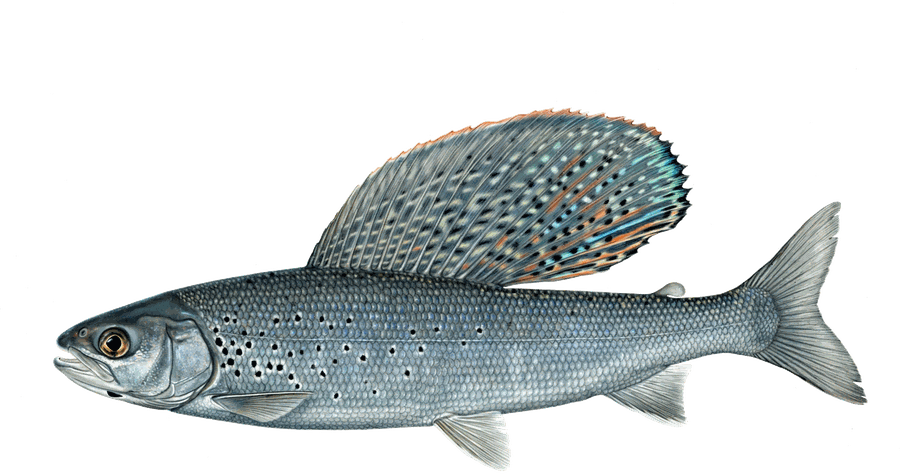
Bump Board's tactics library for Arctic Grayling — where to fish, what to tie on and how to fish it, season by season. In the app, these tips adapt live to the weather, the front and the light.
Arctic Grayling — Prespawn
Where to fish
- Prespawn is a migration season before it is a feeding season: the first rise toward 1 °C starts fish moving from overwintering water toward smaller spawning streams, and adults are travelling, not settled on summer feeding ground. Fish the travel routes and the holding water just below the spawning reaches, and expect the pattern to build as the water climbs toward 4 °C.
- Overwintering fish come out of deep, slow, well-oxygenated water — lakes and the deeper pools where they aggregated — so early prespawn effort belongs where that deep winter water meets the spring routes, in water still carrying more than 4 mg/L of oxygen where you have a choice. Stress begins at or below that 4 mg/L line in the winter record.
- On the stream side, prespawn adults stage below the shallow spawning gravel rather than on it: spawning itself will run over gravel, sand and rubble in about 0.15–0.91 m of water, and the approach water is where travelling fish can be met without fishing the spawning bed itself.
What to tie on
- No lure, fly pattern or size is named for grayling in the research behind this entry, and none is invented here: the supported menu is the drift itself — aquatic insects moving in the water the fish are travelling and holding in — presented naturally and close to the fish's line, because prespawn fish are positioning more than chasing.
- Size the offering to a cold-water drift feeder at the bottom of its temperature curve: at 1–4 °C the model's activity sits at roughly 0.15–0.45, so small and slow is a temperature conclusion, not a style choice.
How to fish it
- Fish the daylight hours first — grayling are sight feeders, feeding mostly during the day, and their ability to locate prey rises dramatically once light passes about 100 lux. A prespawn day is a midday-weighted day.
- Cover the staging water thoroughly and move slowly between spots: prespawn migration is temperature-triggered, so a reach that was empty in the morning can hold travelling fish after the day's warming — re-check the best staging water late in the day before you write it off.
If it's still tough
- If nothing moves, check the thermometer before the tackle: below the first rise toward 1 °C there is no migration stimulus in the record, and below about 4 °C there is no spawning and little feeding — the honest fix is warmer water or a later date, not a new bait.
- Cold, dirty water is a double problem for this visual feeder: suitability is already falling by 8 NTU and reaches about 0.3 at 20 NTU, so in stained prespawn water put the presentation closer and slower, or find the clearest water available.
Arctic Grayling — Spawn
Where to fish
- Spawning runs for about 2–3 weeks after breakup once the water reaches roughly 4 °C — typically mid-May to mid-June in the north — with activity intensifying toward 10 °C. It is a short, daylight event, peaking near midday when the water is warmest, and males defend territories on the spawning ground.
- Lake fish are part of this season, not an exception to it: lake-resident grayling leave the lake to spawn, entering outlet and inlet streams after breakup, then return to feeding water when the 2–3 weeks are done. The stream mouths and the first holding water inside them are the lake-side interception points.
- The spawning address is shallow and specific: adhesive eggs are broadcast over gravel — also sand and rubble — in about 0.15–0.91 m of water, at sites where the measured optimal flow is roughly 0.34–1.19 m/s and no spawning was recorded above about 1.46 m/s. Fish the edges of that shallow gravel rather than standing in the middle of an active bed.
What to tie on
- No spawn-specific lure is named in the grayling record, and whether feeding even dips during the spawn has never been measured — so there is no suppression coefficient and no spawn bait to sell. Keep offerings on the measured diet — drifting and surface insects — and fish them as food, not as a provocation, in and beside the spawning shallows.
- Territorial males are concentrated and visible in shallow daylight water — that is aggregation, not a feeding rate. An offering taken on the bed may be a defence response; the entry states that plainly rather than calling spawn-season strikes a bite pattern.
How to fish it
- Time the effort to daylight, and to midday most of all: spawning movements and activity peak around the middle of the day when the water is at its warmest, and the species feeds by sight. Dawn and dusk still score well in the model (0.85), but the spawn itself is a midday show.
- Work slowly and stay off the bed where you can: fish are territorial, adhesive eggs are on the gravel underfoot, and eggs hatch in roughly 186 degree-days — about 2–3 weeks. Wade and position at the edges, fish across the shallows, and leave active beds their room.
If it's still tough
- If the shallows look empty, the window may not have opened or may already have closed: the whole event lasts only 2–3 weeks, it needs roughly 4 °C after breakup, and northern ice-out varies — check for travelling fish in the deeper holding water below the spawning ground before concluding the run is absent.
- If the spawning reach is running too hard, drop below it: spawning was not recorded above about 1.46 m/s, and feeding positions in fast water cost more than they return — the holding water below the bed is the tough-day address in a high-flow spawn.
Arctic Grayling — Postspawn
Where to fish
- Post-spawn adults move to feeding areas immediately — that is the chronology line — so the pattern flips quickly from the spawning shallows to summer feeding water. Start where the spawning ground empties into deeper holding and feeding water, then follow the fish out as the days pass.
- The water is now climbing through the adult curve's sweet band: field occupancy peaks at 10.8 °C and stays high from about 6.9–14.7 °C, with the model's plateau at 10–14 °C. Postspawn fish in this band are the most catchable grayling of the spring — feeding fish, in warming water, still close to the spawning routes.
- In streams, postspawn fish settle into the drift-feeding order: dominant fish take the positions with the highest predicted net energy intake, and modern field video had fish holding a focal position about 81% of the time. Fish one good holding position thoroughly — the best fish in the reach is likely parked on the best drift line, not cruising.
What to tie on
- Feed them the drift: the measured stream diet is drifting insects taken at the surface and through the column, taken from a held position. Natural insect-profile offerings drifted on the fish's line, at the speed of the water delivering them, are the supported presentation — no specific lure or fly is named in the research, and none is invented here.
- In lakes the menu changes and the entry changes with it: lake grayling are facultative planktivores — zooplankton dominates the diet of shallow-water fish (about 80% in the Toolik lake record) — working the water in a stop-and-go search. Small offerings that read as plankton-sized food, fished slowly in the upper water, match that lake diet better than a big drift presentation.
How to fish it
- Fish the full day, not just the edges: the diel shape is day-led (day 1.0, dawn and dusk 0.85), because reactive distance rises dramatically above about 100 lux. Postspawn is a daylight feeding pattern — be on the best water when the light is on it.
- In current, work the middle velocities hardest: prey encounter rises with flow up to about 46 cm/s, but capture success falls as the water speeds up, and holding effort plateaus around 30 cm/s — net intake peaks at intermediate flow. The fastest water in the reach is not the feeding water, however much drift it carries.
If it's still tough
- If postspawn fish refuse in dirty water, believe the turbidity curve — it is one of the steepest measured in the whole model: full suitability at 0–5 NTU, about 0.6 at 8 NTU, about 0.3 at 20 NTU, and effectively zero at 30 NTU and beyond. Move to clearer water instead of upsizing the bait.
- If the fish have vanished from the spawning area, that is the pattern working, not failing: post-spawn adults leave for feeding areas immediately. Follow them out rather than grinding an empty bed.
Arctic Grayling — Summer
Where to fish
- Summer is the peak — the model's July and August values are 1.0 — but it is a cold-water peak: adult field occupancy tops out at 10.8 °C, the plateau runs 10–14 °C, stress physiology begins above about 16 °C, and fish are stressed at about 17 °C and avoid water over 20 °C. In a warm summer, fish the coldest inflow, outlet and spring-influenced water first; in a cold northern summer, ordinary surface water is already in the band.
- In lakes, summer fish feed visually on zooplankton and on surface and terrestrial insects where column prey is thin — a stop-and-go, saltatory search through the upper water. Work the upper column over and beside the feeding flats rather than dredging deep water the diet does not support.
- Summer stream fish are drift specialists holding ranked, defended positions: dominant fish hold the spots where drift delivery minus holding cost is best, fish held a focal point about 81% of the time in the field-video record, and only about 14% of the time was spent actively foraging away from it. Cast to positions, not to water.
What to tie on
- The summer menu is insects at the surface and in the drift, and zooplankton in lakes — small, natural, and sized to that food. Grayling are famously willing surface feeders in the agency canon, consistent with the measured surface diet; no specific lure, fly pattern or size is named in the research behind this entry, and none is invented here.
- Know which fish you are rating: this curve is built on adults. Juveniles prefer and grow best near 17 °C — about 5 °C warmer — so in a 15–18 °C midsummer lake the smaller, younger fish may still be feeding willingly while the adult curve is already declining. A day of small fish in warm water is that life-stage split showing, not the model failing.
How to fish it
- Fish daylight first and keep the water clear in your planning: reactive distance collapses as turbidity rises — it falls with the logarithm of turbidity, so most of the damage is done by the first 10–20 NTU. A bright day on clear water is this visual feeder's best condition; a stained day is a close-range day.
- Do not save the day for dark: night reactive distance is only about 20–30% of the daytime value and the model's night score is 0.25. Grayling do move at night in summer — the fishpass record shows night passage — but movement is not feeding, and this entry does not sell a night bite the vision record contradicts.
If it's still tough
- If summer fish shut down, take the temperature before changing anything: above about 20 °C adults avoid the water, chronic survival failed above 22 °C in the long trial, and the cold-acclimated incipient lethal is 23 °C. There is no presentation fix for water at the top of this fish's range — find cold water, or leave warm-water fish alone.
- A hard, roiling wind is a measured problem, not a mood: wind and rain that roil the surface disturb this surface feeder's feeding. On a blown-out day, fish the sheltered shore and the subsurface drift, and expect the surface pattern to be the first thing the weather takes.
Arctic Grayling — Fall
Where to fish
- Fall feeding continues into the migration: fish build fat stores for winter while the season curve is still high in September (0.90), then the overwintering migration — usually September, running August to December — pulls them toward lakes and deep, slow pools. Early fall is feeding water; late fall is travel and arrival water.
- As the water falls through the plateau and out the bottom of it, follow the fish toward the winter address: deeper, slower, well-oxygenated holding water. The temperature that ends the summer pattern is the same signal that starts the winter aggregation.
- In streams the fall move is downstream and deliberate: fish leave summer feeding reaches for the deeper, slow-current pools of medium and large water, where winter fish in one telemetry study all held inside just 3.5 km of river, in near-zero flow with cover. Late-fall stream effort belongs in and above those deep pools, not spread over summer runs.
What to tie on
- The fall menu is the summer menu cooling down: drifting and benthic invertebrates, taken by a fish whose activity now tracks the falling temperature day by day. Smaller and slower as the water drops through single digits is the temperature applied to tackle; no fall-specific lure is named in the research.
- Keep offerings on the drift line and in the upper column early in the fall, and lower and slower as fish settle toward winter holding water — the diet does not change its identity in fall, only its delivery speed.
How to fish it
- The day-led clock still runs the fall, and it matters more as darkness returns: at northern latitudes the long summer twilight is gone by September, real night is back, and the night score (0.25) applies in full. Concentrate effort in full daylight, when reactive distance is at its measured best.
- Start honouring the oxygen rule before the ice does it for you: grayling select water above 4 mg/L when they can choose, and show stress responses at or below it. Stagnant, depleting backwaters that fished well in summer are the wrong late-fall bet.
If it's still tough
- If fall fish are gone from summer water, they have not vanished — they have migrated. The overwinter move is the strongest calendar fact in the fall record; fish the routes and the deep winter pools before you conclude the season is over.
- In the coldest late-fall water the season value has fallen to 0.30–0.60 and feeding is thinning toward the winter minimum — slow everything down, fish the warmest part of the day, and give holding fish repeated close presentations rather than covering water.
Arctic Grayling — Winter
Where to fish
- Winter fish are aggregated, not scattered: grayling overwinter in lakes and in deep, slow pools, packed into a small fraction of the water they use in summer. Find the deep, slow, covered winter water and you have found the population; the rest of the system is mostly empty of them.
- Oxygen is the winter address inside the address: adults select deeper, more oxygenated water when they can, stress begins at or below about 4 mg/L, and yet the survival physiology is remarkable — the adult 24-hour LC50 is 0.75 mg/L at 1–3 °C, and winter survival ran 0.95–0.97 in the lake study despite near-anoxic bottom water. Fish the oxygenated layer over the deep holding water, not the bottom of a depleting basin.
What to tie on
- Winter food, where it has been looked for, is invertebrates: the March stomach sample held caddis and other invertebrates, one fish full of invertebrates, sand and algae. Small invertebrate-profile offerings, delivered close and still, are the honest winter tackle story — no winter lure is named in the research, and feeding is minimal, so presentation has to arrive at the fish.
How to fish it
- Fish winter as a low-rate pattern, because that is the measured description: the agency record says grayling feed minimally in winter and conserve energy, while the habitat synopsis says they apparently feed through it, probably limited by poor visibility under snow and ice. Both lines point the same way — slow, close, patient, in the aggregation.
- Keep the day-led habit even in winter: this is a sight feeder whose reactive distance depends on light, and winter light is the scarcest of the year. The brightest part of the short day, over the located aggregation, is the winter window.
If it's still tough
- If a winter spot is dead, suspect oxygen before presentation: a basin or pool that has slid toward the stress line at 4 mg/L and below will hold surviving fish that are not feeding. Move toward better-oxygenated deep water.
- Know the honest limit of the season: winter feeding has never been quantified for this species — there is no winter catch-rate record behind any winter claim. A blank winter day is inside the evidence, not a surprise the entry hid from you.
Arctic Grayling on the ice — Through the ice season
Where to fish
- The ice set for grayling is PROVISIONAL, capped at Moderate confidence, and the entry carries that flag openly: overwinter habitat, aggregation and the oxygen gradient are measured for this species, and March stomachs show low-level winter feeding — but winter feeding rate has never been quantified, the under-ice timing below is the open-water day shape carried under ice as a labelled transfer, and no ice catch-rate record exists. Fish the deep, slow winter water where fish aggregated in the fall.
- Oxygen decides the winter map: fish select water above about 4 mg/L when they can, stress responses start at or below 4 mg/L, and adults survive far lower — a 24-hour LC50 of 0.75 mg/L — by holding in the oxygenated layer. Set up over deep holding water that still carries oxygen, not over the deepest, most depleted bottom.
What to tie on
- Small invertebrate offerings, fished close and still over the aggregation: the only direct winter food evidence is invertebrates in March stomachs — caddis and other invertebrates, one fish full of them. No ice-specific lure or presentation is measured for grayling; small and slow is the winter record applied honestly.
How to fish it
- Work the brightest part of the short day first: the under-ice diel shape has never been measured, so the timing here is the measured open-water day-led shape (day on top, night at 0.20 under ice) carried across and labelled as a transfer. Give each hole over the aggregation real time — winter fish move little and feed minimally.
- Treat a located aggregation as the whole pattern: winter fish compress into a small share of their summer water, so searching away from the deep, slow, oxygenated holding water is fishing where the fish are not.
If it's still tough
- Mid-winter silence is usually oxygen or rate, not bait: feeding is minimal all winter even where fish are present and surviving well. Move toward better-oxygenated water before changing presentations — and know that a provisional set means exactly this: the winter pattern is real, its size is unmeasured.
Manitoba Master Angler
A Arctic Grayling of 46 cm (18 in) or better qualifies for Manitoba's Master Angler Program.
Where Arctic Grayling live
162 waters in the Bump Board dataset hold Arctic Grayling. A selection:
Manitoba
- Big Sand Lake
- Hunt Lake
- Little Duck Lake
- Lyons Lake
- Munroe Lake
- Nejanilini Lake
- North Knife Lake
- Nueltin Lake
- Reindeer Lake
- Vanderkerckhove Lake
Ontario
Alaska
- Alder Pond
- Arc Lake
- Arizona Lake
- Ballaine Lake
- Bathing Beauty Pond
- Beach Lake
- Bear Lake
- Beaver Lake
- Big D Pond
- Birch Lake
- Bolio Lake
- Bruce Lake
- Canoe Lake
- Chena Lake
- Chet Lake
- Connor Lake
- DeLong Lake
- Dick Lake
- Dune Lake
- Finger Lake
- First Lake
- Florence Lake
- Forgotten Lake
- Goober Lake
Plus 37 more Alaska waters — browse Alaska lakes.
Colorado
- Bonham Reservoir
- Crosho Lake
- Hartenstein Lake
- Joe Wright Reservoir
- Kitson Reservoir
- North Fork Reservoir
- Pearl Lake
- Silver King Lake
- Silver Lake
Idaho
Montana
- Axolotl Lake
- Bobcat Lakes
- Chiquita Lake
- Chrome Lake
- Deer Lake
- Diamond Lake
- Dollar Lake
- Elk Lake
- Emerald Lake
- Fox Lake
- Fuse Lake
- Grayling Lake
- Hamby Lake
- Handkerchief Lake
- Heart Lake
- Hungry Horse Reservoir
- Hyalite Reservoir
- Indian Knife Lake
- Lake Diaphanous
- Lima Reservoir
- Line Lake
- Lost Lake
- Lower Miner Lakes
- Lower Red Rock Lake
Plus 23 more Montana waters — browse Montana lakes.
Utah
- Blue Lake
- Emerald Lake
- Lake Blanche
- Lake Lillian
- Long Park Reservoir
- Lower Gooseberry Reservoir
- Moon Lake
- Oowah Lake
- Silver Lake
- Silver Lake Flat Reservoir
- Smith and Morehouse Reservoir
- Tibble Fork Reservoir